Picoides arcticus
Black-backed Woodpecker
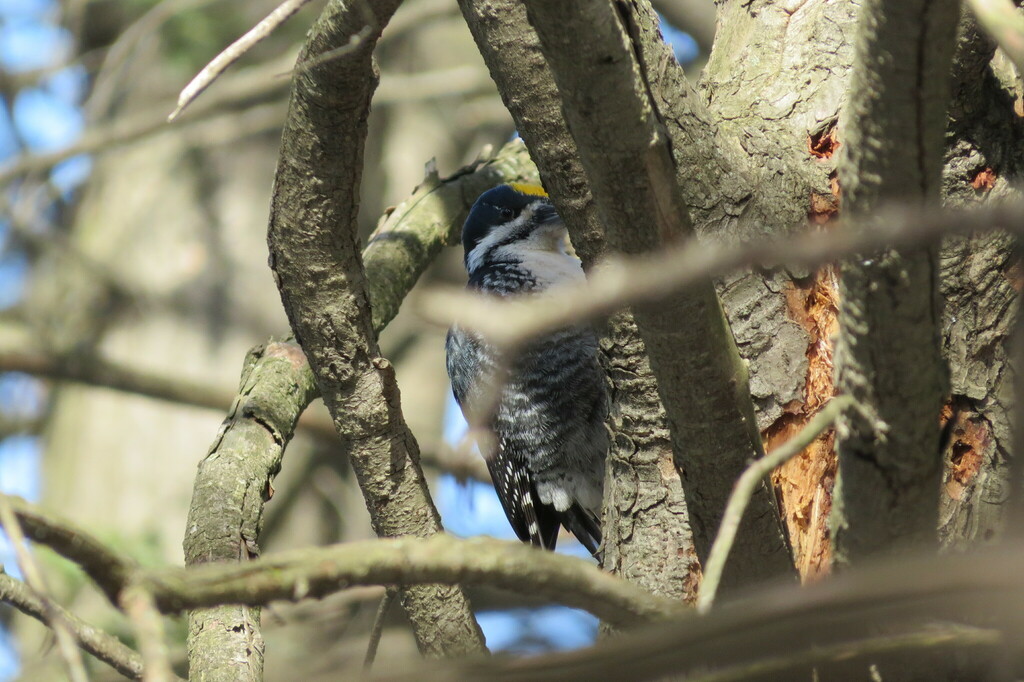
(c) Teá Montagna, some rights reserved (CC BY) · licence
Family: Picidae · Class: Aves · Order: Piciformes
Conservation status: G5 S2
Picoides arcticus (Black-backed Woodpecker) is a California animal in the Picidae family.
The Black-backed Woodpecker is a medium-sized woodpecker measuring 23 to 25 cm (9 to 10 inches) in length with a wingspan of 38 to 40 cm (15 to 16 inches). Males are distinguished by their solid black backs, white underparts with black barring on the flanks, and bright yellow crown patches. Females lack the yellow crown, displaying entirely black heads. Both sexes have white outer tail feathers that flash conspicuously during flight. The species has a relatively long, chisel-like bill adapted for excavating wood-boring beetle larvae. In California, Black-backed Woodpeckers occur primarily in the Sierra Nevada, Cascade Range, and northern Coast Ranges. The species inhabits montane coniferous forests, typically at elevations between 1,200 and 3,000 meters (4,000 to 10,000 feet). Historical records indicate a broader distribution, but current populations are largely restricted to areas with suitable forest conditions. The species also occurs across boreal regions of Canada and Alaska, with isolated populations in the northern Rocky Mountains. This woodpecker specializes in burned and beetle-killed coniferous forests, particularly those dominated by lodgepole pine, Douglas-fir, and true firs. Recent burns within one to eight years post-fire provide optimal foraging habitat, as wood-boring beetle populations peak during this period. The species also utilizes mature forests with standing dead trees (snags) and areas affected by bark beetle outbreaks. Black-backed Woodpeckers require large territories, with home ranges typically exceeding 100 hectares. Black-backed Woodpeckers are highly specialized feeders, with wood-boring beetle larvae comprising up to 75% of their diet. They use their long bills and extensible tongues to extract larvae from beneath bark and within wood. The species exhibits specialized foraging efficiency, often scaling bark from trees to access prey. Breeding occurs from May through July, with pairs excavating nest cavities in dead or dying trees. Females typically lay three to four glossy white eggs, which both parents incubate for 12 to 14 days. Young fledge after 24 to 25 days but remain dependent on parents for several weeks. The Black-backed Woodpecker is not federally listed but carries a state rank of S2 in California, indicating it is imperiled with typically 6 to 20 occurrences or few remaining individuals. The species faces significant conservation challenges due to fire suppression policies that reduce natural burn cycles and post-fire salvage logging that removes the dead trees essential for foraging and nesting. Climate change may alter fire regimes and forest composition, potentially affecting habitat availability. Population monitoring is challenging due to the species' dependence on ephemeral post-fire habitats and its naturally patchy distribution. Conservation efforts focus on maintaining fire-adapted forest ecosystems and protecting post-fire habitats from immediate salvage logging operations.
Classification
Class: Aves · Order: Piciformes · Family: Picidae
Conservation status
G5 S2
Frequently asked questions
How is Picoides arcticus classified?
Picoides arcticus belongs to class Aves, order Piciformes, family Picidae.
What family does Picoides arcticus belong to?
Picoides arcticus is in the Picidae family.
Is Picoides arcticus protected or of conservation concern?
Picoides arcticus carries the following status: G5 S2.
What is Picoides arcticus?
The Black-backed Woodpecker is a medium-sized woodpecker measuring 23 to 25 cm (9 to 10 inches) in length with a wingspan of 38 to 40 cm (15 to 16 inches).
Is Picoides arcticus found in California?
Yes. Picoides arcticus is recorded in California in The California Species Project's catalogue.
Related species
Other California species in the same genus, family, or bioregion.
Data from The California Species Project — 14,000+ California species with verified data from CNPS, CDFW, USFWS, and more.