Pieris marginalis
Margined White
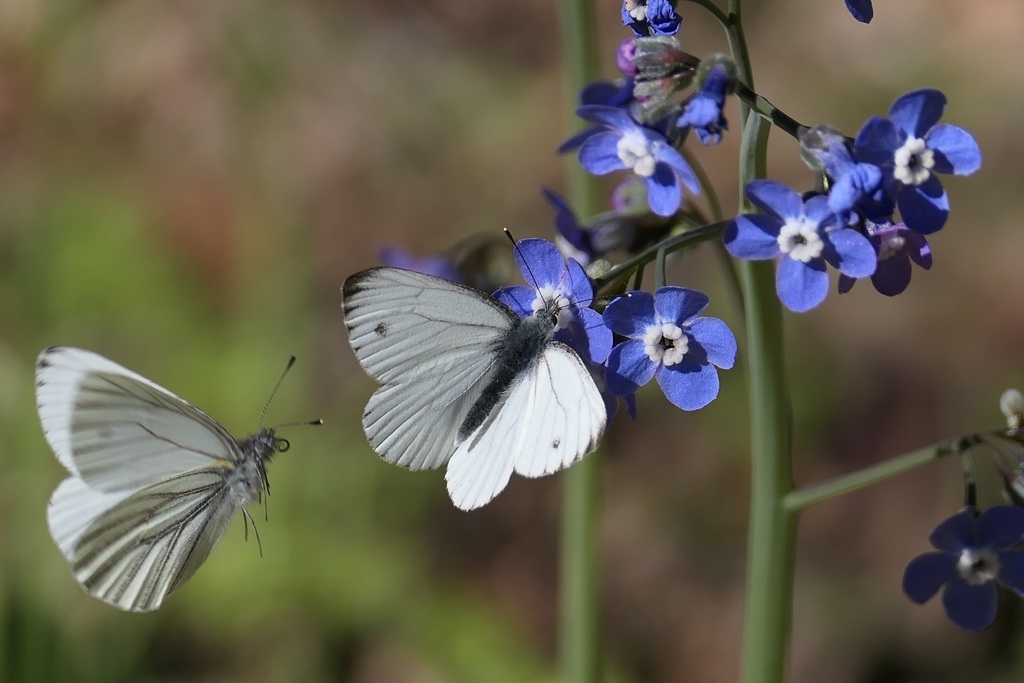
(c) John Hibbard, some rights reserved (CC BY) · licence
Family: Pieridae · Class: Insecta · Order: Lepidoptera
Pieris marginalis (Margined White) is a California animal in the Pieridae family.
The Margined White is a medium-sized butterfly in the family Pieridae, with adults displaying distinctive white wings marked by dark borders. Males typically measure 38-48 mm (1.5-1.9 inches) in wingspan, while females are slightly larger at 42-52 mm (1.7-2.0 inches). The dorsal wing surfaces are predominantly white with black or dark gray marginal borders that give the species its common name. Males exhibit narrower dark borders compared to females, and the borders are typically more pronounced on the forewings than hindwings. The ventral surfaces are pale yellow-white with subtle gray-green veining, particularly visible on the hindwings. Antennae are black with white-tipped clubs. The Margined White ranges from southern British Columbia and Alberta south to central California and southern New Mexico, extending east to eastern Wyoming and eastern Colorado. In California, populations occur primarily in mountainous regions of the Sierra Nevada, Cascade Range, and northern Coast Ranges. The species is typically found at elevations between 1,200 and 3,000 meters (4,000-10,000 feet), though it may occur at lower elevations in northern portions of its range. This butterfly inhabits montane and subalpine environments, including coniferous forests, mountain meadows, forest clearings, and alpine zones. Adults frequent areas with abundant native mustard family plants, particularly in openings and edge habitats where host plants receive adequate sunlight. The species shows preference for cooler, moister sites compared to other Pieris species, often occurring near streams or in north-facing slopes that retain snowpack longer into the growing season. Margined Whites are univoltine, producing one generation per year. Adults emerge from late May through August, with peak flight activity occurring in June and July at most elevations. Mating typically occurs shortly after emergence, with females laying eggs singly on various native plants in the mustard family (Brassicaceae). Host plants include species of rockcress (Arabis), mustard (Brassica), and other native crucifers. Larvae develop through five instars, feeding on leaves and flowers of host plants. The species overwinters in the pupal stage, with pupae attached to host plant stems or nearby vegetation. Adults are strong fliers and may disperse considerable distances from breeding sites in search of nectar sources, which include wildflowers such as asters, lupines, and penstemon. The Margined White is not federally listed and appears to maintain stable populations across much of its range. However, the species faces potential threats from climate change, as warming temperatures may shift suitable habitat to higher elevations. Forest management practices that alter montane ecosystems, including logging and fire suppression, may impact local populations by reducing habitat connectivity. Urban development in mountain communities and recreational activities in sensitive alpine areas pose additional localized threats. The species' dependence on native host plants makes it vulnerable to invasive plant species that compete with or displace native Brassicaceae.
Classification
Class: Insecta · Order: Lepidoptera · Family: Pieridae
Frequently asked questions
How is Pieris marginalis classified?
Pieris marginalis belongs to class Insecta, order Lepidoptera, family Pieridae.
What family does Pieris marginalis belong to?
Pieris marginalis is in the Pieridae family.
What is Pieris marginalis?
The Margined White is a medium-sized butterfly in the family Pieridae, with adults displaying distinctive white wings marked by dark borders.
Is Pieris marginalis found in California?
Yes. Pieris marginalis is recorded in California in The California Species Project's catalogue.
Related species
Other California species in the same genus, family, or bioregion.
Data from The California Species Project — 14,000+ California species with verified data from CNPS, CDFW, USFWS, and more.