Pinicola enucleator
Pine Grosbeak
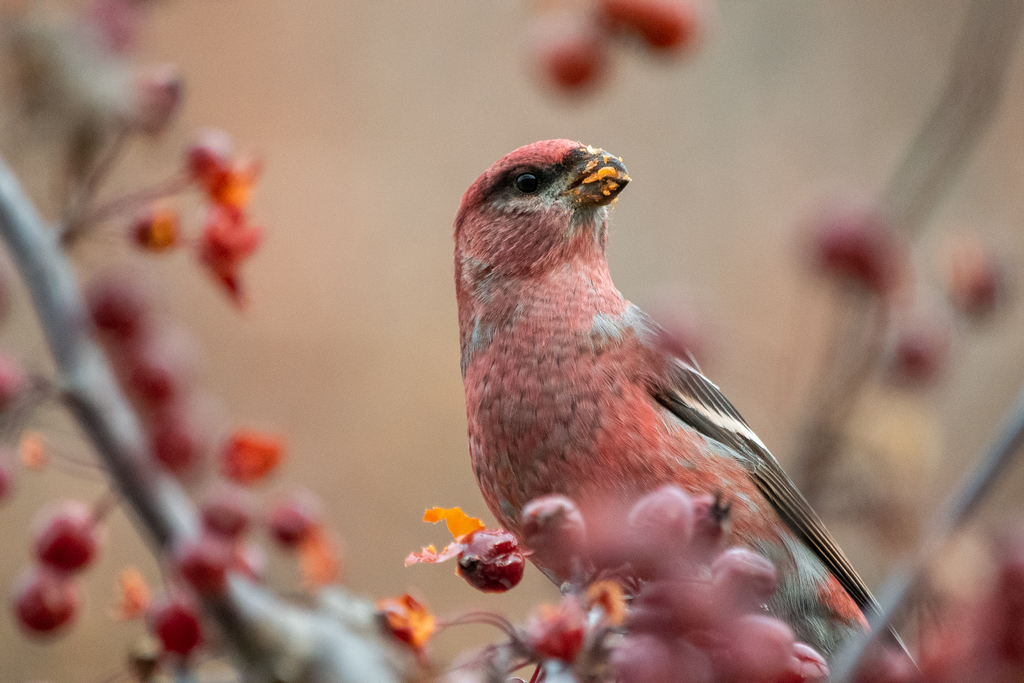
(c) Richard Littauer, some rights reserved (CC BY) · licence
Family: Fringillidae · Class: Aves · Order: Passeriformes
Pinicola enucleator (Pine Grosbeak) is a California animal in the Fringillidae family.
The Pine Grosbeak is a large, stocky finch measuring 20 to 25 cm (7.9 to 9.8 inches) in length with a wingspan of 33 to 37 cm (13 to 14.6 inches). Adult males display rose-red to pinkish-red plumage on the head, breast, and rump, contrasting with gray wings marked by two prominent white wing bars. The back shows a mixture of red and gray coloration. Adult females and juveniles are primarily gray with yellowish or olive tones on the head and rump, also featuring the characteristic white wing bars. Both sexes possess a large, thick, conical bill adapted for seed extraction, dark legs, and a relatively long, notched tail. Pine Grosbeaks breed across the boreal forests of Alaska, Canada, and the northern United States. In California, they occur primarily as irregular winter visitors to the Sierra Nevada, Cascade Range, and occasionally the Coast Ranges. The species shows irruptive behavior, with some winters bringing substantial numbers to lower elevations while other years see few or no individuals. Their distribution in California extends from Siskiyou and Modoc counties southward through the Sierra Nevada to Tulare County, typically above 1,500 meters (4,900 feet) elevation during winter. This species inhabits coniferous and mixed forests dominated by spruce, fir, pine, and hemlock. During winter in California, Pine Grosbeaks frequent montane forests of white fir, red fir, lodgepole pine, and Jeffrey pine. They show a preference for forest edges, openings, and areas with abundant fruiting trees and shrubs. The species often descends to elevations as low as 1,200 meters (3,900 feet) during severe weather, occasionally reaching foothill oak woodlands. Pine Grosbeaks are primarily granivorous, feeding on seeds from conifers, deciduous trees, and shrubs. Their diet includes seeds of pine, fir, maple, ash, and mountain ash, as well as buds and fruits of various plants. They possess specialized jaw muscles that allow them to extract seeds from closed cones. During breeding season, they supplement their diet with insects, particularly feeding them to nestlings. The species exhibits a slow, deliberate foraging behavior, often hanging upside down to reach seeds and fruits. Breeding occurs from May through July in northern boreal forests, with females constructing loose cup nests in conifer branches. Clutch size typically ranges from 2 to 5 eggs, with an incubation period of 13 to 14 days. Pine Grosbeaks are not federally or state listed in California, maintaining stable populations across their primary breeding range. The species benefits from extensive boreal forest habitat in Canada and Alaska. Climate change may affect their distribution patterns and irruptive behavior by altering food availability and weather patterns. Forest management practices that maintain diverse age classes of coniferous forests support population stability. As of December 2025, the species shows no immediate conservation concerns, though long-term monitoring continues to track population trends and habitat changes.
Classification
Class: Aves · Order: Passeriformes · Family: Fringillidae
Frequently asked questions
How is Pinicola enucleator classified?
Pinicola enucleator belongs to class Aves, order Passeriformes, family Fringillidae.
What family does Pinicola enucleator belong to?
Pinicola enucleator is in the Fringillidae family.
What is Pinicola enucleator?
The Pine Grosbeak is a large, stocky finch measuring 20 to 25 cm (7.9 to 9.8 inches) in length with a wingspan of 33 to 37 cm (13 to 14.6 inches).
Is Pinicola enucleator found in California?
Yes. Pinicola enucleator is recorded in California in The California Species Project's catalogue.
Related species
Other California species in the same genus, family, or bioregion.
Data from The California Species Project — 14,000+ California species with verified data from CNPS, CDFW, USFWS, and more.