Pipilo chlorurus
Green-tailed Towhee
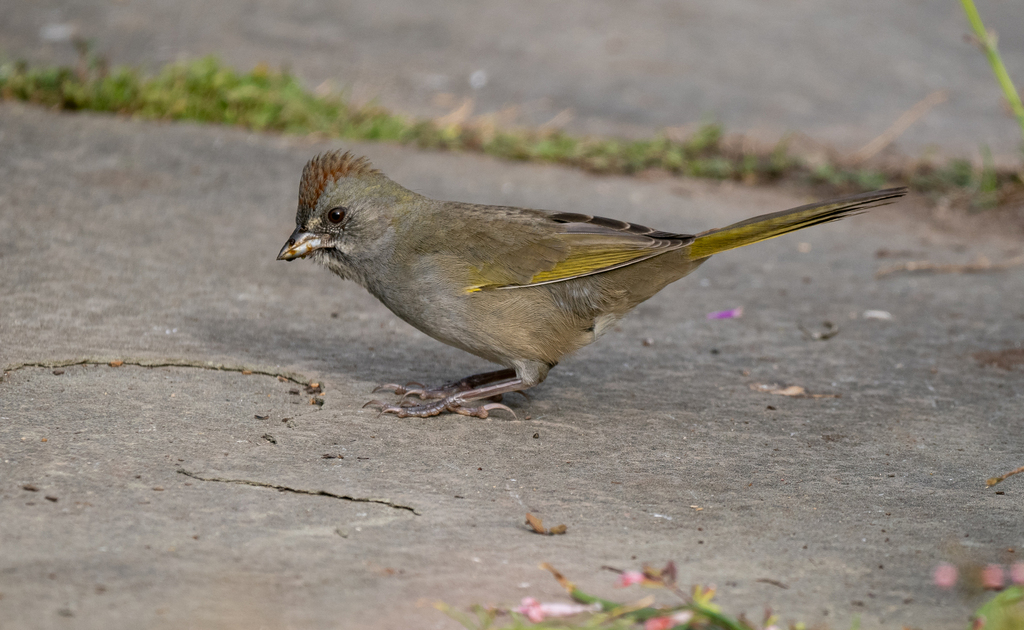
(c) Forest Botial-Jarvis, some rights reserved (CC BY) · licence
Family: Emberizidae · Class: Aves · Order: Passeriformes
Pipilo chlorurus (Green-tailed Towhee) is a California animal in the Emberizidae family.
The Green-tailed Towhee is a medium-sized sparrow measuring 18-20 cm (7.1-7.9 inches) in length with a wingspan of 26-28 cm (10.2-11.0 inches). Adults weigh 29-34 grams (1.0-1.2 ounces). The species displays distinctive plumage with a rufous crown contrasting sharply with a white throat bordered by dark malar stripes. The back and wings are olive-green to grayish-green, while the underparts are pale gray with a white belly. The tail shows olive-green coloration with subtle darker barring. Males and females appear similar, though males may show slightly brighter coloration during breeding season. Juveniles display streaked brownish plumage before acquiring adult characteristics. Green-tailed Towhees breed across western North America from southern British Columbia and Alberta south through the western United States to northern Baja California and central Mexico. In California, the species breeds primarily in the Sierra Nevada, Cascade Range, and mountains of northeastern California, with populations extending south through the Transverse and Peninsular Ranges. During winter, most populations migrate to the southwestern United States and western Mexico, though some individuals remain year-round in southern California's lower elevation areas. The species inhabits montane shrubland and woodland edge habitats, typically occurring between 1,200-3,400 meters (4,000-11,200 feet) elevation. Preferred breeding habitat consists of dense shrub communities including mountain mahogany, serviceberry, manzanita, and oak brush. Green-tailed Towhees also utilize riparian areas with willow and aspen, forest clearings, and areas recovering from fire or logging. During migration and winter, birds occupy desert scrub, chaparral, and riparian woodland at lower elevations. Green-tailed Towhees are primarily ground-foraging birds that employ a distinctive double-scratch feeding technique, jumping forward and then rapidly scratching backward with both feet to expose food items beneath leaf litter. Their diet consists of seeds, insects, and berries, with seasonal variation favoring insects during breeding season and seeds during fall and winter. Breeding occurs from May through August, with females constructing cup-shaped nests in dense shrubs 0.3-1.2 meters (1-4 feet) above ground. Clutches typically contain 3-5 eggs, which are incubated for 11-13 days. Young fledge after 10-11 days but remain dependent on parents for approximately three weeks. The species typically produces one brood per year, though second broods may occur in favorable conditions. Green-tailed Towhees are not federally or state listed and maintain stable populations across most of their range. The species is classified as Least Concern by the International Union for Conservation of Nature. According to the North American Breeding Bird Survey, populations have remained relatively stable since 1970, with slight increases noted in some regions. Primary threats include habitat loss from development, fire suppression altering natural disturbance regimes, and climate change potentially shifting suitable habitat to higher elevations. The species benefits from forest management practices that maintain shrub understory and create edge habitats.
Classification
Class: Aves · Order: Passeriformes · Family: Emberizidae
Frequently asked questions
How is Pipilo chlorurus classified?
Pipilo chlorurus belongs to class Aves, order Passeriformes, family Emberizidae.
What family does Pipilo chlorurus belong to?
Pipilo chlorurus is in the Emberizidae family.
What is Pipilo chlorurus?
The Green-tailed Towhee is a medium-sized sparrow measuring 18-20 cm (7.1-7.9 inches) in length with a wingspan of 26-28 cm (10.2-11.0 inches).
Is Pipilo chlorurus found in California?
Yes. Pipilo chlorurus is recorded in California in The California Species Project's catalogue.
Related species
Other California species in the same genus, family, or bioregion.
Data from The California Species Project — 14,000+ California species with verified data from CNPS, CDFW, USFWS, and more.