Pipilo maculatus
Spotted Towhee
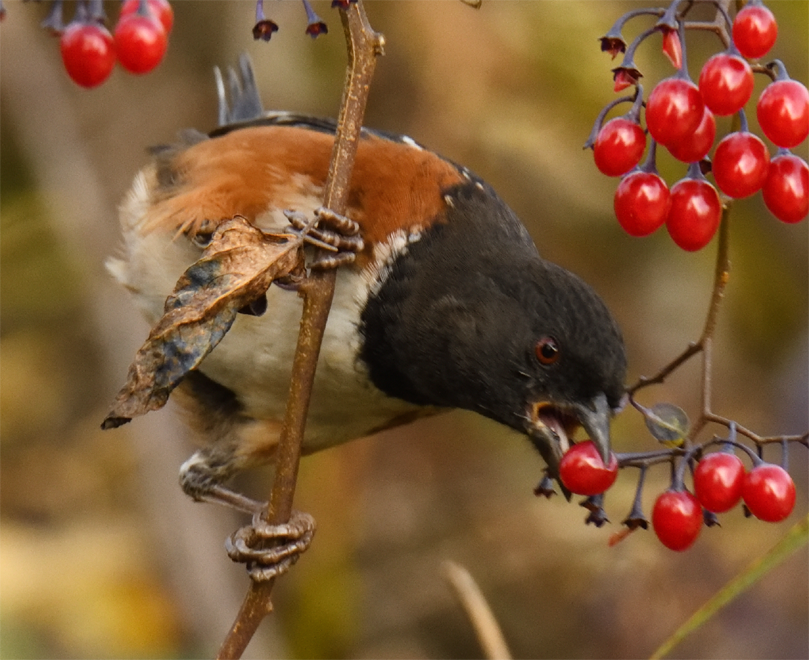
(c) smeckert, some rights reserved (CC BY) · licence
Family: Emberizidae · Class: Aves · Order: Passeriformes
Pipilo maculatus (Spotted Towhee) is a California animal in the Emberizidae family.
The Spotted Towhee is a medium-sized sparrow measuring 17 to 21 centimeters (6.7 to 8.3 inches) in length with a wingspan of 28 to 29 centimeters (11 inches). Males display distinctive black upperparts including the head, throat, and back, with white spotting on the wings and scapulars. The flanks are rufous-orange, and the belly is white. Females show similar patterning but with dark brown replacing the black areas. Both sexes have bright red eyes and long, dark tails with white corners visible during flight. The bill is dark and conical, adapted for seed consumption. Spotted Towhees occur throughout western North America from southern British Columbia to Guatemala. In California, the species is a year-round resident in suitable habitat from sea level to approximately 3,000 meters (9,800 feet) elevation. The distribution includes the Coast Ranges, Sierra Nevada, Cascades, and desert mountain ranges. Populations in higher elevations may move to lower areas during winter months. The species inhabits chaparral, oak woodlands, mixed coniferous forests, riparian areas, and brushy undergrowth. Spotted Towhees prefer areas with dense shrub cover and open patches for foraging. They are commonly found in manzanita, ceanothus, and scrub oak communities, as well as forest edges and clearings with substantial understory vegetation. Urban and suburban areas with appropriate shrubland habitat also support populations. Spotted Towhees employ a distinctive foraging behavior known as double-scratch feeding, jumping forward and then rapidly scratching backward with both feet to uncover food items beneath leaf litter. Their diet consists primarily of insects during breeding season, including beetles, moths, caterpillars, and ants, while seeds and fruits become more important during fall and winter months. Breeding occurs from April through August, with females constructing cup-shaped nests in shrubs or on the ground. Clutch size ranges from two to six eggs, typically three to four, with an incubation period of 12 to 14 days. Females may produce two broods per season in favorable conditions. Males are highly territorial during breeding season, singing from prominent perches and engaging in aggressive displays toward intruders. The primary song is a trill preceded by one to three introductory notes, often described as 'drink-your-tea.' Spotted Towhees are generally non-migratory in California, though some altitudinal movement occurs seasonally. The Spotted Towhee is not federally or state listed and maintains stable populations throughout most of its range. According to the North American Breeding Bird Survey, populations have remained relatively stable over the past several decades, though some localized declines have been documented in urban areas due to habitat loss and fragmentation. The species adapts well to human-modified landscapes when appropriate shrubland habitat is maintained. Primary conservation concerns include habitat loss from development, fire suppression that reduces habitat heterogeneity, and invasive plant species that alter understory composition.
Classification
Class: Aves · Order: Passeriformes · Family: Emberizidae
Frequently asked questions
How is Pipilo maculatus classified?
Pipilo maculatus belongs to class Aves, order Passeriformes, family Emberizidae.
What family does Pipilo maculatus belong to?
Pipilo maculatus is in the Emberizidae family.
What is Pipilo maculatus?
The Spotted Towhee is a medium-sized sparrow measuring 17 to 21 centimeters (6.7 to 8.3 inches) in length with a wingspan of 28 to 29 centimeters (11 inches).
Is Pipilo maculatus found in California?
Yes. Pipilo maculatus is recorded in California in The California Species Project's catalogue.
Related species
Other California species in the same genus, family, or bioregion.
Data from The California Species Project — 14,000+ California species with verified data from CNPS, CDFW, USFWS, and more.