Pipilo maculatus clementae
San Clemente Spotted Towhee
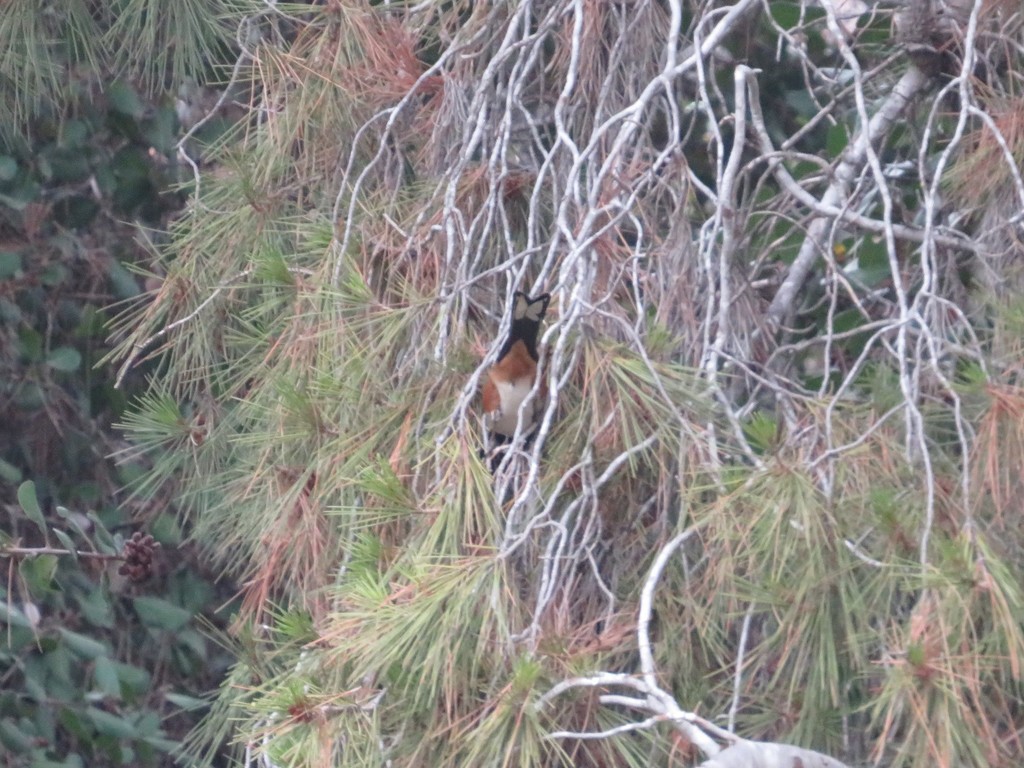
(c) Linzy L., some rights reserved (CC BY-SA) · licence
Family: Emberizidae · Class: Aves · Order: Passeriformes
Conservation status: G5T1T2 S3
Pipilo maculatus clementae (San Clemente Spotted Towhee) is a California animal in the Emberizidae family.
The San Clemente Spotted Towhee is a large sparrow with a thick, pointed bill, short neck, chunky body, and long, rounded tail. Males display jet-black upperparts contrasting with white wing spots and rufous flanks, while females show similar patterns in brown tones. This subspecies is distinguished from other Spotted Towhee populations by subtle morphological differences adapted to its island environment. Adults measure approximately 17-21 cm (6.7-8.3 inches) in length with a wingspan of 29 cm (11.4 inches). This subspecies is endemic to San Clemente Island, located approximately 100 kilometers (62 miles) west of San Diego, California. The San Clemente Spotted Towhee represents one of the most geographically restricted subspecies of Spotted Towhee, with its entire global population confined to this single Channel Island. The subspecies was first described by Grinnell and Miller (1944) and has remained isolated on San Clemente Island throughout its evolutionary history. San Clemente Spotted Towhees inhabit the island's diverse scrubland communities, including coastal sage scrub, maritime chaparral, and grassland edges. They prefer areas with dense understory vegetation that provides cover for foraging and nesting. The species adapts to the island's Mediterranean climate, characterized by mild, wet winters and warm, dry summers. Elevation on San Clemente Island ranges from sea level to approximately 599 meters (1,965 feet), with towhees occupying suitable habitat throughout this range. Like other Spotted Towhee subspecies, San Clemente birds are ground foragers that employ a distinctive two-footed scratching technique to uncover food beneath leaf litter and loose soil. Their diet consists primarily of seeds, insects, and small invertebrates. The species exhibits monogamous pair bonds and territorial behavior during breeding season. Nests are typically constructed in dense shrubs, with females laying 2-4 eggs. The breeding season extends from March through July, with pairs potentially raising multiple broods in favorable years. The San Clemente Spotted Towhee is designated as a California Species of Special Concern, reflecting conservation concerns about its extremely limited range and small population size. The subspecies' Global/State Rank of G5T1T2 S3 indicates that while the species as a whole is secure, this particular subspecies faces significant vulnerability due to its restricted distribution. Historical habitat modification from military activities and introduced ungulates impacted island ecosystems, though ongoing restoration efforts have improved conditions. The subspecies was included in the U.S. Fish and Wildlife Service's Birds of Conservation Concern list (USFWS 2002), highlighting its conservation priority status. Current threats include potential habitat degradation, invasive plant species, and the inherent vulnerability associated with small, isolated populations. Climate change poses additional long-term risks through altered precipitation patterns and potential sea level rise affecting coastal habitats. Population monitoring and habitat restoration continue to be essential for the subspecies' long-term persistence.
Classification
Class: Aves · Order: Passeriformes · Family: Emberizidae
Conservation status
G5T1T2 S3
Frequently asked questions
How is Pipilo maculatus clementae classified?
Pipilo maculatus clementae belongs to class Aves, order Passeriformes, family Emberizidae.
What family does Pipilo maculatus clementae belong to?
Pipilo maculatus clementae is in the Emberizidae family.
Is Pipilo maculatus clementae protected or of conservation concern?
Pipilo maculatus clementae carries the following status: G5T1T2 S3.
What is Pipilo maculatus clementae?
The San Clemente Spotted Towhee is a large sparrow with a thick, pointed bill, short neck, chunky body, and long, rounded tail.
Is Pipilo maculatus clementae found in California?
Yes. Pipilo maculatus clementae is recorded in California in The California Species Project's catalogue.
Related species
Other California species in the same genus, family, or bioregion.
Data from The California Species Project — 14,000+ California species with verified data from CNPS, CDFW, USFWS, and more.