Piranga flava
Hepatic Tanager
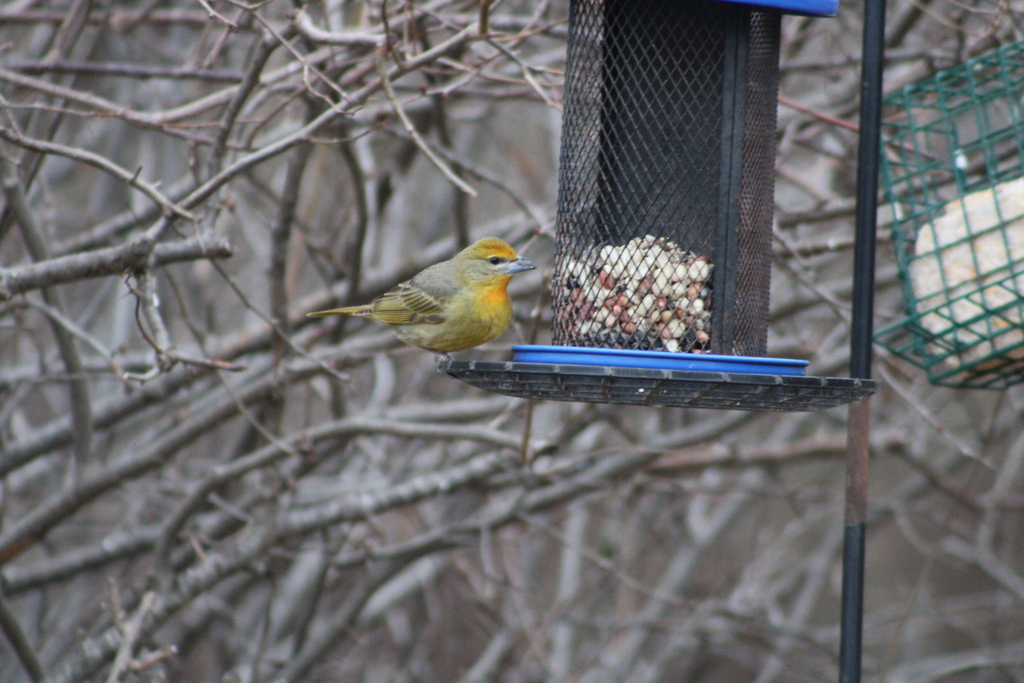
(c) oksanaetal, some rights reserved (CC BY) · licence
Family: Cardinalidae · Class: Aves · Order: Passeriformes
Conservation status: WL · G5 S1
Piranga flava (Hepatic Tanager) is a California animal in the Cardinalidae family.
The Hepatic Tanager is a medium-sized songbird measuring 18 to 20 cm (7.1 to 7.9 inches) in length with a wingspan of approximately 30 cm (11.8 inches). Adult males display brick-red to orange-red plumage on the head, back, and underparts, with darker red on the wings and tail. The bill is dark gray to black with a pale lower mandible base. Females and juveniles are yellow-olive above with yellowish underparts and lack the male's red coloration. Both sexes have a relatively large, thick bill adapted for their omnivorous diet. The Hepatic Tanager has a broad range extending from the southwestern United States through Central America to northern South America. In California, this species occurs as a rare visitor or vagrant, primarily documented in the southern and eastern portions of the state. Records exist from the Mojave Desert, Colorado River valley, and mountainous areas of San Bernardino and Riverside counties. The species is not known to breed regularly in California, with most observations occurring during migration periods or as occasional wanderers from breeding populations in Arizona and New Mexico. Preferred habitat consists of pine-oak woodlands, montane coniferous forests, and riparian areas at elevations ranging from 1,200 to 3,000 meters (3,900 to 9,800 feet) in their core breeding range. In California, vagrant individuals have been observed in desert oases, riparian corridors, and mountain canyons where water and suitable perching sites are available. The species shows preference for areas with mixed vegetation structure including both canopy cover and open foraging areas. Hepatic Tanagers are omnivorous, feeding on insects, fruits, and berries. Their diet includes beetles, caterpillars, ants, wasps, and flying insects captured through gleaning and aerial hawking. During breeding season, insects comprise the majority of their diet, while fruits become increasingly important during migration and winter months. The species is generally solitary outside of breeding season, though individuals may join mixed-species foraging flocks. Breeding occurs from April through August in their core range, with females constructing shallow cup nests in the outer branches of trees. Clutch size typically ranges from 3 to 5 eggs. The Hepatic Tanager maintains a California listing status of Watch List, reflecting its rarity and irregular occurrence within the state. The global population is considered stable with a rank of G5, indicating the species faces no immediate conservation concerns across its range. However, the California population rank of S1 reflects the extremely limited and sporadic nature of occurrences within the state. Climate change may affect the species' distribution patterns and the frequency of vagrant occurrences in California. Habitat loss in breeding areas outside California could potentially impact the likelihood of future vagrant records. Monitoring programs document occasional sightings, contributing to understanding of the species' occurrence patterns in California.
Classification
Class: Aves · Order: Passeriformes · Family: Cardinalidae
Conservation status
WL · G5 S1
Frequently asked questions
How is Piranga flava classified?
Piranga flava belongs to class Aves, order Passeriformes, family Cardinalidae.
What family does Piranga flava belong to?
Piranga flava is in the Cardinalidae family.
Is Piranga flava protected or of conservation concern?
Piranga flava carries the following status: WL · G5 S1.
What is Piranga flava?
The Hepatic Tanager is a medium-sized songbird measuring 18 to 20 cm (7.1 to 7.9 inches) in length with a wingspan of approximately 30 cm (11.8 inches).
Is Piranga flava found in California?
Yes. Piranga flava is recorded in California in The California Species Project's catalogue.
Related species
Other California species in the same genus, family, or bioregion.
Data from The California Species Project — 14,000+ California species with verified data from CNPS, CDFW, USFWS, and more.