Piranga ludoviciana
Western Tanager
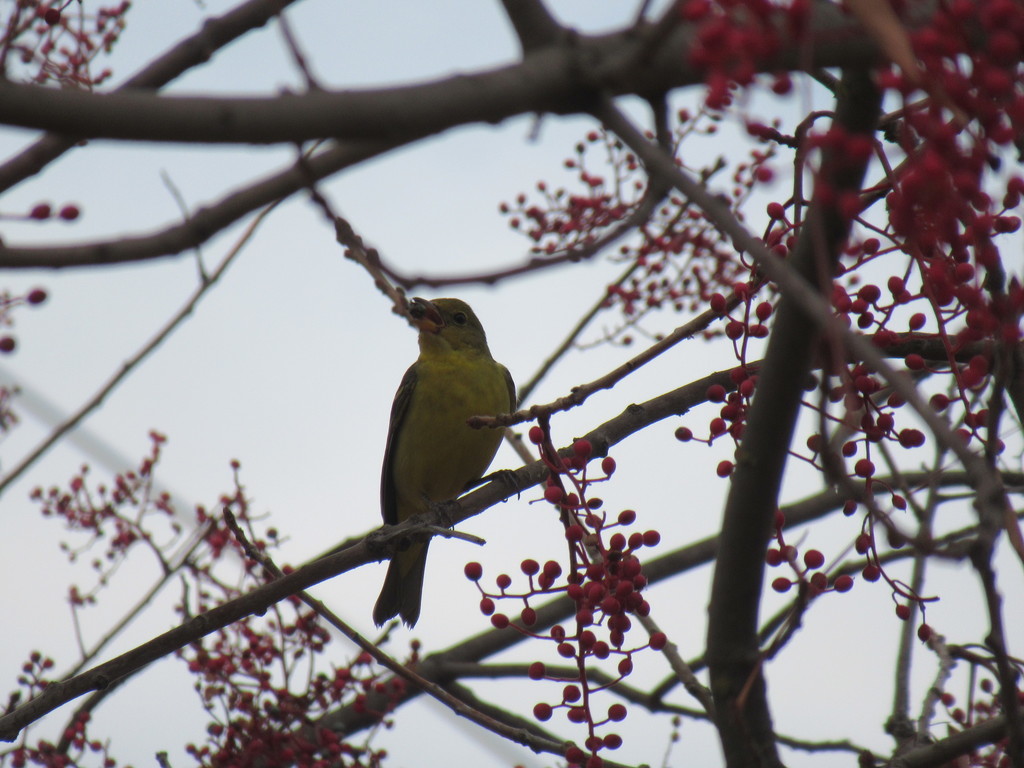
no rights reserved · CC0
Family: Cardinalidae · Class: Aves · Order: Passeriformes
Piranga ludoviciana (Western Tanager) is a California animal in the Cardinalidae family.
The Western Tanager is a medium-sized songbird measuring 16 to 19 cm (6.3 to 7.5 inches) in length with a wingspan of 29 to 30 cm (11.4 to 11.8 inches). Adult males in breeding plumage display a bright red head, yellow body, and black wings and tail with prominent white wing bars. The red pigmentation comes from rhodoxanthin, a rare carotenoid obtained from their diet. Females and non-breeding males are yellow-green above and yellow below with grayish wings and two white wing bars. Both sexes have thick, pointed bills adapted for their varied diet. Western Tanagers breed across the western United States and southwestern Canada, from British Columbia south to northern Baja California and from the Pacific coast east to the western Great Plains. In California, they are widespread breeding residents in mountainous and forested regions throughout most of the state, except for the Central Valley floor and desert regions. The species winters primarily in Central America from Mexico to Costa Rica, with some individuals remaining in southern California and Arizona. The species inhabits coniferous and mixed forests, particularly those dominated by Douglas fir, ponderosa pine, lodgepole pine, and true firs. They occur from sea level to approximately 3,200 meters (10,500 feet) elevation, with highest breeding densities in montane forests between 1,200 and 2,400 meters (4,000 to 8,000 feet). Western Tanagers also utilize oak woodlands, riparian forests, and parks with mature trees during migration and winter. Western Tanagers are primarily insectivorous during breeding season, consuming beetles, ants, flies, caterpillars, and other arthropods. They also eat fruits and berries, particularly during migration and winter, including elderberries, mulberries, and cherries. The species employs various foraging techniques including gleaning insects from foliage, hawking flying insects, and hover-gleaning from branch tips. Breeding occurs from May through July, with females constructing shallow cup nests on horizontal branches 4 to 10 meters above ground. Clutches typically contain 3 to 5 blue-green eggs with brown spotting. Females incubate eggs for 12 to 14 days, and both parents feed nestlings for 13 to 15 days until fledging. The Western Tanager is not federally or state listed and maintains stable populations across most of its range. The North American Breeding Bird Survey indicates relatively stable long-term population trends, though some regional declines have been documented. The global population is estimated at approximately 10 million individuals. Primary conservation concerns include habitat loss from logging, development, and wildfire, particularly in lower elevation breeding areas. Climate change may affect the species through shifts in forest composition and insect prey availability. The species benefits from forest management practices that maintain diverse age classes and canopy structure.
Classification
Class: Aves · Order: Passeriformes · Family: Cardinalidae
Frequently asked questions
How is Piranga ludoviciana classified?
Piranga ludoviciana belongs to class Aves, order Passeriformes, family Cardinalidae.
What family does Piranga ludoviciana belong to?
Piranga ludoviciana is in the Cardinalidae family.
What is Piranga ludoviciana?
The Western Tanager is a medium-sized songbird measuring 16 to 19 cm (6.3 to 7.5 inches) in length with a wingspan of 29 to 30 cm (11.4 to 11.8 inches).
Is Piranga ludoviciana found in California?
Yes. Piranga ludoviciana is recorded in California in The California Species Project's catalogue.
Related species
Other California species in the same genus, family, or bioregion.
Data from The California Species Project — 14,000+ California species with verified data from CNPS, CDFW, USFWS, and more.