Piranga olivacea
Scarlet Tanager
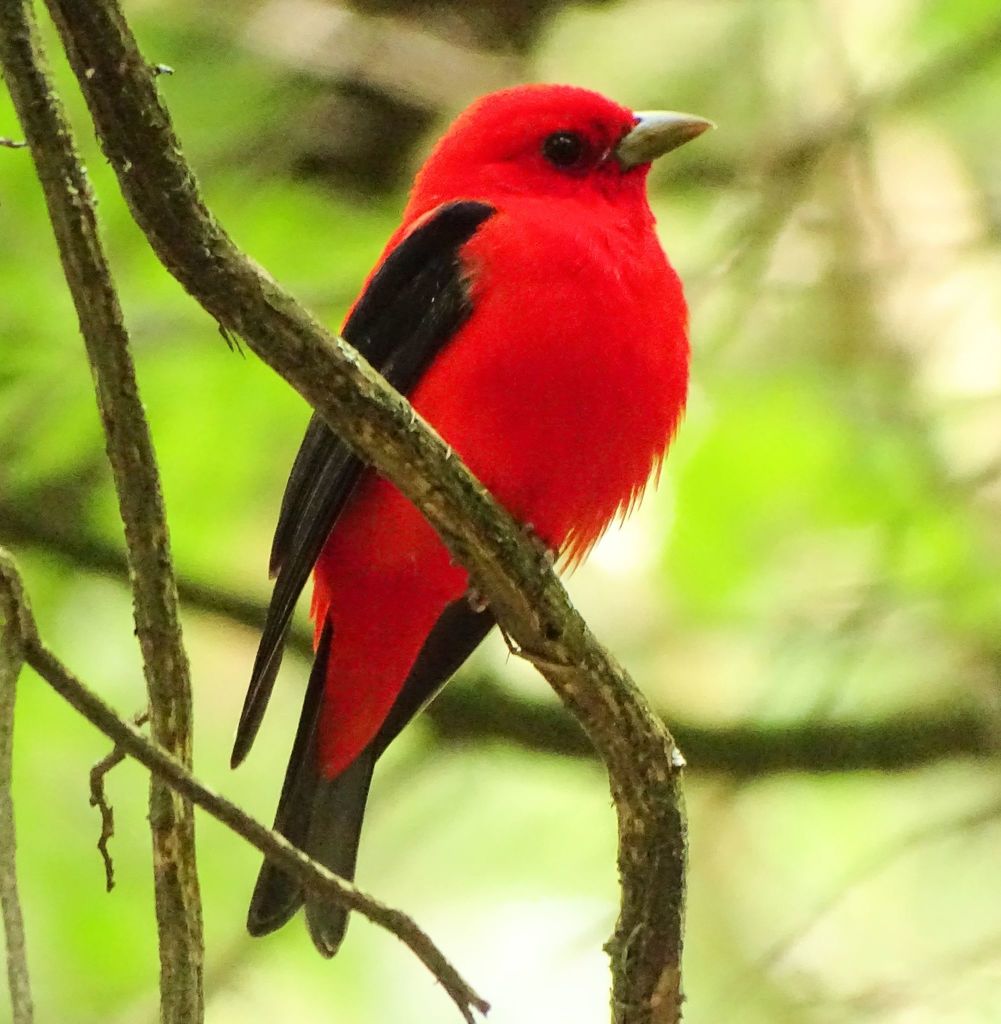
(c) Shirley Zundell, some rights reserved (CC BY) · licence
Family: Cardinalidae · Class: Aves · Order: Passeriformes
Piranga olivacea (Scarlet Tanager) is a California animal in the Cardinalidae family.
The Scarlet Tanager is a medium-sized songbird measuring 16 to 19 cm (6.3 to 7.5 inches) in length with a wingspan of 25 to 29 cm (9.8 to 11.4 inches). Adult males during breeding season display bright red plumage with contrasting black wings and tail. The conical bill is pale yellow to horn-colored. Non-breeding males, females, and juveniles are olive-yellow above and yellow below, with darker wings and tail that may show faint barring. Females can be distinguished from similar tanager species by their darker wings and more robust bill structure. The Scarlet Tanager breeds across eastern North America, from southeastern Canada south to northern Georgia and west to the Great Plains. In California, this species occurs as an uncommon to rare migrant and vagrant, primarily during spring migration from late April through May and fall migration from August through October. Most California records come from coastal locations, with scattered inland occurrences documented in the Central Valley and desert regions. The species is most frequently observed in riparian corridors, parks, and wooded residential areas during migration. Breeding habitat consists of mature deciduous and mixed forests, particularly those dominated by oak, maple, and beech trees. During migration, Scarlet Tanagers utilize a variety of wooded habitats including riparian forests, oak woodlands, and urban parks. The species shows preference for forest canopy and mid-story levels, rarely foraging on the ground. Elevation range during breeding extends from sea level to approximately 1,500 meters (4,900 feet). Scarlet Tanagers are primarily insectivorous during the breeding season, feeding on caterpillars, moths, beetles, and other arthropods gleaned from foliage and bark. Diet shifts to include fruits and berries during migration and winter, particularly wild cherries, elderberries, and mulberries. Breeding occurs from May through July, with females constructing shallow cup nests on horizontal branches 3 to 23 meters (10 to 75 feet) above ground. Clutch size ranges from 3 to 5 eggs, which are incubated for 12 to 14 days. Males are noted for their distinctive song, described as a robin-like phrase with a hoarse quality. The Scarlet Tanager is not federally or state listed in California, reflecting its status as a vagrant species rather than a breeding resident. According to Partners in Flight, continental populations have declined by approximately 15 percent since 1970, primarily due to forest fragmentation on breeding grounds and habitat loss on wintering grounds in South America. Climate change may be shifting the species' range northward. In California, the species remains an exciting find for birders, with most observations occurring during peak migration periods along the coast and at desert oases where migrants concentrate.
Classification
Class: Aves · Order: Passeriformes · Family: Cardinalidae
Frequently asked questions
How is Piranga olivacea classified?
Piranga olivacea belongs to class Aves, order Passeriformes, family Cardinalidae.
What family does Piranga olivacea belong to?
Piranga olivacea is in the Cardinalidae family.
What is Piranga olivacea?
The Scarlet Tanager is a medium-sized songbird measuring 16 to 19 cm (6.3 to 7.5 inches) in length with a wingspan of 25 to 29 cm (9.8 to 11.4 inches).
Is Piranga olivacea found in California?
Yes. Piranga olivacea is recorded in California in The California Species Project's catalogue.
Related species
Other California species in the same genus, family, or bioregion.
Data from The California Species Project — 14,000+ California species with verified data from CNPS, CDFW, USFWS, and more.