Piranga rubra
Summer Tanager
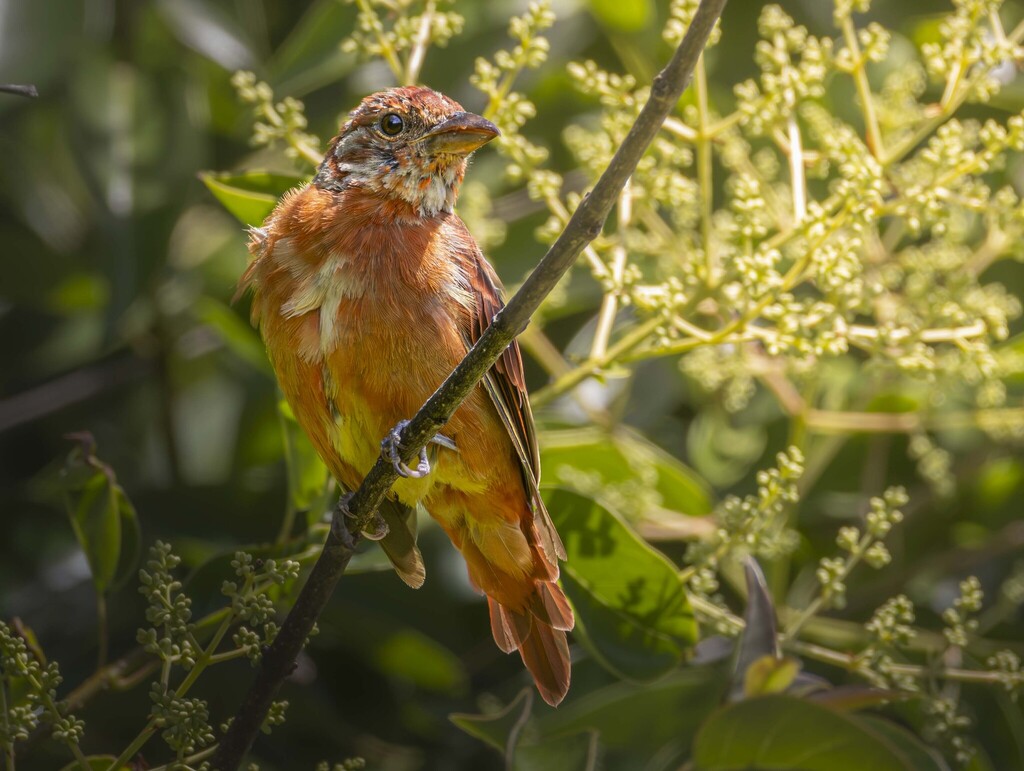
(c) Brooke J., some rights reserved (CC BY) · licence
Family: Cardinalidae · Class: Aves · Order: Passeriformes
Conservation status: WL · G5 S1
Piranga rubra (Summer Tanager) is a California animal in the Cardinalidae family.
The Summer Tanager is a medium-sized songbird measuring 17-19 cm (6.7-7.5 inches) in length with a wingspan of 28-30 cm (11-12 inches). Adult males display brilliant red plumage year-round, while females and immature birds are olive-yellow to orange-yellow. Males lack the black wings and tail of the closely related Scarlet Tanager. Both sexes possess a thick, pale-colored bill adapted for their insectivorous diet, and relatively long tails compared to other tanager species. The Summer Tanager breeds across much of the southeastern and south-central United States, with populations extending from southern California through the southwestern states to the Atlantic coast. In California, the species occurs as a rare breeder in riparian woodlands of the southeastern desert regions, primarily in Imperial and eastern Riverside counties along the Colorado River. The species winters primarily in Mexico and Central America, with some individuals reaching northern South America. In California, Summer Tanagers inhabit mature riparian forests dominated by cottonwoods and willows, typically at elevations below 500 meters (1,640 feet). They prefer dense canopy cover along permanent water sources, including the Colorado River corridor and associated tributaries. During migration, individuals may be found in desert oases and mountain canyons with adequate tree cover. The species requires large insects for successful reproduction, making intact riparian ecosystems essential for breeding success. Summer Tanagers are primarily insectivorous, specializing in capturing bees, wasps, and other hymenopterans, which they skillfully remove stingers from before consuming. They also feed on beetles, moths, caterpillars, and occasionally fruits during migration and winter. Breeding occurs from May through July in California, with females constructing shallow cup nests on horizontal branches 3-10 meters above ground. Clutches typically contain 3-4 pale blue eggs marked with brown spots. Males are known for their robin-like song, described as a series of melodic phrases, and both sexes give a distinctive 'pik-a-tuk' call. The Summer Tanager is designated as a Watch List species by the California Department of Fish and Wildlife, reflecting its extremely limited breeding range and small population size within the state. The species receives a state rank of S1, indicating it is critically imperiled in California with fewer than 20 breeding pairs estimated statewide. Primary threats include riparian habitat loss and degradation along the Colorado River due to water diversions, urban development, and invasive plant species such as tamarisk. Climate change may further impact the species through altered precipitation patterns affecting riparian forest health. The Summer Tanager's dependence on large, intact riparian forests makes it particularly vulnerable to habitat fragmentation. Conservation efforts focus on maintaining and restoring native riparian vegetation along the Colorado River corridor and controlling invasive species that degrade nesting habitat quality.
Classification
Class: Aves · Order: Passeriformes · Family: Cardinalidae
Conservation status
WL · G5 S1
Frequently asked questions
How is Piranga rubra classified?
Piranga rubra belongs to class Aves, order Passeriformes, family Cardinalidae.
What family does Piranga rubra belong to?
Piranga rubra is in the Cardinalidae family.
Is Piranga rubra protected or of conservation concern?
Piranga rubra carries the following status: WL · G5 S1.
What is Piranga rubra?
The Summer Tanager is a medium-sized songbird measuring 17-19 cm (6.7-7.5 inches) in length with a wingspan of 28-30 cm (11-12 inches).
Is Piranga rubra found in California?
Yes. Piranga rubra is recorded in California in The California Species Project's catalogue.
Related species
Other California species in the same genus, family, or bioregion.
Data from The California Species Project — 14,000+ California species with verified data from CNPS, CDFW, USFWS, and more.