Pisaster ochraceus
Ochre Sea Star
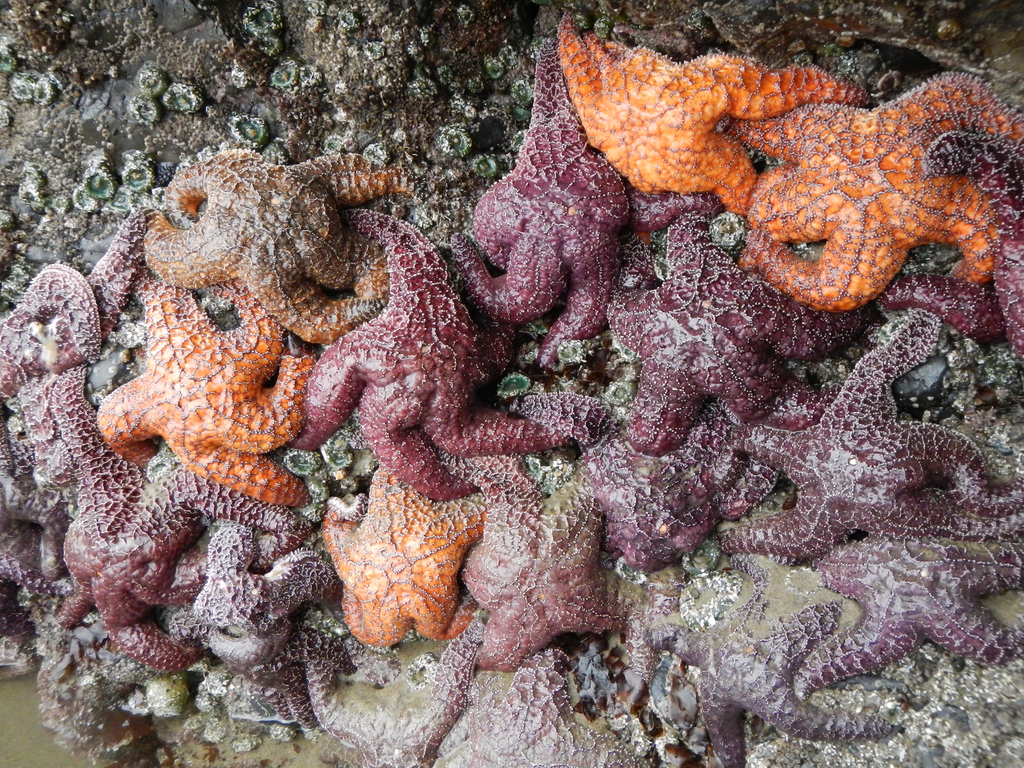
(c) Lee Cain, some rights reserved (CC BY) · licence
Family: Asteriidae · Class: Asteroidea · Order: Forcipulatida
Pisaster ochraceus (Ochre Sea Star) is a California animal in the Asteriidae family.
The ochre sea star is a large, five-armed echinoderm commonly found along the Pacific coast from Alaska to Baja California. Adults typically measure 15 to 25 centimeters (6 to 10 inches) in diameter, though some individuals can reach up to 35 centimeters (14 inches). Despite its common name, the species exhibits considerable color variation, ranging from purple and orange to brown, yellow, and red. The body surface is covered with short, blunt spines and prominent tube feet that enable both locomotion and prey capture. In California, Pisaster ochraceus occurs along the entire coastline, inhabiting rocky intertidal zones from the high tide line to depths of approximately 90 meters (300 feet). The species is particularly abundant in areas with hard substrate where mussels and other preferred prey species are common. California's marine protected areas, including Abalone Cove State Marine Conservation Area, Double Cone Rock State Marine Conservation Area, and Sea Lion Gulch State Marine Reserve, provide important habitat for ochre sea star populations. Ochre sea stars occupy rocky intertidal and subtidal habitats, including tidepools, rocky shores, kelp forests, and areas with mixed sandy and rocky substrates. They are well-adapted to the dynamic intertidal environment, tolerating exposure to air during low tides and varying salinity levels. The species shows strong site fidelity, often returning to the same crevices or depressions during low tide periods. As a keystone predator, Pisaster ochraceus plays a critical role in maintaining intertidal community structure. The species feeds primarily on mussels, particularly California mussels (Mytilus californianus), but also consumes barnacles, snails, limpets, and chitons. Using their powerful tube feet, ochre sea stars pry open mussel shells and extrude their stomach to digest prey externally. Reproduction occurs through broadcast spawning, typically during spring and summer months when water temperatures are optimal. Fertilized eggs develop into planktonic larvae that drift in ocean currents for several weeks before settling and metamorphosing into juvenile sea stars. While not currently listed under federal or state endangered species legislation, ochre sea stars face significant conservation challenges. The species has experienced dramatic population declines since 2013 due to sea star wasting syndrome, a disease that causes tissue deterioration and death. This epidemic has affected populations from Mexico to Alaska, with some areas experiencing mortality rates exceeding 90 percent. Climate change-related factors, including ocean acidification and warming temperatures, may increase susceptibility to disease outbreaks and affect prey availability. Ocean acidification particularly threatens the species' ability to maintain its calcium carbonate skeleton. Monitoring programs within California's marine protected areas track population recovery and provide baseline data for conservation efforts. The Multi-Agency Rocky Intertidal Network conducts standardized surveys using permanent plots to monitor ochre sea star density and size distribution at multiple sites along the California coast.
Classification
Class: Asteroidea · Order: Forcipulatida · Family: Asteriidae
Frequently asked questions
How is Pisaster ochraceus classified?
Pisaster ochraceus belongs to class Asteroidea, order Forcipulatida, family Asteriidae.
What family does Pisaster ochraceus belong to?
Pisaster ochraceus is in the Asteriidae family.
What is Pisaster ochraceus?
The ochre sea star is a large, five-armed echinoderm commonly found along the Pacific coast from Alaska to Baja California.
Is Pisaster ochraceus found in California?
Yes. Pisaster ochraceus is recorded in California in The California Species Project's catalogue.
Related species
Other California species in the same genus, family, or bioregion.
Data from The California Species Project — 14,000+ California species with verified data from CNPS, CDFW, USFWS, and more.