Plagodis pulveraria
American Barred Umber
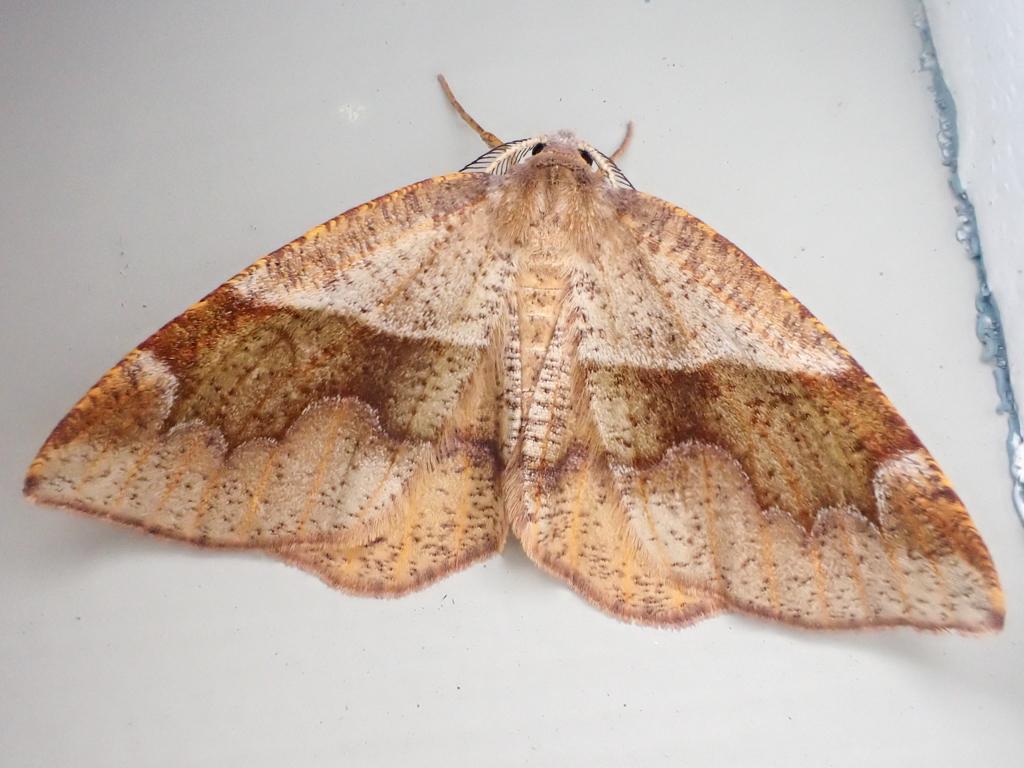
(c) Trevor Van Loon, some rights reserved (CC BY) · licence
Family: Geometridae · Class: Insecta · Order: Lepidoptera
Plagodis pulveraria (American Barred Umber) is a California animal in the Geometridae family.
The American Barred Umber (Plagodis pulveraria) is a medium-sized geometrid moth with a wingspan typically ranging from 25 to 35 mm (1.0 to 1.4 inches). The forewings display a characteristic pattern of wavy, brownish cross-lines on a pale yellowish to light brown background, creating the distinctive barred appearance referenced in its common name. The hindwings are similarly patterned but generally paler. Males possess feathery antennae, while females have thread-like antennae. At rest, the moth holds its wings horizontally, resembling a small piece of bark or dried leaf. This species occurs across much of North America, from southern Canada through the United States. In California, the American Barred Umber is found primarily in forested regions of the northern and central portions of the state, including the Sierra Nevada, Coast Ranges, and areas of the Central Valley with suitable woodland habitat. The species extends from sea level to elevations of approximately 2,000 meters (6,600 feet) in mountainous terrain. The American Barred Umber inhabits deciduous and mixed woodlands, particularly areas dominated by oak species. Adults are commonly found in oak woodlands, riparian forests, and suburban areas with mature trees. The species shows a strong association with Quercus species, which serve as primary larval host plants. Moths are attracted to artificial lights and can be found around porch lights and street lamps in residential areas adjacent to suitable habitat. Adults are active from late spring through early fall, with peak flight periods typically occurring from May through August in California. The species is univoltine, producing one generation per year. Females deposit eggs on or near the leaves of host plants, primarily various oak species including coast live oak (Quercus agrifolia), valley oak (Q. lobata), and blue oak (Q. douglasii). Larvae are typically green geometrid caterpillars, commonly called inchworms or loopers, that feed on oak foliage during summer months. The caterpillars pupate in soil or leaf litter, overwintering as pupae before emerging as adults the following spring. Larvae exhibit the characteristic looping locomotion of geometrid caterpillars, moving by extending the front portion of their body forward, then drawing the rear segments up to meet the front, creating an arching motion. This feeding behavior can occasionally cause localized defoliation of oak trees, though significant damage is uncommon. Adult moths are primarily nocturnal and are attracted to light sources, making them frequent visitors to moth traps used in ecological surveys. The American Barred Umber is not currently listed under federal or California state endangered species legislation. The species appears to maintain stable populations throughout its range, benefiting from the widespread distribution of oak woodlands in California. However, like many native moths, populations may be affected by habitat loss due to urban development, changes in fire management practices, and climate-related shifts in oak woodland distribution. The species serves as a pollinator for various native plants and provides food for insectivorous birds, bats, and spiders, contributing to ecosystem function in California's oak woodland communities.
Classification
Class: Insecta · Order: Lepidoptera · Family: Geometridae
Frequently asked questions
How is Plagodis pulveraria classified?
Plagodis pulveraria belongs to class Insecta, order Lepidoptera, family Geometridae.
What family does Plagodis pulveraria belong to?
Plagodis pulveraria is in the Geometridae family.
What is Plagodis pulveraria?
The American Barred Umber (Plagodis pulveraria) is a medium-sized geometrid moth with a wingspan typically ranging from 25 to 35 mm (1.0 to 1.4 inches).
Is Plagodis pulveraria found in California?
Yes. Plagodis pulveraria is recorded in California in The California Species Project's catalogue.
Related species
Other California species in the same genus, family, or bioregion.
Data from The California Species Project — 14,000+ California species with verified data from CNPS, CDFW, USFWS, and more.