Plathemis lydia
Common Whitetail
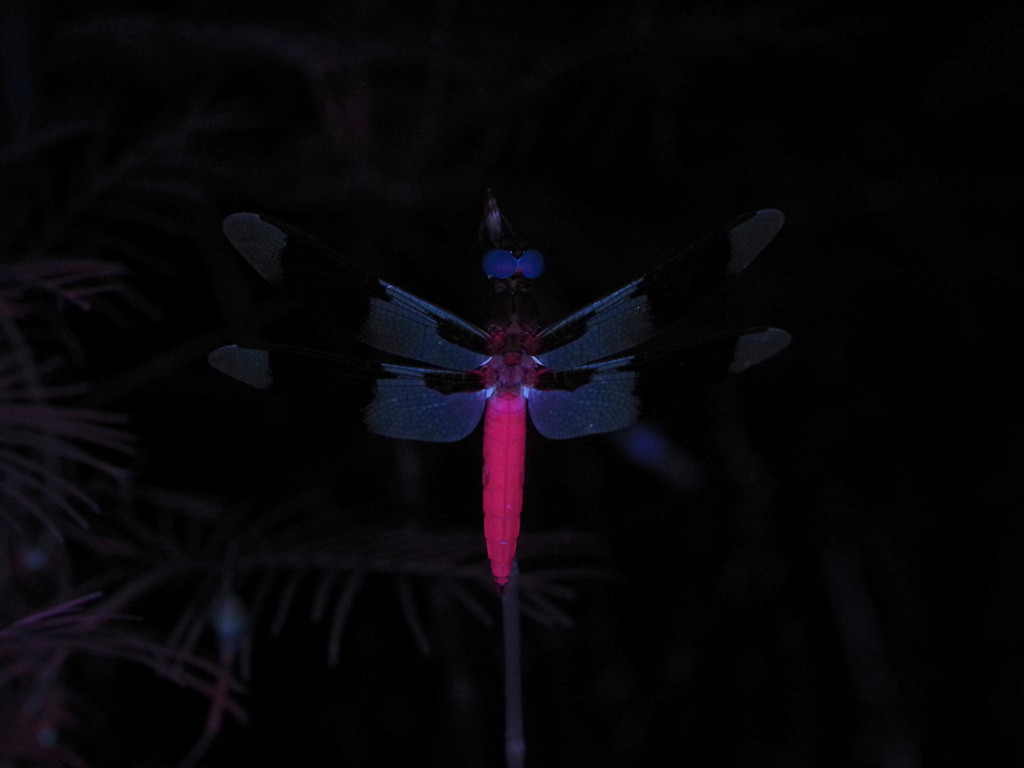
(c) Michelle W. (鍾偉瑋), some rights reserved (CC BY) · licence
Family: Libellulidae · Class: Insecta · Order: Odonata
Plathemis lydia (Common Whitetail) is a California animal in the Libellulidae family.
The Common Whitetail is a medium-sized dragonfly belonging to the family Libellulidae, measuring approximately 43-48 mm (1.7-1.9 inches) in length with a wingspan of 76-84 mm (3.0-3.3 inches) (Paulson 2009). Males are easily distinguished by their chalky white abdomen and broad, flattened body shape, from which the species derives its common name. The thorax is dark brown to black with yellowish stripes. Females and immature males display a brown and yellow striped pattern on the abdomen with three yellow spots on each side, resembling a wasp. Both sexes have four large wing patches - one at the base and one at the tip of each wing - though these markings are more prominent in males (Abbott 2005). Common Whitetails have one of the broadest distributions among North American dragonflies, ranging from southern Canada south to northern South America (Paulson 2009). In California, they occur throughout most of the state except for the highest elevations of the Sierra Nevada and the most arid portions of the southeastern deserts. The species is found from sea level to approximately 2,400 meters (8,000 feet) elevation, with populations documented in all major California bioregions (Manolis 2003). This species inhabits a wide variety of aquatic environments, showing considerable adaptability to different water conditions. Common Whitetails breed in ponds, lakes, slow-moving streams, marshes, and even temporary water bodies such as roadside ditches and constructed wetlands (Abbott 2005). They prefer areas with emergent vegetation and muddy or sandy bottoms. Adults are often observed perching on prominent structures near water, including fence posts, bare branches, and pier pilings, from which they launch hunting forays (Dunkle 2000). Common Whitetails are aggressive territorial predators, with males establishing and defending territories around suitable breeding sites. They employ a perch-and-patrol hunting strategy, capturing prey in flight including mosquitoes, midges, flying ants, and other small flying insects (Paulson 2009). Mating occurs from late spring through early fall, with peak activity in summer months. Females oviposit by dipping their abdomen into water while in flight, releasing eggs that sink to the bottom substrate. The aquatic nymphs are voracious predators that feed on aquatic invertebrates, small fish, and tadpoles, requiring 1-3 years to complete development depending on climate conditions (Abbott 2005). The species exhibits no special conservation status and maintains stable populations throughout its range. Common Whitetails demonstrate notable resilience to habitat modification and can successfully colonize artificial water bodies, making them less vulnerable than many other dragonfly species to human development (Manolis 2003). Their broad habitat tolerance and adaptability have allowed them to maintain healthy populations even in urbanized areas. Climate change may potentially expand their northern range as temperatures warm (Hassall & Thompson 2008), though specific population monitoring data for California is limited. The species serves as an important predator of pest insects and contributes to the biodiversity of aquatic ecosystems throughout the state.
Classification
Class: Insecta · Order: Odonata · Family: Libellulidae
Frequently asked questions
How is Plathemis lydia classified?
Plathemis lydia belongs to class Insecta, order Odonata, family Libellulidae.
What family does Plathemis lydia belong to?
Plathemis lydia is in the Libellulidae family.
What is Plathemis lydia?
The Common Whitetail is a medium-sized dragonfly belonging to the family Libellulidae, measuring approximately 43-48 mm (1.7-1.9 inches) in length with a wingspan of 76-84 mm (3.0-3.3 inches) (Paulson 2009).
Is Plathemis lydia found in California?
Yes. Plathemis lydia is recorded in California in The California Species Project's catalogue.
Related species
Other California species in the same genus, family, or bioregion.
Data from The California Species Project — 14,000+ California species with verified data from CNPS, CDFW, USFWS, and more.