Platynota stultana
Omnivorous Leaf-roller
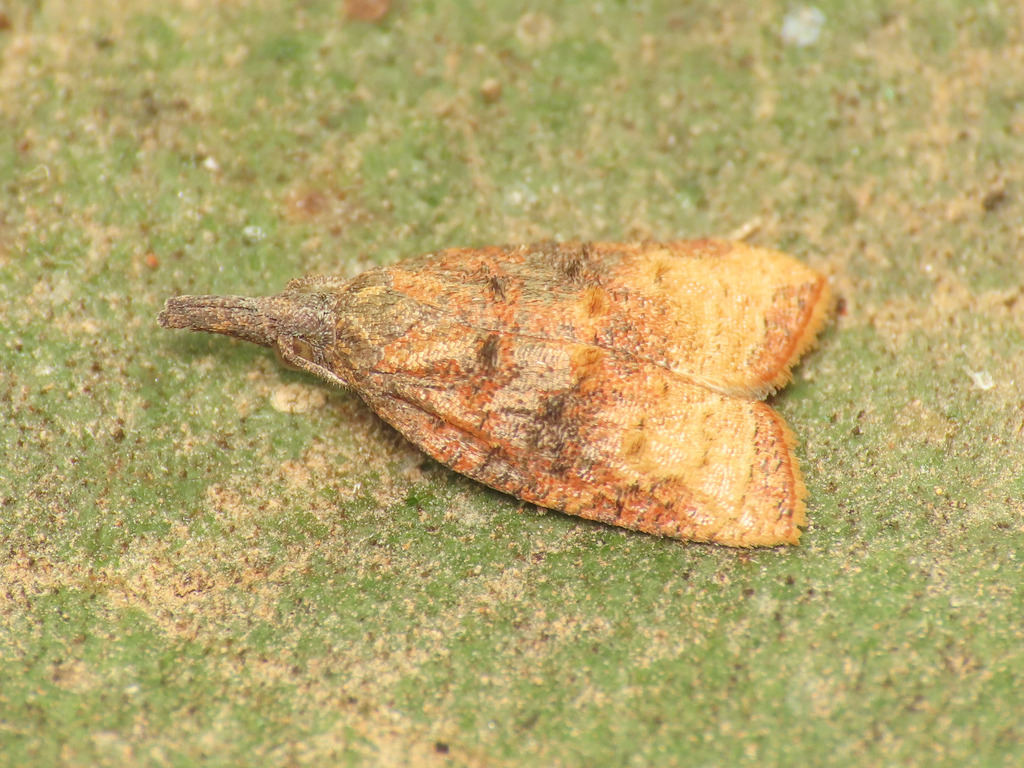
(c) Emanuele Santarelli, some rights reserved (CC BY-SA) · licence
Family: Tortricidae · Class: Insecta · Order: Lepidoptera
Platynota stultana (Omnivorous Leaf-roller) is a California animal in the Tortricidae family.
The omnivorous leaf-roller (Platynota stultana) is a small moth in the family Tortricidae, characterized by forewings that typically measure 8 to 12 millimeters (0.3 to 0.5 inches) in length when at rest. Adults display brownish forewings with distinctive darker brown and lighter tan markings forming irregular bands and patches. The hindwings are pale gray to whitish with a slight iridescent sheen. At rest, the wings are held roof-like over the body, creating the characteristic tortricid moth profile. The head bears prominent compound eyes and thread-like antennae. This species exhibits one of the broadest distributions among North American tortricid moths, ranging from Texas to California across the southern United States, and extending through Florida and the Atlantic coastal states. The species occurs from sea level to approximately 1,500 meters (4,900 feet) elevation, with populations documented in both coastal and inland regions. In California, P. stultana is found throughout the Central Valley, coastal ranges, and southern California, with records extending north into the San Francisco Bay Area. The omnivorous leaf-roller inhabits diverse environments including agricultural areas, urban gardens, natural woodland edges, and riparian zones. Adults are attracted to areas with abundant flowering plants that provide nectar sources. The species demonstrates high ecological plasticity, successfully colonizing both natural and human-modified landscapes. Optimal habitat includes areas with mixed vegetation that support the species' exceptionally broad host plant range. True to its common name, P. stultana larvae feed on numerous host plants spanning multiple plant families, including both conifers and monocots, as well as dicotyledonous plants. This polyphagous feeding strategy contributes significantly to the species' widespread distribution and ecological success. Larvae create characteristic shelters by rolling or folding leaves and securing them with silk webbing. The species typically completes two to three generations annually in warmer regions, with continuous breeding possible in southern California and other mild climates. Adults are primarily nocturnal and are attracted to artificial lights. Mating occurs during evening hours, with females depositing eggs singly or in small clusters on host plant foliage. Platynota stultana is not currently listed under federal or state endangered species legislation and appears to maintain stable populations throughout its range. The species' broad host plant range, ecological adaptability, and multiple annual generations contribute to its resilience. In some agricultural contexts, the larvae are considered minor pests due to their feeding on crop plants, particularly in nurseries and ornamental plantings. Climate change may potentially expand the species' range northward as temperatures increase, though current populations show no indication of conservation concern. The species serves as a food source for various predators and parasitoids, contributing to local food web dynamics across its extensive range.
Classification
Class: Insecta · Order: Lepidoptera · Family: Tortricidae
Frequently asked questions
How is Platynota stultana classified?
Platynota stultana belongs to class Insecta, order Lepidoptera, family Tortricidae.
What family does Platynota stultana belong to?
Platynota stultana is in the Tortricidae family.
What is Platynota stultana?
The omnivorous leaf-roller (Platynota stultana) is a small moth in the family Tortricidae, characterized by forewings that typically measure 8 to 12 millimeters (0.3 to 0.5 inches) in length when at rest.
Is Platynota stultana found in California?
Yes. Platynota stultana is recorded in California in The California Species Project's catalogue.
Related species
Other California species in the same genus, family, or bioregion.
Data from The California Species Project — 14,000+ California species with verified data from CNPS, CDFW, USFWS, and more.