Platypedia putnami
Putnam's Cicada
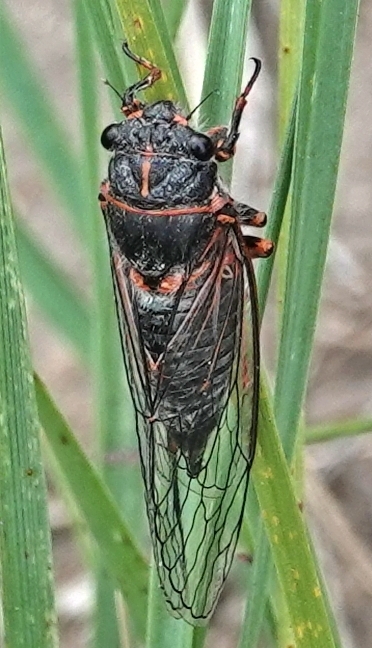
(c) Colin Croft, some rights reserved (CC BY) · licence
Family: Cicadidae · Class: Insecta · Order: Hemiptera
Platypedia putnami (Putnam's Cicada) is a California animal in the Cicadidae family.
Putnam's cicada is a small to medium-sized cicada in the family Cicadidae, subfamily Tibicininae. Adults typically measure 15-25 mm (0.6-1.0 inches) in body length with a wingspan of approximately 30-40 mm (1.2-1.6 inches). The species exhibits the characteristic flattened appearance of the genus Platypedia, with relatively broad, flat forewings and a robust thorax. Coloration ranges from pale brown to gray-brown, often with darker markings on the forewings and a lighter colored underside. Putnam's cicada occurs in western North America, with populations documented across multiple states including California, Oregon, Washington, Idaho, and Nevada. The species shows considerable subspecific variation across its range, with several recognized subspecies including P. p. putnami, P. p. lutea, P. p. occidentalis, and P. p. keddiensis (BugGuide 2025). In California, the species is tracked by the California Department of Fish and Wildlife's Natural Diversity Database as a special status species, indicating it faces some conservation concern within the state. This cicada inhabits a variety of forested and woodland environments, particularly areas dominated by coniferous trees. The species is commonly associated with pine, fir, and other needle-bearing trees, though specific host plant relationships require further documentation. Putnam's cicada typically occurs at elevations ranging from sea level to approximately 2,000 meters (6,600 feet), showing adaptation to both coastal and montane forest ecosystems. Adults are most commonly observed during the warmer months, typically emerging from late spring through early fall depending on elevation and local climate conditions. Like other cicadas, Putnam's cicada follows a complex life cycle with an extended underground nymphal stage lasting several years. Nymphs develop by feeding on tree root fluids before emerging to molt into winged adults. Males produce species-specific acoustic signals to attract females for mating, though the specific acoustic characteristics of P. putnami calls have not been extensively documented. Adult cicadas are short-lived, typically surviving only a few weeks to complete reproduction before dying. Putnam's cicada faces conservation challenges throughout portions of its range, particularly in California where habitat loss and fragmentation affect many forest-dwelling species. The species' inclusion on California's Special Animals List reflects concerns about population stability and habitat quality. Primary threats likely include forest management practices, urban development in forested areas, and climate change impacts on forest ecosystems. However, comprehensive population surveys and trend analyses are lacking for this species. The presence of multiple subspecies across its range suggests historical population fragmentation and potential local adaptation, making subspecies-level conservation important for maintaining genetic diversity. Additional research is needed to better understand population trends, specific habitat requirements, and the conservation status of individual subspecies across the species' range.
Classification
Class: Insecta · Order: Hemiptera · Family: Cicadidae
Frequently asked questions
How is Platypedia putnami classified?
Platypedia putnami belongs to class Insecta, order Hemiptera, family Cicadidae.
What family does Platypedia putnami belong to?
Platypedia putnami is in the Cicadidae family.
What is Platypedia putnami?
Putnam's cicada is a small to medium-sized cicada in the family Cicadidae, subfamily Tibicininae.
Is Platypedia putnami found in California?
Yes. Platypedia putnami is recorded in California in The California Species Project's catalogue.
Related species
Other California species in the same genus, family, or bioregion.
Data from The California Species Project — 14,000+ California species with verified data from CNPS, CDFW, USFWS, and more.