Platyptilia carduidactyla
Artichoke Plume Moth
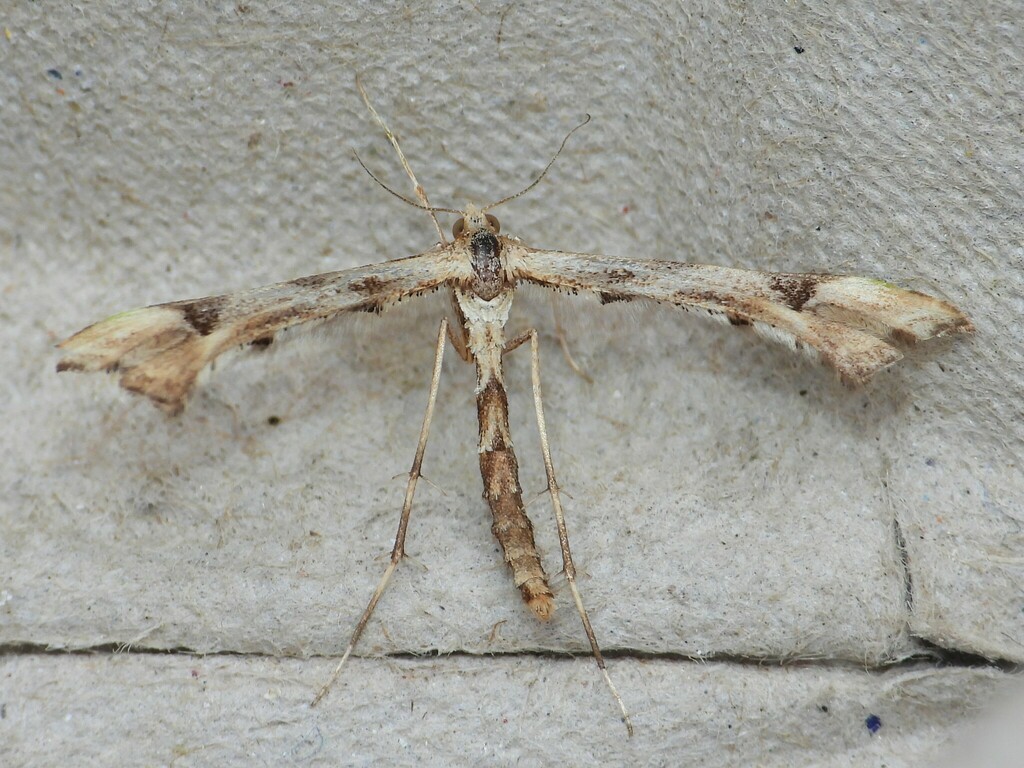
(c) Dan MacNeal, some rights reserved (CC BY) · licence
Family: Pterophoridae · Class: Insecta · Order: Lepidoptera
Platyptilia carduidactyla (Artichoke Plume Moth) is a California animal in the Pterophoridae family.
The Artichoke Plume Moth is a small moth in the family Pterophoridae, characterized by the distinctive feathery wing structure typical of plume moths. Like other members of this family, the forewings are deeply divided into plume-like segments, giving the moth its common name. When at rest, the wings are held perpendicular to the body, creating a distinctive T-shaped silhouette. This species has a broad North American distribution, ranging from Labrador south to Virginia and Texas, and extending west across Canada to British Columbia and south to California (BugGuide). The moth occurs throughout much of the continental United States and southern Canada, demonstrating considerable ecological adaptability across diverse climatic zones. The Artichoke Plume Moth inhabits a variety of environments where its host plants occur. Adults are attracted to artificial lights and can be found in both natural and disturbed habitats. The species appears to tolerate a range of elevations and habitat types, from coastal areas to inland regions, reflecting its wide geographic distribution. As suggested by its common name, this species is associated with plants in the family Asteraceae, particularly artichoke and related species. The larvae likely feed on the foliage, flowers, or developing seed heads of these composite plants. Like many Pterophoridae, the caterpillars may bore into stems or feed within flower heads, though specific details of the larval biology require further documentation. Adults are nocturnal and come to light sources (BugGuide). The species likely has multiple generations per year in warmer portions of its range, with overwintering occurring in the pupal or adult stage. Despite its wide distribution, detailed ecological studies of the Artichoke Plume Moth remain limited. The moth's association with cultivated artichoke suggests it may occasionally be found in agricultural settings, though it does not appear to be considered a significant pest species. The ability to utilize both native and introduced Asteraceae plants may have contributed to the species' apparent stability across its range. The Artichoke Plume Moth currently has no formal conservation status at federal or state levels. Its broad distribution and apparent ecological flexibility suggest the species is not facing immediate conservation concerns. However, like many specialized herbivorous insects, local populations may be affected by habitat loss, agricultural practices, or changes in host plant availability. The species' relationship with both wild and cultivated Asteraceae may provide some buffer against habitat changes, though comprehensive population monitoring has not been conducted. Scientific documentation for this species remains limited despite its wide range. The information presented here is based on available sources including BugGuide and iNaturalist. If you have additional verified information about this species' biology, distribution, or ecology, please contact us to help improve this species account.
Classification
Class: Insecta · Order: Lepidoptera · Family: Pterophoridae
Frequently asked questions
How is Platyptilia carduidactyla classified?
Platyptilia carduidactyla belongs to class Insecta, order Lepidoptera, family Pterophoridae.
What family does Platyptilia carduidactyla belong to?
Platyptilia carduidactyla is in the Pterophoridae family.
What is Platyptilia carduidactyla?
The Artichoke Plume Moth is a small moth in the family Pterophoridae, characterized by the distinctive feathery wing structure typical of plume moths.
Is Platyptilia carduidactyla found in California?
Yes. Platyptilia carduidactyla is recorded in California in The California Species Project's catalogue.
Related species
Other California species in the same genus, family, or bioregion.
Data from The California Species Project — 14,000+ California species with verified data from CNPS, CDFW, USFWS, and more.