Platyrhinoidis triseriata
Thornback Guitarfish
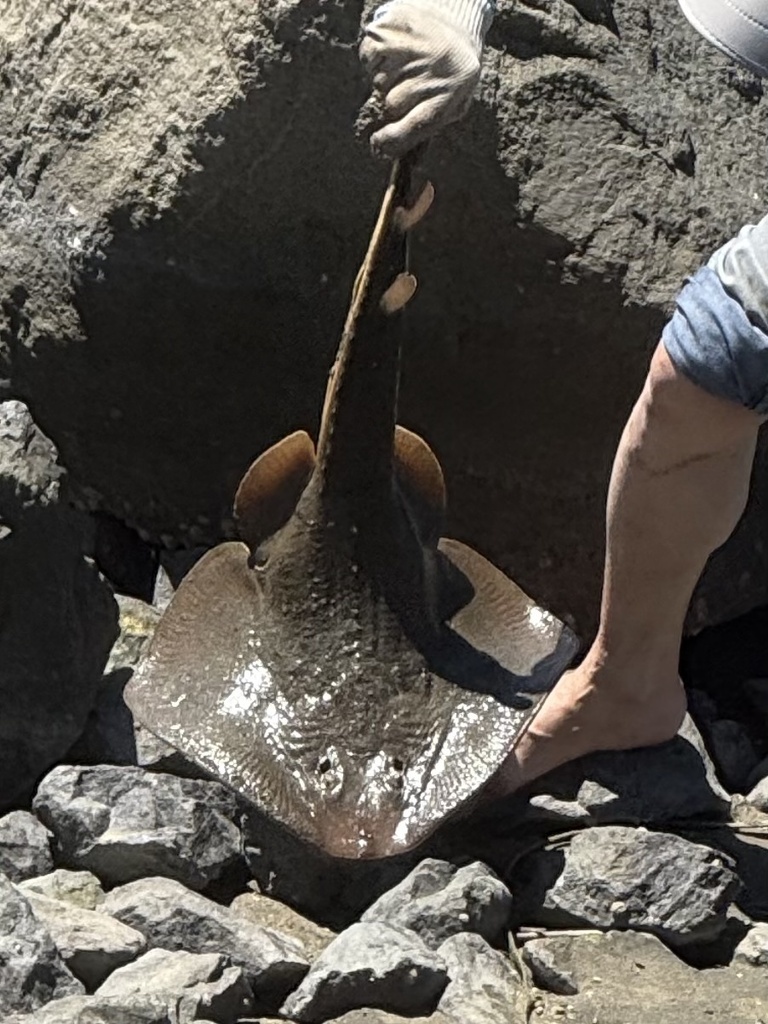
no rights reserved · CC0
Family: Platyrhinidae · Class: Chondrichthyes · Order: Rhinobatiformes
Platyrhinoidis triseriata (Thornback Guitarfish) is a California animal in the Platyrhinidae family.
The thornback guitarfish is a flattened elasmobranch that combines characteristics of both sharks and rays. Adults reach a maximum length of 91 centimeters (2.9 feet), though most individuals do not exceed 61 centimeters (2 feet) in length. The body displays a distinctive guitar-like shape with a flattened disc anterior to the pectoral fins and an elongated, shark-like tail. The dorsal surface is covered with three rows of thorns or spines extending from the head to the first dorsal fin, giving the species its common name. The body coloration is typically brownish to grayish above with darker spots and blotches, while the ventral surface is pale white to cream colored. The thornback guitarfish ranges from Tomales Bay, California, south to the Gulf of California, Mexico. This distribution encompasses the entire California coast, with populations occurring in nearshore waters throughout the state. The species demonstrates a continuous distribution along this range without apparent population breaks or geographic isolation. Juvenile and adult thornbacks inhabit fine sand to mud bottoms in depths ranging from the surf zone to 137 meters (449 feet). Adults are commonly found in and around kelp beds, utilizing these areas for foraging and shelter. The species shows a preference for soft substrates where it can partially bury itself for camouflage and ambush feeding. Shallow water individuals may form small aggregations associated with rocky areas and kelp forests, while deeper water populations tend to remain closer to the seafloor. Thornback guitarfish are bottom-dwelling predators that feed primarily on benthic invertebrates including polychaete worms, crustaceans, and mollusks. They employ an ambush feeding strategy, lying partially buried in sand or mud to capture prey. The species exhibits ovoviviparous reproduction, with females giving birth to live young after internal development. Their life span is estimated at approximately 15 years. Seasonal movements and migration patterns remain poorly documented, though the species appears to maintain relatively stable home ranges. Currently, the thornback guitarfish does not hold federal or state listing status in California. The species is managed as part of the broader skate and ray complex under California's Marine Life Management Act. Population trends have not been systematically assessed, though the species continues to be taken incidentally in commercial bottom trawl fisheries and targeted by recreational anglers. Climate change impacts on suitable habitat and prey availability represent potential future concerns, particularly for shallow water populations. The species' relatively slow growth rate and low reproductive output make it potentially vulnerable to overfishing pressure, though current exploitation levels appear sustainable based on continued presence throughout its historical range.
Classification
Class: Chondrichthyes · Order: Rhinobatiformes · Family: Platyrhinidae
Frequently asked questions
How is Platyrhinoidis triseriata classified?
Platyrhinoidis triseriata belongs to class Chondrichthyes, order Rhinobatiformes, family Platyrhinidae.
What family does Platyrhinoidis triseriata belong to?
Platyrhinoidis triseriata is in the Platyrhinidae family.
What is Platyrhinoidis triseriata?
The thornback guitarfish is a flattened elasmobranch that combines characteristics of both sharks and rays.
Is Platyrhinoidis triseriata found in California?
Yes. Platyrhinoidis triseriata is recorded in California in The California Species Project's catalogue.
More California species
This species has no close relatives in our California data — here are other species to explore.
Data from The California Species Project — 14,000+ California species with verified data from CNPS, CDFW, USFWS, and more.