Plebejus acmon
Acmon Blue
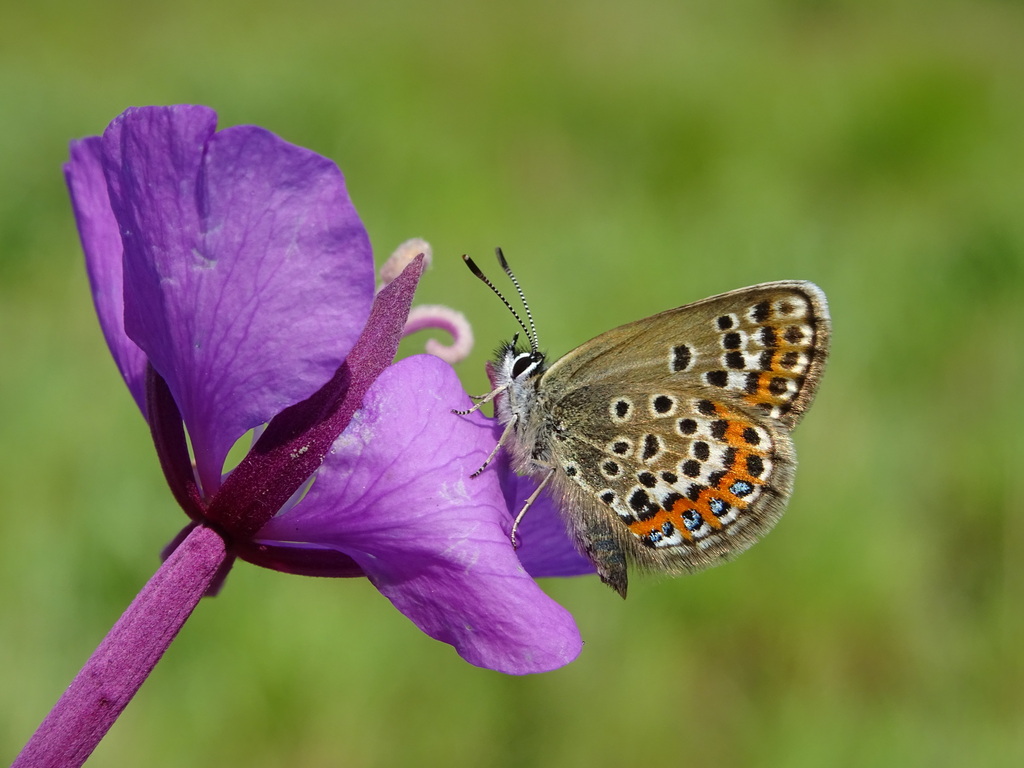
(c) Joey Bom, some rights reserved (CC BY) · licence
Family: Lycaenidae · Class: Insecta · Order: Lepidoptera
Plebejus acmon (Acmon Blue) is a California animal in the Lycaenidae family.
The Acmon Blue is a small butterfly in the family Lycaenidae, with adults measuring 19 to 32 mm (0.75 to 1.26 inches) in wingspan. Males display bright blue dorsal wing surfaces with narrow black borders and white wing fringes. The hindwings feature small orange spots along the outer margin, typically accompanied by metallic blue-green scaling. Females are predominantly brown dorsally with orange marginal spots on both wings and variable amounts of blue scaling near the wing bases. The ventral surfaces of both sexes are grayish-white to pale gray with black spots outlined in white, and prominent orange submarginal bands on the hindwings bordered by metallic blue-green spots. The species occurs primarily in California west of the Sierra Nevada-Cascade Divide, extending south into northern Baja California, Mexico. The precise northern and eastern limits in Oregon and Nevada remain incompletely documented. Within California, the Acmon Blue is found from sea level to approximately 3,048 meters (10,000 feet) in elevation, occupying diverse habitats from coastal areas to montane regions. Populations occur throughout the Central Valley, Coast Ranges, and western Sierra Nevada foothills. The Acmon Blue inhabits open areas including chaparral, oak woodlands, grasslands, desert washes, roadsides, and disturbed sites where host plants are present. The species shows strong fidelity to areas containing buckwheats (Eriogonum species), lupines (Lupinus species), trefoils (Lotus species), and milkvetches (Astragalus species). Adults are frequently observed nectaring on their larval host plants as well as other flowering plants including clovers, asters, and rabbitbrush. The species exhibits multivoltine behavior with two to four generations annually, depending on elevation and local climate conditions. Flight periods extend from March through October at lower elevations, with peak activity during spring and fall months. Adults typically fly within 1 to 2 meters of the ground and rarely venture far from host plant colonies. Females deposit single white eggs on flower buds, young leaves, or stems of host plants. Larvae are green with diagonal white stripes and develop through four instars, feeding on flowers, buds, and young foliage. The species overwinters as pupae in leaf litter or soil beneath host plants. Males establish territories near host plants and engage in perching behavior, investigating passing objects for potential mates. The Acmon Blue is not federally or state listed and appears to maintain stable populations across much of its range. The species benefits from its ability to utilize multiple host plant families and tolerance for disturbed habitats. However, localized populations may face pressure from habitat conversion, particularly in rapidly developing areas of California. Urban expansion and agricultural intensification can reduce available habitat, though the butterfly's use of weedy environments and roadside areas provides some resilience. Climate change effects on host plant phenology and distribution patterns represent potential future concerns for montane populations.
Classification
Class: Insecta · Order: Lepidoptera · Family: Lycaenidae
Frequently asked questions
How is Plebejus acmon classified?
Plebejus acmon belongs to class Insecta, order Lepidoptera, family Lycaenidae.
What family does Plebejus acmon belong to?
Plebejus acmon is in the Lycaenidae family.
What is Plebejus acmon?
The Acmon Blue is a small butterfly in the family Lycaenidae, with adults measuring 19 to 32 mm (0.75 to 1.26 inches) in wingspan.
Is Plebejus acmon found in California?
Yes. Plebejus acmon is recorded in California in The California Species Project's catalogue.
Related species
Other California species in the same genus, family, or bioregion.
Data from The California Species Project — 14,000+ California species with verified data from CNPS, CDFW, USFWS, and more.