Plebejus cassiope
Cassiope Blue
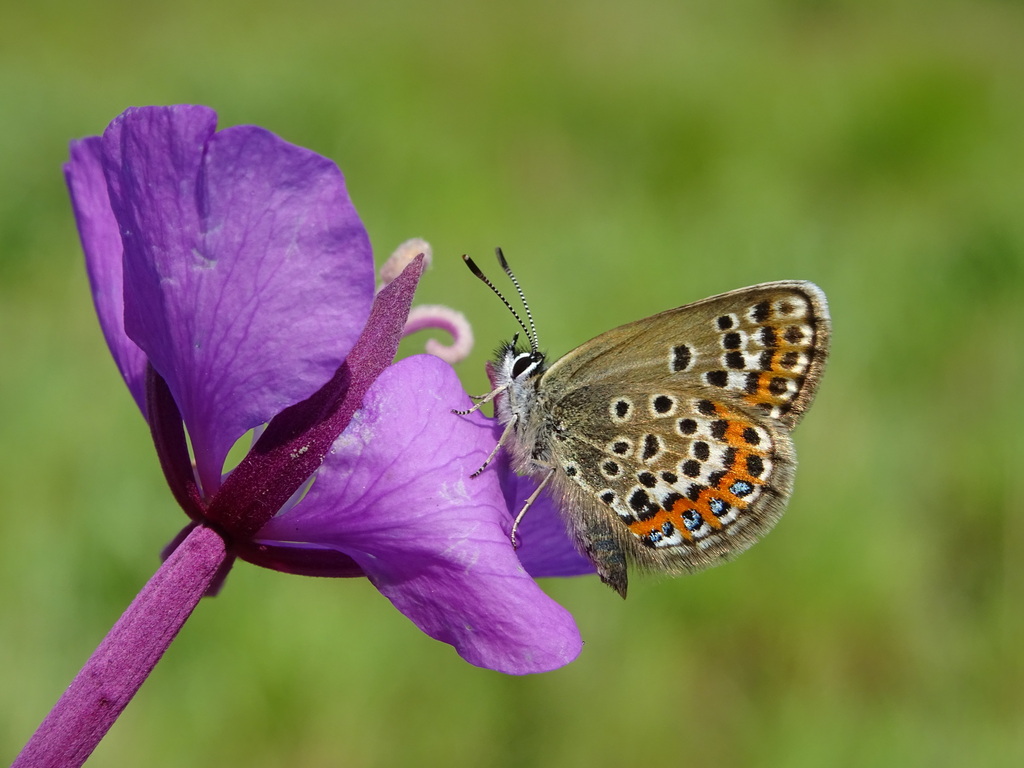
(c) Joey Bom, some rights reserved (CC BY) · licence
Family: Lycaenidae · Class: Insecta · Order: Lepidoptera
Plebejus cassiope (Cassiope Blue) is a California animal in the Lycaenidae family.
The Cassiope Blue is a small butterfly belonging to the family Lycaenidae, subfamily Polyommatinae. Adults have a wingspan of approximately 22 to 28 mm (0.9 to 1.1 inches). Males display bright blue dorsal wing surfaces with narrow black borders, while females exhibit brown wings with blue scaling near the wing bases and orange submarginal spots. The ventral wing surfaces of both sexes are grayish-white with distinctive black spots and orange marginal bands along the hindwings. The species can be distinguished from related blues by its association with high-elevation heather communities and its specific host plant requirements. Plebejus cassiope has an extremely limited distribution in California, occurring only in the Trinity Alps of northwestern California and near the crest of the Sierra Nevada. Within the Sierra Nevada, populations are documented at scattered high-elevation sites from Tulare County north to Alpine County. The species' range extends beyond California into Oregon, Washington, and British Columbia, following the distribution of suitable alpine and subalpine habitat. In California, the butterfly represents the southernmost populations of this primarily northern species. The Cassiope Blue inhabits alpine and subalpine zones at elevations typically ranging from 1,800 to 3,400 meters (5,900 to 11,200 feet). The species occurs in open, rocky areas within heather communities, including alpine fell-fields, subalpine meadow margins, and exposed ridges. These habitats are characterized by short growing seasons, intense solar radiation, and extreme temperature fluctuations. The butterfly requires areas where its obligate host plant, mountain heather (Cassiope mertensiana), grows in association with other ericaceous shrubs and alpine wildflowers. Adults are univoltine, producing one generation per year with a flight period typically occurring from mid-July through August, depending on elevation and seasonal conditions. Males engage in territorial behavior, perching on rocks or low vegetation to locate females. Mating occurs shortly after emergence, and females deposit eggs singly on or near the host plant. Larvae feed exclusively on Cassiope mertensiana, a low-growing evergreen shrub in the heath family. The caterpillars likely overwinter in early instars, resuming feeding the following spring before pupating in late June or July. Development from egg to adult requires nearly two full years due to the harsh alpine environment and short growing seasons. The Cassiope Blue faces conservation challenges related to its highly specialized habitat requirements and restricted range. Climate change poses the primary threat, as warming temperatures force alpine species upward in elevation, potentially eliminating suitable habitat. The species' dependence on mountain heather makes it particularly vulnerable to changes in precipitation patterns and snowpack duration. Additional threats include recreational activities in alpine areas, though the remote nature of most populations provides some protection. Current population trends in California are not well documented, and the species would benefit from systematic monitoring to assess population stability and habitat quality across its limited range.
Classification
Class: Insecta · Order: Lepidoptera · Family: Lycaenidae
Frequently asked questions
How is Plebejus cassiope classified?
Plebejus cassiope belongs to class Insecta, order Lepidoptera, family Lycaenidae.
What family does Plebejus cassiope belong to?
Plebejus cassiope is in the Lycaenidae family.
What is Plebejus cassiope?
The Cassiope Blue is a small butterfly belonging to the family Lycaenidae, subfamily Polyommatinae.
Is Plebejus cassiope found in California?
Yes. Plebejus cassiope is recorded in California in The California Species Project's catalogue.
Related species
Other California species in the same genus, family, or bioregion.
Data from The California Species Project — 14,000+ California species with verified data from CNPS, CDFW, USFWS, and more.