Plebejus fridayi
Friday's Blue
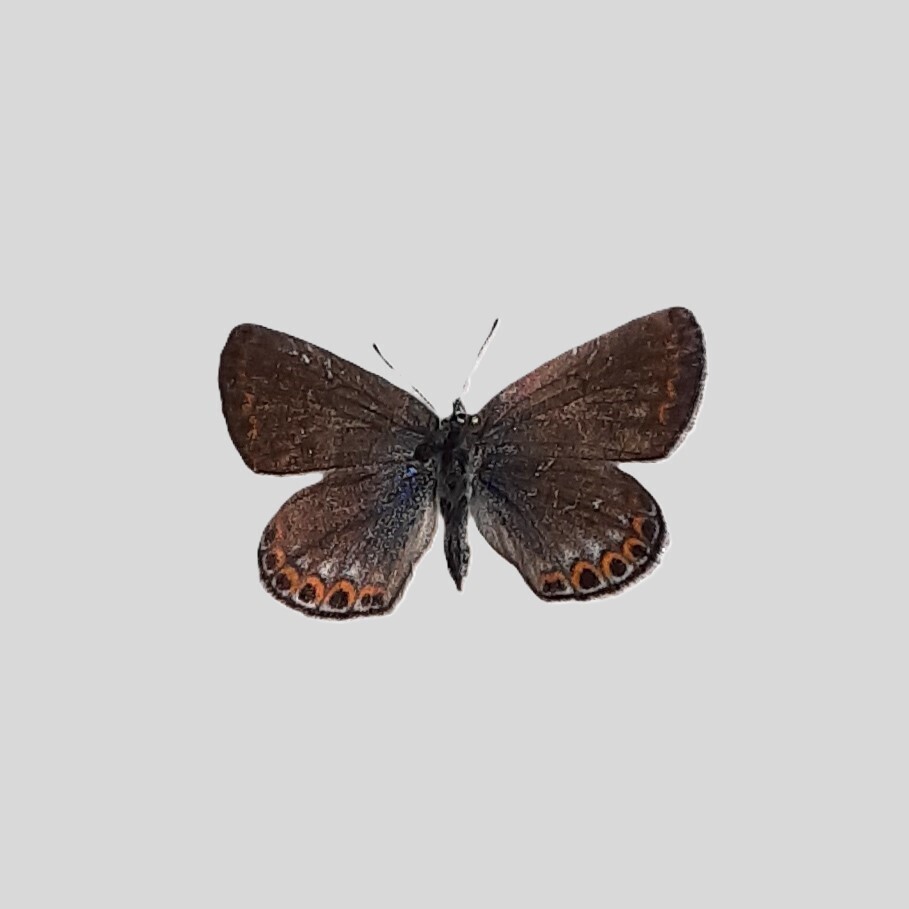
(c) Jim Dreier, some rights reserved (CC BY) · licence
Family: Lycaenidae · Class: Insecta · Order: Lepidoptera
Plebejus fridayi (Friday's Blue) is a California animal in the Lycaenidae family.
Friday's Blue is a small butterfly species endemic to California, belonging to the gossamer-winged butterfly family Lycaenidae. Adults exhibit typical lycaenid characteristics with a wingspan measuring approximately 20-25 mm (0.8-1.0 inches). Males display bright blue dorsal wing surfaces with narrow dark borders, while females show more subdued coloration with brownish-blue wings and broader dark margins. The ventral wing surfaces of both sexes are pale gray with distinctive black spots and orange marginal crescents, providing effective camouflage when perched with wings closed. The species possesses the characteristic hair-like tails on the hindwings common to many blue butterflies. Friday's Blue has an extremely limited distribution within California's eastern Sierra Nevada region. The species is known primarily from high-elevation sites in Mono County, with documented populations occurring in the vicinity of Mount Whitney and surrounding areas. This butterfly occupies one of the most restricted ranges among California's endemic lepidoptera, with its distribution closely tied to the availability of its singular host plant. The species inhabits alpine and subalpine environments at elevations ranging from approximately 2,400 to 3,400 meters (7,900 to 11,200 feet). Friday's Blues are closely associated with sites containing their caterpillar host plant, Whitney Locoweed (Astragalus whitneyi). These habitats typically consist of open, rocky slopes and meadow edges with scattered populations of the host plant. The butterfly shows strong fidelity to areas where Whitney Locoweed grows in suitable densities, often in association with other high-elevation plant communities including alpine fell-fields and subalpine scrubland. Adult Friday's Blues are active during the brief high-elevation growing season, typically emerging in late June through August depending on snowmelt and weather conditions. Males engage in territorial behavior, perching on prominent rocks or vegetation to intercept passing females. Mating occurs shortly after emergence, with females seeking out Whitney Locoweed plants for oviposition. Eggs are deposited singly on or near the host plant, where larvae develop by feeding exclusively on Astragalus whitneyi. The species likely overwinters in the larval stage, pupating the following spring as snow recedes and temperatures warm. The conservation status of Friday's Blue reflects the vulnerability associated with its highly restricted distribution and specialized habitat requirements. The species faces threats from climate change effects on high-elevation ecosystems, including altered precipitation patterns and rising temperatures that may shift suitable habitat upslope. Recreational activities in alpine areas and potential impacts to Whitney Locoweed populations represent additional concerns. The butterfly's dependence on a single host plant species with similarly limited distribution creates heightened vulnerability to environmental changes. Continued monitoring of both Friday's Blue populations and Whitney Locoweed availability remains essential for understanding the species' long-term viability in California's changing alpine environments.
Classification
Class: Insecta · Order: Lepidoptera · Family: Lycaenidae
Frequently asked questions
How is Plebejus fridayi classified?
Plebejus fridayi belongs to class Insecta, order Lepidoptera, family Lycaenidae.
What family does Plebejus fridayi belong to?
Plebejus fridayi is in the Lycaenidae family.
What is Plebejus fridayi?
Friday's Blue is a small butterfly species endemic to California, belonging to the gossamer-winged butterfly family Lycaenidae.
Is Plebejus fridayi found in California?
Yes. Plebejus fridayi is recorded in California in The California Species Project's catalogue.
Related species
Other California species in the same genus, family, or bioregion.
Data from The California Species Project — 14,000+ California species with verified data from CNPS, CDFW, USFWS, and more.