Plebejus glandon
Arctic Blue
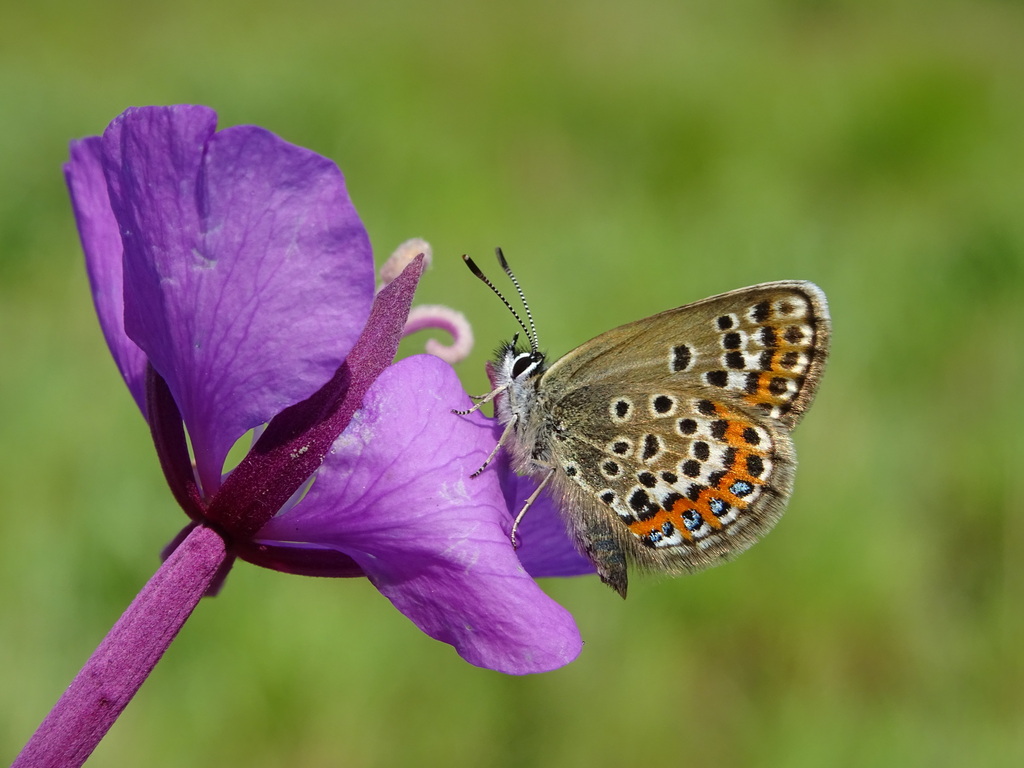
(c) Joey Bom, some rights reserved (CC BY) · licence
Family: Lycaenidae · Class: Insecta · Order: Lepidoptera
Plebejus glandon (Arctic Blue) is a California animal in the Lycaenidae family.
The Arctic Blue is a small butterfly in the family Lycaenidae, with a wingspan typically ranging from 22 to 30 mm (0.9 to 1.2 inches). Males display bright blue dorsal wing surfaces with narrow dark borders, while females are predominantly brown with blue restricted to the wing bases. The ventral wing surfaces are gray-brown with white-ringed black spots and a distinctive row of orange crescents along the hindwing margins. This species can be distinguished from related blues by its relatively small size and the specific arrangement of ventral wing markings. The Arctic Blue has a Holarctic distribution, occurring across northern regions of both North America and Eurasia. In North America, the species ranges from Alaska east to Newfoundland, extending south through western mountains to Washington, northern Arizona, and northern New Mexico. Within this range, populations are typically found at high elevations in mountainous regions and in arctic and subarctic environments. This butterfly inhabits alpine and arctic environments, including alpine meadows, ridges, slopes, and summits above timberline. The species occurs in rocky areas within the tundra zone and demonstrates a strong association with high-elevation ecosystems. In the western United States, Arctic Blues are typically found at elevations exceeding 2,400 meters (8,000 feet), where they occupy open areas with sparse vegetation and exposed rocky substrates. Arctic Blue larvae feed on plants in the primrose family (Primulaceae), including rock primrose (Androsace septrentrionalis) and sweet-flower rock-jasmine (Androsace chamaejasme) (Xerces Society 2024). In some regions of the United States, larvae also utilize plants in the saxifrage family (Saxifragaceae). Adults are active during the brief alpine summer, typically flying from late June through August depending on elevation and latitude. The species is univoltine, producing one generation per year. Males engage in territorial behavior on hilltops and ridges, where they patrol for females. Eggs are laid singly on or near host plants, and larvae develop slowly in the harsh alpine environment. The Arctic Blue has experienced significant population decline across its range. According to the Xerces Society's State of the Butterflies in the United States report, the species showed a 90.17% decline over a 20-year monitoring period, with a negative growth rate of -0.116 annually (Xerces Society 2024). This decline pattern places the Arctic Blue among the most rapidly declining butterfly species in western North America. Primary threats include climate change impacts on high-elevation habitats, as warming temperatures cause shifts in suitable habitat zones upslope. The species' specialized habitat requirements and limited dispersal ability make it particularly vulnerable to environmental changes. Additional threats may include recreational activities in alpine areas and potential impacts from atmospheric nitrogen deposition. The Arctic Blue's dependence on stable, cool alpine conditions makes it an indicator species for climate change effects on high-elevation ecosystems.
Classification
Class: Insecta · Order: Lepidoptera · Family: Lycaenidae
Frequently asked questions
How is Plebejus glandon classified?
Plebejus glandon belongs to class Insecta, order Lepidoptera, family Lycaenidae.
What family does Plebejus glandon belong to?
Plebejus glandon is in the Lycaenidae family.
What is Plebejus glandon?
The Arctic Blue is a small butterfly in the family Lycaenidae, with a wingspan typically ranging from 22 to 30 mm (0.9 to 1.2 inches).
Is Plebejus glandon found in California?
Yes. Plebejus glandon is recorded in California in The California Species Project's catalogue.
Related species
Other California species in the same genus, family, or bioregion.
Data from The California Species Project — 14,000+ California species with verified data from CNPS, CDFW, USFWS, and more.