Plebejus icarioides
Boisduval's Blue
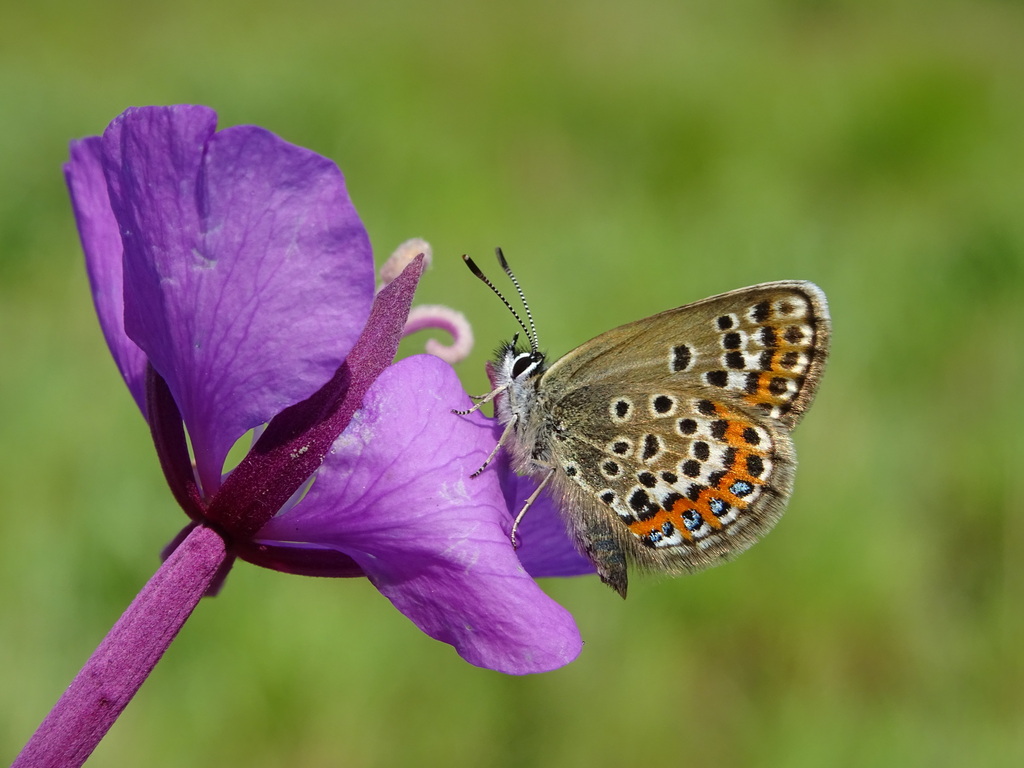
(c) Joey Bom, some rights reserved (CC BY) · licence
Family: Lycaenidae · Class: Insecta · Order: Lepidoptera
Plebejus icarioides (Boisduval's Blue) is a California animal in the Lycaenidae family.
Boisduval's Blue (Plebejus icarioides) is a small butterfly in the family Lycaenidae with distinctive sexual dimorphism in wing coloration. Males display bright blue dorsal wing surfaces with narrow black borders, while females are predominantly brown with orange marginal spots and white-ringed eyespots on the hindwings. The ventral wing surfaces of both sexes are gray-white with black spots circled in white and orange submarginal bands. Adults have a wingspan ranging from 22 to 32 mm (0.9 to 1.3 inches). The species is distinguished from similar lycaenids by the combination of blue male coloration, specific wing spot patterns, and association with lupine host plants. Boisduval's Blue occurs across western North America from British Columbia east to the western edge of the Great Plains, extending south to New Mexico, Arizona, southern California, and Baja California. In California, the species is found throughout much of the state except the Central Valley floor and southeastern deserts. Populations occur from sea level coastal areas to elevations exceeding 3,000 meters (9,800 feet) in the Sierra Nevada and other mountain ranges. The species demonstrates considerable geographic variation across its extensive range. This butterfly inhabits diverse open habitats where lupine host plants grow, including grasslands, meadows, chaparral, oak woodlands, montane forest clearings, and disturbed areas. Adults are commonly observed in areas with scattered shrubs, along roadsides, and in agricultural edges. The species shows particular affinity for areas with well-drained soils and moderate moisture levels that support robust lupine growth. Elevation tolerance varies regionally, with populations adapted to local climatic conditions. Boisduval's Blue larvae feed exclusively on various lupine species (Lupinus) in the pea family. Eggs are laid singly on lupine flower buds, leaves, or stems. First-instar larvae typically feed on flowers and developing seed pods, while later instars consume leaves and stems. The species exhibits facultative myrmecophily, with larvae tended by various ant species that receive honeydew secretions in exchange for protection from predators and parasitoids. Adults are active during daylight hours, with males engaging in territorial perching behavior on elevated perches near host plants. Females fly low among vegetation while seeking oviposition sites. The species typically produces one to three broods annually depending on elevation and local climate conditions. Flight periods extend from March through October at lower elevations, with peak activity varying by region. In montane areas, the species may be univoltine with flight periods restricted to summer months. Adults nectar on diverse flowering plants including buckwheat, asters, and other composites. Boisduval's Blue is not federally or state listed and appears relatively secure across much of its range. However, local populations face threats from habitat loss due to urban development, agricultural conversion, and altered fire regimes that affect lupine host plant communities. Invasive plant species can outcompete native lupines, reducing breeding habitat quality. Climate change may affect montane populations through shifting temperature and precipitation patterns that influence lupine distribution and phenology.
Classification
Class: Insecta · Order: Lepidoptera · Family: Lycaenidae
Frequently asked questions
How is Plebejus icarioides classified?
Plebejus icarioides belongs to class Insecta, order Lepidoptera, family Lycaenidae.
What family does Plebejus icarioides belong to?
Plebejus icarioides is in the Lycaenidae family.
What is Plebejus icarioides?
Boisduval's Blue (Plebejus icarioides) is a small butterfly in the family Lycaenidae with distinctive sexual dimorphism in wing coloration.
Is Plebejus icarioides found in California?
Yes. Plebejus icarioides is recorded in California in The California Species Project's catalogue.
Related species
Other California species in the same genus, family, or bioregion.
Data from The California Species Project — 14,000+ California species with verified data from CNPS, CDFW, USFWS, and more.