Plebejus lupini
Lupine Blue
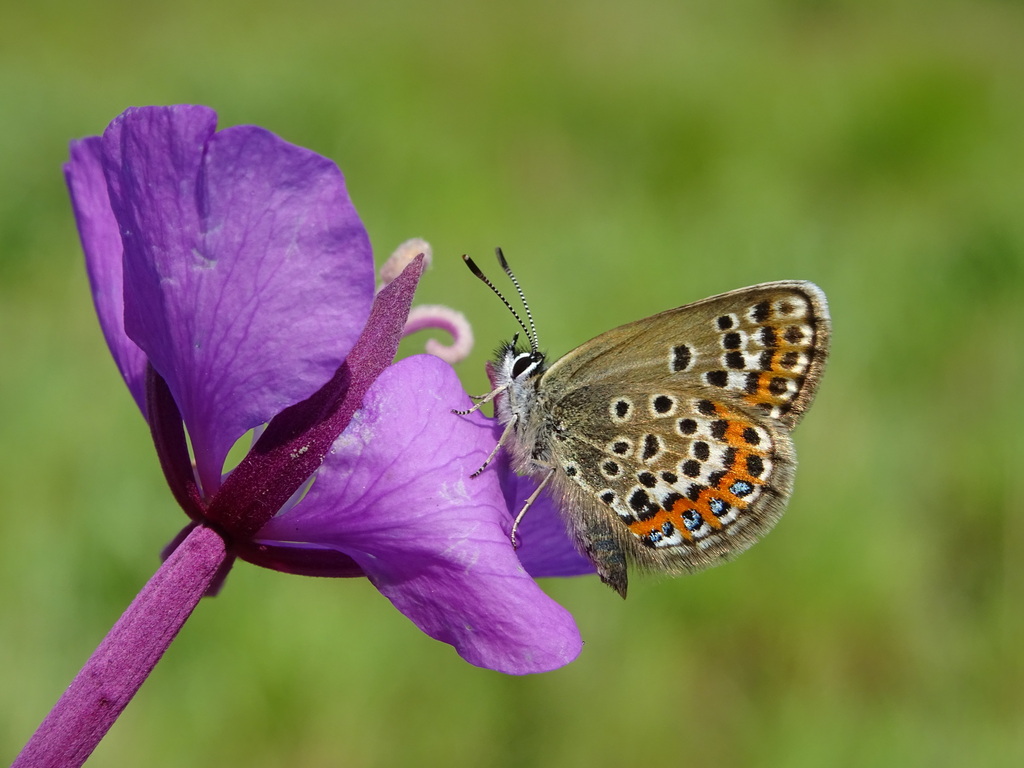
(c) Joey Bom, some rights reserved (CC BY) · licence
Family: Lycaenidae · Class: Insecta · Order: Lepidoptera
Plebejus lupini (Lupine Blue) is a California animal in the Lycaenidae family.
The Lupine Blue (Plebejus lupini) is a small butterfly in the family Lycaenidae, with forewings measuring 12 to 15 mm (0.5 to 0.6 inches) in length. Males display bright blue dorsal wing surfaces with narrow black borders, while females are typically brown or grayish-brown with orange marginal spots along the hindwing edges. The ventral wing surfaces of both sexes are pale gray to whitish with distinctive black spots circled in white, and orange submarginal bands on the hindwings. The species can be distinguished from similar blues by the presence of orange crescents on the hindwing undersides and the specific arrangement of ventral spot patterns. The Lupine Blue occurs across a broad range extending from southwestern Canada south through much of the mountainous and intermountain West and high plains to northern Mexico. In California, populations are found primarily in montane and subalpine regions of the Sierra Nevada, Cascade Range, and northern Coast Ranges. The species typically occurs at elevations between 1,200 and 3,500 meters (4,000 to 11,500 feet), though local populations may extend slightly outside this range. This butterfly inhabits open areas within coniferous forests, mountain meadows, alpine zones, and sagebrush steppes where host plants are abundant. The species requires sunny exposures with scattered shrubs and is often found on slopes, ridges, and clearings. Adults are closely associated with several species of perennial wild buckwheat including sulfur flower (Eriogonum umbellatum) and flat top (Eriogonum fasciculatum) in the buckwheat family (Polygonaceae). These host plants provide both nectar sources for adults and larval food plants. Lupine Blue adults typically emerge in a single brood from late June through August, with timing varying by elevation and latitude. Males establish territories near host plant clusters and engage in patrolling behavior to locate females. Mating occurs on or near the host plants, and females deposit single pale green eggs on flower buds or young leaves of buckwheat species. Larvae feed on flowers, developing seed heads, and occasionally leaves of the host plants. The species overwinters as a chrysalis, with pupation occurring in leaf litter or soil crevices near the host plant base. Adults feed on nectar from various flowers including their buckwheat hosts, as well as members of the aster and mint families. The Lupine Blue is not federally or state listed and appears to maintain stable populations across much of its range. However, localized populations may face pressure from habitat loss due to development, overgrazing, and altered fire regimes that affect host plant communities. Climate change may impact high-elevation populations by shifting suitable habitat zones upward. The species benefits from forest management practices that maintain open areas and diverse plant communities, and from grazing management that preserves native buckwheat populations.
Classification
Class: Insecta · Order: Lepidoptera · Family: Lycaenidae
Frequently asked questions
How is Plebejus lupini classified?
Plebejus lupini belongs to class Insecta, order Lepidoptera, family Lycaenidae.
What family does Plebejus lupini belong to?
Plebejus lupini is in the Lycaenidae family.
What is Plebejus lupini?
The Lupine Blue (Plebejus lupini) is a small butterfly in the family Lycaenidae, with forewings measuring 12 to 15 mm (0.5 to 0.6 inches) in length.
Is Plebejus lupini found in California?
Yes. Plebejus lupini is recorded in California in The California Species Project's catalogue.
Related species
Other California species in the same genus, family, or bioregion.
Data from The California Species Project — 14,000+ California species with verified data from CNPS, CDFW, USFWS, and more.