Plebejus melissa
Melissa Blue (includes Karner Blue)
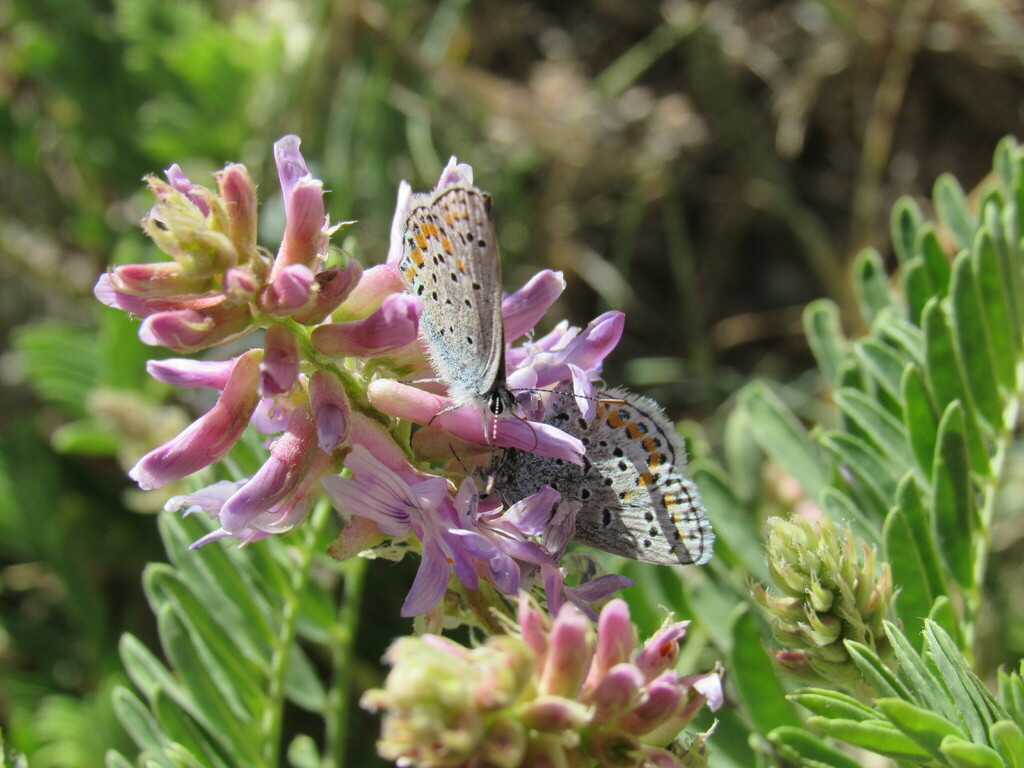
(c) Anders Hastings, some rights reserved (CC BY) · licence
Family: Lycaenidae · Class: Insecta · Order: Lepidoptera
Plebejus melissa (Melissa Blue (includes Karner Blue)) is a California animal in the Lycaenidae family.
The Melissa Blue is a small butterfly with distinct sexual dimorphism and regional variation. Males display bright blue dorsal wing surfaces with narrow black borders, while females are brownish-gray with varying amounts of blue scaling near the wing bases. Both sexes have gray-white ventral wing surfaces with distinctive black spots ringed in white, and orange submarginal spots along the hindwing borders. The wingspan ranges from 22 to 32 mm (0.9 to 1.3 inches). The eastern subspecies samuelis, commonly known as the Karner Blue, is distinguished by its slightly smaller size and more restricted host plant requirements. The species occurs in two disjunct populations across North America. The western population (subspecies melissa) ranges throughout the Intermountain West from Canada to Baja California, extending eastward across plains and prairies to northwestern Iowa and southwestern Minnesota. The eastern population (subspecies samuelis) exists in small, isolated colonies from southern New Hampshire and central New York west to Wisconsin, with the largest remaining populations in Wisconsin, Michigan, and New York. Melissa Blues inhabit open areas including prairies, meadows, pine barrens, oak savannas, and disturbed sites such as roadsides and utility corridors. The western population occurs from sea level to elevations exceeding 3,000 meters (9,800 feet) in montane environments. Eastern populations are typically found in sandy soils supporting lupine communities, often in areas maintained by periodic disturbance such as fire or mechanical management. The species exhibits complex ecological relationships with its host plants and associated organisms. In the east, larvae feed exclusively on wild lupine (Lupinus perennis), while the western population utilizes various legumes including Astragalus, Glycyrrhiza, Lotus, Lupinus, and Medicago species. Females deposit eggs singly on or near host plants. Larvae are tended by ants in a mutualistic relationship, with ants providing protection in exchange for honeydew secretions. The eastern subspecies typically produces one generation annually, flying from late May through July, while western populations may have multiple broods depending on elevation and climate. The Karner Blue (subspecies samuelis) was federally listed as endangered in 1992 due to severe population decline and habitat loss. Populations declined by over 99% from historical levels, primarily due to fire suppression, development, and agricultural conversion that eliminated lupine habitat. Recovery efforts include habitat restoration, prescribed burning, lupine seeding, and captive breeding programs. Current populations exist in fewer than 10 states, with Wisconsin supporting the largest numbers. The western subspecies melissa is not federally listed but faces localized threats from habitat conversion, overgrazing, and invasive species. Conservation strategies focus on maintaining early successional habitats and lupine populations through prescribed management activities.
Classification
Class: Insecta · Order: Lepidoptera · Family: Lycaenidae
Frequently asked questions
How is Plebejus melissa classified?
Plebejus melissa belongs to class Insecta, order Lepidoptera, family Lycaenidae.
What family does Plebejus melissa belong to?
Plebejus melissa is in the Lycaenidae family.
What is Plebejus melissa?
The Melissa Blue is a small butterfly with distinct sexual dimorphism and regional variation.
Is Plebejus melissa found in California?
Yes. Plebejus melissa is recorded in California in The California Species Project's catalogue.
Related species
Other California species in the same genus, family, or bioregion.
Data from The California Species Project — 14,000+ California species with verified data from CNPS, CDFW, USFWS, and more.