Plebejus neurona
Veined Blue
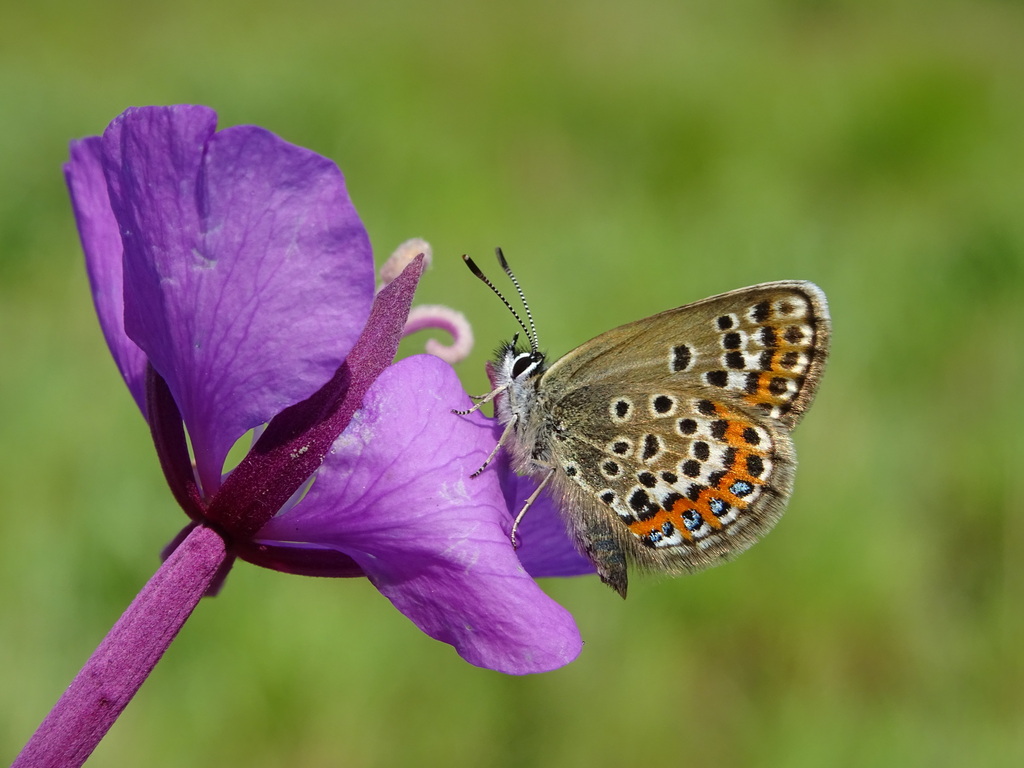
(c) Joey Bom, some rights reserved (CC BY) · licence
Family: Lycaenidae · Class: Insecta · Order: Lepidoptera
Plebejus neurona (Veined Blue) is a California animal in the Lycaenidae family.
The Veined Blue is a small butterfly in the family Lycaenidae, formerly classified as Icaricia neurona. Adults measure approximately 22 to 30 mm (0.9 to 1.2 inches) in wingspan. Males display iridescent blue dorsal wing surfaces with narrow black borders, while females are predominantly brown with blue scaling near the wing bases. The ventral wing surfaces are pale gray to white with distinctive black spots arranged in regular patterns, giving rise to the common name "veined" blue. Both sexes possess short tails on the hindwings and orange marginal spots along the hindwing edges. Plebejus neurona has an extremely limited distribution in southern California, occurring very locally in the Tehachapi Mountains and mountains of San Bernardino County. This represents one of the most restricted ranges among California's blue butterflies. Historical records suggest the species may have occurred more broadly in suitable habitat, but current populations are confined to scattered, isolated sites within these mountain ranges. The species inhabits montane chaparral and woodland communities, typically at elevations between 1,200 and 2,400 meters (4,000 to 8,000 feet). Adults are found in areas where the host plant, Wright's buckwheat (Eriogonum wrightii), grows in open, rocky slopes and canyon bottoms. This perennial shrub in the buckwheat family provides the exclusive larval food source. Habitat typically features well-drained soils with scattered oak woodland or pinyon-juniper associations. Veined Blues are univoltine, producing one generation per year. Adults emerge from late spring through early summer, typically May through July, coinciding with the blooming period of Wright's buckwheat. Females deposit eggs singly on flower buds and young leaves of the host plant. Larvae feed on flowers, developing seeds, and occasionally tender foliage. The species overwinters as pupae, with development synchronized to the host plant's phenology. Males engage in hilltopping behavior, establishing territories on prominent ridges and peaks to locate mates. Larvae maintain facultative associations with ants, particularly species in the genus Formica, which tend caterpillars in exchange for honeydew secretions. This mutualistic relationship provides protection from parasitoids and predators during the vulnerable larval stage. While not federally or state listed, the Veined Blue's extremely restricted range and specific habitat requirements make it vulnerable to habitat loss and fragmentation. Primary threats include urban development, recreational activities, fire management practices, and climate change effects on montane ecosystems. The species' dependence on a single host plant species increases vulnerability to environmental changes affecting Wright's buckwheat populations. Small population sizes and habitat isolation may limit genetic diversity and recolonization potential following local extinctions. Conservation efforts focus on habitat protection and monitoring of known populations to assess long-term viability.
Classification
Class: Insecta · Order: Lepidoptera · Family: Lycaenidae
Frequently asked questions
How is Plebejus neurona classified?
Plebejus neurona belongs to class Insecta, order Lepidoptera, family Lycaenidae.
What family does Plebejus neurona belong to?
Plebejus neurona is in the Lycaenidae family.
What is Plebejus neurona?
The Veined Blue is a small butterfly in the family Lycaenidae, formerly classified as Icaricia neurona.
Is Plebejus neurona found in California?
Yes. Plebejus neurona is recorded in California in The California Species Project's catalogue.
Related species
Other California species in the same genus, family, or bioregion.
Data from The California Species Project — 14,000+ California species with verified data from CNPS, CDFW, USFWS, and more.