Plebejus podarce
Sierra Nevada Blue
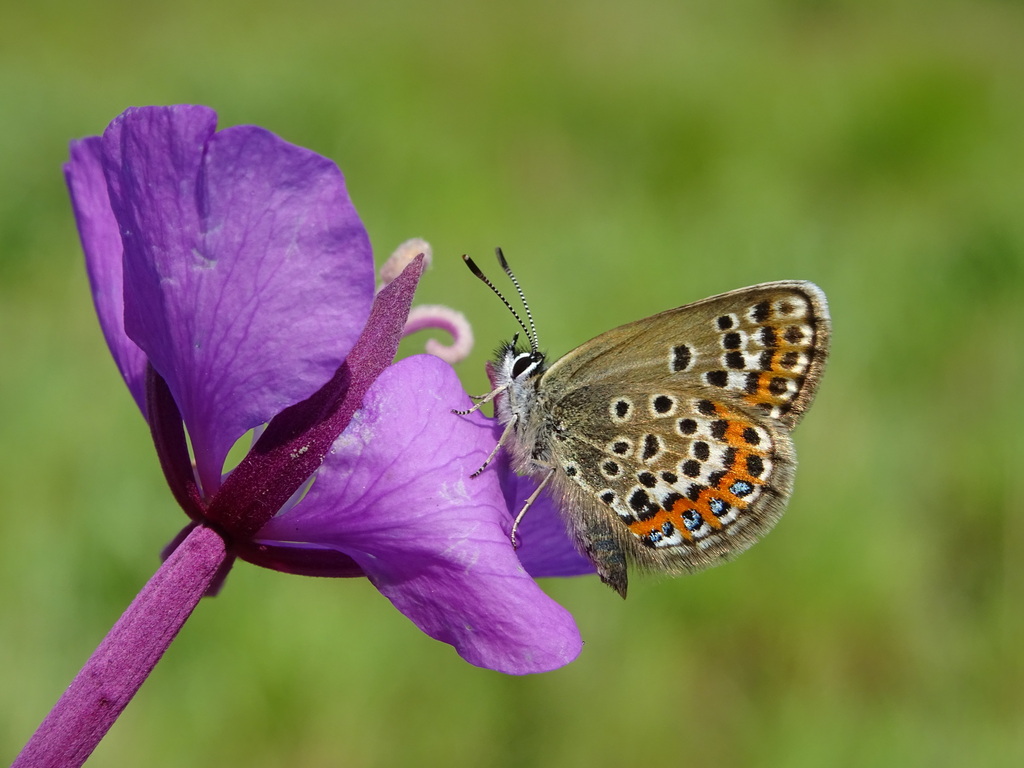
(c) Joey Bom, some rights reserved (CC BY) · licence
Family: Lycaenidae · Class: Insecta · Order: Lepidoptera
Plebejus podarce (Sierra Nevada Blue) is a California animal in the Lycaenidae family.
The Sierra Nevada Blue (Plebejus podarce) is a small butterfly endemic to montane regions of western North America. Adults have a wingspan of approximately 22 to 28 mm (0.9 to 1.1 inches). Males display iridescent blue dorsal wing surfaces with narrow black borders, while females are typically brown with varying amounts of blue scaling near the wing bases. The ventral wing surfaces of both sexes are gray to light brown with distinctive white-ringed black spots and orange submarginal crescents along the hindwing edges. The species can be distinguished from similar blues by its specific wing pattern and association with its host plant. The Sierra Nevada Blue ranges from southern Oregon southward through central California, occurring in the Klamath Range and Sierra Nevada mountain systems. In California, populations are documented from the southern Cascade Range through the Sierra Nevada, with records extending south to the central Sierra Nevada. The species typically occurs at elevations between 1,200 and 2,400 meters (4,000 to 8,000 feet), though local populations may be found outside this range depending on habitat availability and host plant distribution. This butterfly inhabits montane meadows, forest openings, and riparian areas where its host plants occur. The species is obligately associated with shooting stars (Dodecatheon species), herbaceous perennials in the primrose family that bloom in spring and early summer. Suitable habitat includes moist meadows, seeps, and streamside areas in mixed coniferous forests dominated by ponderosa pine, Douglas-fir, and white fir. The butterflies require areas with adequate moisture to support shooting star populations and nearby nectar sources for adult feeding. Sierra Nevada Blues are univoltine, producing one generation per year. Adults typically emerge from late May through July, coinciding with the blooming period of their host plants. Females deposit eggs singly on or near shooting star plants, where larvae develop by feeding on leaves and flower buds. The species overwinters as eggs or early instar larvae. Adults nectar on various wildflowers including buckwheats, composites, and other low-growing plants found in their montane habitat. Males engage in territorial behavior, perching on prominent objects to locate potential mates. The conservation status of the Sierra Nevada Blue is not well-documented, as the species lacks formal state or federal listing status. However, like many montane butterflies dependent on specific host plants and habitat conditions, populations may be vulnerable to climate change, habitat modification, and alterations in precipitation patterns that affect shooting star populations. The species' distribution in relatively intact montane ecosystems provides some protection, though localized threats may include livestock grazing, recreational activities, and hydrological changes that affect riparian and meadow habitats. Long-term monitoring would help assess population trends and habitat requirements for this specialized butterfly.
Classification
Class: Insecta · Order: Lepidoptera · Family: Lycaenidae
Frequently asked questions
How is Plebejus podarce classified?
Plebejus podarce belongs to class Insecta, order Lepidoptera, family Lycaenidae.
What family does Plebejus podarce belong to?
Plebejus podarce is in the Lycaenidae family.
What is Plebejus podarce?
The Sierra Nevada Blue (Plebejus podarce) is a small butterfly endemic to montane regions of western North America.
Is Plebejus podarce found in California?
Yes. Plebejus podarce is recorded in California in The California Species Project's catalogue.
Related species
Other California species in the same genus, family, or bioregion.
Data from The California Species Project — 14,000+ California species with verified data from CNPS, CDFW, USFWS, and more.