Plebejus saepiolus
Greenish Blue
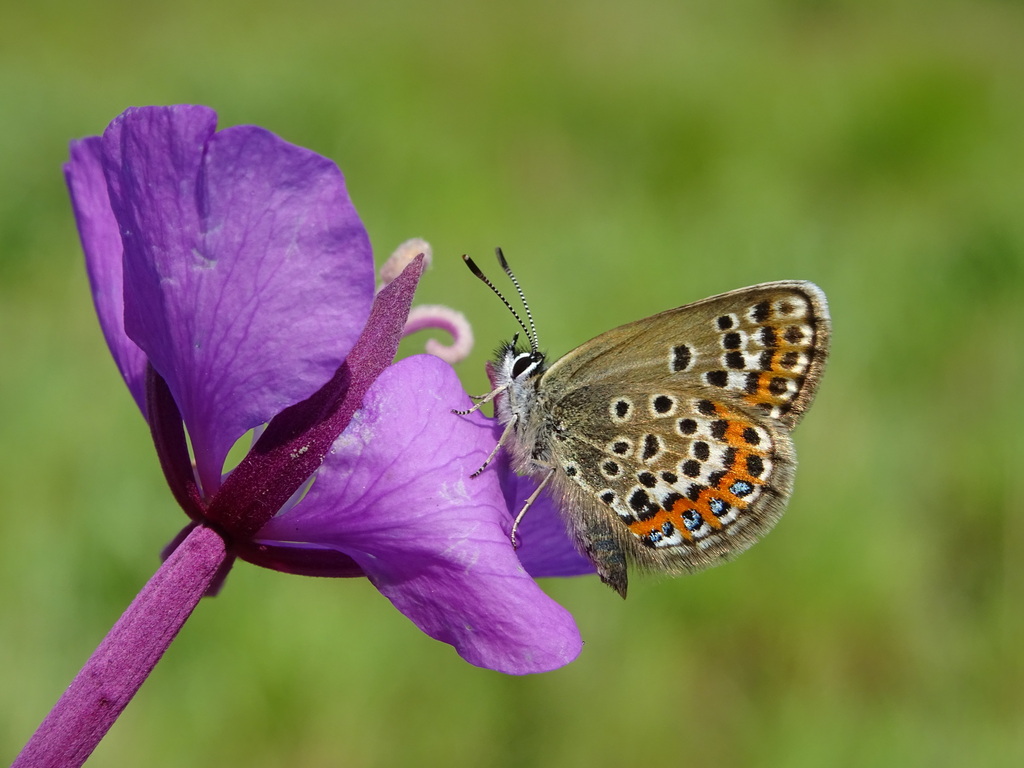
(c) Joey Bom, some rights reserved (CC BY) · licence
Family: Lycaenidae · Class: Insecta · Order: Lepidoptera
Plebejus saepiolus (Greenish Blue) is a California animal in the Lycaenidae family.
The Greenish Blue (Plebejus saepiolus) is a small butterfly in the family Lycaenidae, characterized by distinctive sexual dimorphism in wing coloration. Males display iridescent blue dorsal wing surfaces with narrow dark borders, while females typically exhibit brown or grayish-brown dorsal coloration with varying degrees of blue scaling near the wing bases. The ventral surfaces of both sexes are pale gray to whitish with prominent black spots circled in white. Wing span ranges from 18 to 28 mm (0.7 to 1.1 inches). The species can be distinguished from similar blues by the arrangement of postmedian spots on the hindwing underside and the presence of orange marginal crescents. The Greenish Blue occupies one of the most extensive ranges among North American lycaenids, distributed across boreal western North America from central Alaska south along mountainous regions to southern California and southwestern New Mexico. The range extends eastward across southern Canada and the northern Great Lakes region to Maine. In California, populations occur primarily in the Sierra Nevada, Cascade Range, and higher elevations of the Coast Ranges. The species shows considerable elevation tolerance, occurring from near sea level in northern latitudes to over 3,000 meters (9,800 feet) in montane areas. This butterfly inhabits diverse open habitats including mountain meadows, forest clearings, alpine zones, prairies, and disturbed areas such as roadsides and fields. The species demonstrates strong fidelity to areas supporting its host plants and requires habitats with adequate moisture during larval development. In mountainous regions, populations typically occur in subalpine and alpine meadows with rich wildflower communities. Greenish Blues are closely associated with various clover species, with larvae feeding primarily on flowers of alsike clover (Trifolium hybridum) and other Trifolium species. Adults are active from late spring through early fall, with flight periods varying by latitude and elevation. Northern and high-elevation populations typically have a single generation per year, while some southern populations may produce two broods annually. Mating occurs in areas with abundant host plants, where females deposit eggs singly on flower heads. Larvae feed within the developing seed pods, and the species overwinters as a mature larva or pupa depending on local conditions. The Greenish Blue currently holds no federal or state conservation status and appears to maintain stable populations across much of its range. The species' broad distribution, habitat flexibility, and association with widely distributed host plants contribute to its apparent resilience. However, local populations may face pressure from habitat conversion, particularly in developed areas of California where meadow and grassland habitats have been reduced. Climate change may affect high-elevation populations through shifts in suitable habitat zones and alterations to host plant phenology.
Classification
Class: Insecta · Order: Lepidoptera · Family: Lycaenidae
Frequently asked questions
How is Plebejus saepiolus classified?
Plebejus saepiolus belongs to class Insecta, order Lepidoptera, family Lycaenidae.
What family does Plebejus saepiolus belong to?
Plebejus saepiolus is in the Lycaenidae family.
What is Plebejus saepiolus?
The Greenish Blue (Plebejus saepiolus) is a small butterfly in the family Lycaenidae, characterized by distinctive sexual dimorphism in wing coloration.
Is Plebejus saepiolus found in California?
Yes. Plebejus saepiolus is recorded in California in The California Species Project's catalogue.
Related species
Other California species in the same genus, family, or bioregion.
Data from The California Species Project — 14,000+ California species with verified data from CNPS, CDFW, USFWS, and more.