Plebejus shasta
Shasta Blue
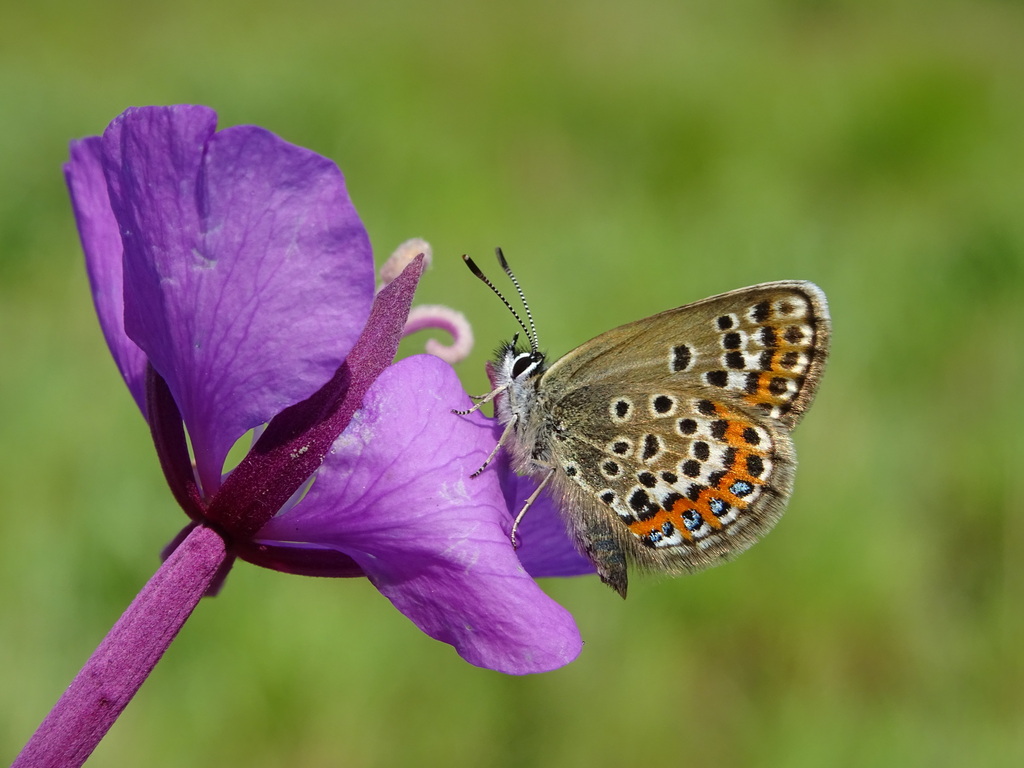
(c) Joey Bom, some rights reserved (CC BY) · licence
Family: Lycaenidae · Class: Insecta · Order: Lepidoptera
Plebejus shasta (Shasta Blue) is a California animal in the Lycaenidae family.
The Shasta blue (Plebejus shasta) is a small butterfly in the copper family Lycaenidae, characterized by its compact size and distinctive wing coloration. Adults have a wingspan of approximately 19 to 25 mm (0.75 to 1.0 inches). Males display bright blue dorsal wing surfaces with narrow black borders, while females are typically brownish-gray above with varying amounts of blue scaling near the wing bases. The ventral wing surfaces of both sexes are pale gray with small black spots outlined in white, and orange marginal spots along the hindwing edges. The species can be distinguished from similar blues by its relatively small size and specific ventral wing pattern. Plebejus shasta occurs at high elevations from Washington east to North Dakota and Nebraska, extending south to central California and Colorado. In California, the species is found in mountainous regions of the Sierra Nevada and Cascade Range, typically above 1,500 meters (4,900 feet) elevation. Populations are often localized and associated with specific habitat conditions that support their host plants. The Shasta blue inhabits alpine and subalpine meadows, mountain slopes, and forest clearings where leguminous host plants are present. The species prefers open areas with scattered shrubs and herbaceous vegetation, often in proximity to seasonal moisture sources. Elevations typically range from 1,500 to 3,000 meters (4,900 to 9,800 feet), though specific elevation limits vary by geographic location and local topographic conditions. Larvae feed exclusively on various species within the pea family (Fabaceae), including milk-vetches (Astragalus species), lupines (Lupinus species), and clovers (Trifolium species). Adult butterflies are active during the brief mountain growing season, typically from June through August depending on elevation and local conditions. Males establish territories on hilltops and ridges where they perch and patrol for females. Mating occurs during mid-summer, with females depositing eggs singly on or near host plant foliage. The species overwinters as eggs or early instar larvae, with development resuming the following spring when host plants begin active growth. The Shasta blue appears to have a single generation per year, adapted to the short growing seasons characteristic of high-elevation environments. Adults nectar on various wildflowers, including members of the Asteraceae, Scrophulariaceae, and other families that bloom during the alpine summer. Plebejus shasta is not currently listed under federal or California state endangered species legislation. However, like many high-elevation specialists, populations may be vulnerable to climate change effects that alter alpine and subalpine habitats. Potential threats include habitat modification from recreational activities, grazing pressure on host plants, and upward shifts in vegetation zones due to warming temperatures. The species' dependence on specific host plants and high-elevation habitats makes it sensitive to environmental changes that affect these specialized ecosystems.
Classification
Class: Insecta · Order: Lepidoptera · Family: Lycaenidae
Frequently asked questions
How is Plebejus shasta classified?
Plebejus shasta belongs to class Insecta, order Lepidoptera, family Lycaenidae.
What family does Plebejus shasta belong to?
Plebejus shasta is in the Lycaenidae family.
What is Plebejus shasta?
The Shasta blue (Plebejus shasta) is a small butterfly in the copper family Lycaenidae, characterized by its compact size and distinctive wing coloration.
Is Plebejus shasta found in California?
Yes. Plebejus shasta is recorded in California in The California Species Project's catalogue.
Related species
Other California species in the same genus, family, or bioregion.
Data from The California Species Project — 14,000+ California species with verified data from CNPS, CDFW, USFWS, and more.