Plegadis chihi
White-faced Ibis
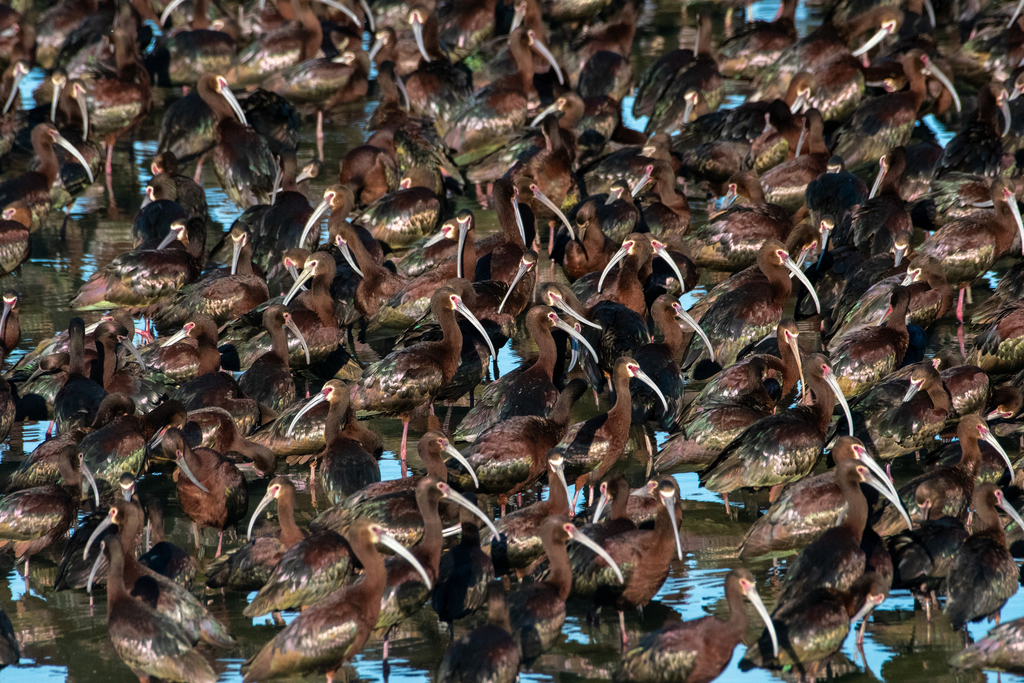
(c) Jonathan Eisen, some rights reserved (CC BY) · licence
Family: Threskiornithidae · Class: Aves · Order: Pelecaniformes
Conservation status: WL · G5 S3S4
Plegadis chihi (White-faced Ibis) is a California animal in the Threskiornithidae family.
The White-faced Ibis is a medium-sized wading bird measuring 46 to 56 cm (18 to 22 inches) in length with a wingspan of 80 to 100 cm (31 to 39 inches). Adults weigh between 485 to 970 grams (1.1 to 2.1 pounds). During breeding season, adults display dark reddish-brown to bronze-colored plumage with iridescent green and purple sheens on the wings and back. The distinguishing white facial border extends from the base of the bill around the eye to the chin, bordered by a thin red line. The long, decurved bill is dark gray to black, and legs range from gray to reddish. Non-breeding adults lose the white facial markings and appear uniformly dark brown. Juveniles resemble non-breeding adults but with less iridescent coloration. Historically, White-faced Ibis bred throughout much of the western United States, including California's Central Valley and intermountain regions. The species experienced significant population declines and range contractions during the mid-20th century due to habitat loss and pesticide use. Current breeding populations in California are concentrated in the Central Valley, particularly in the San Joaquin Valley, with smaller populations in the Sacramento Valley, northeastern California, and scattered locations in the Sierra Nevada foothills. The species also occurs in coastal areas during migration and winter months. White-faced Ibis inhabit freshwater and brackish wetlands including marshes, flooded agricultural fields, shallow ponds, and irrigation canals. They prefer areas with water depths of 5 to 25 cm (2 to 10 inches) for foraging. Breeding habitat consists of emergent vegetation such as cattails, bulrush, and sedges in permanent or semi-permanent wetlands. Nesting colonies are typically established in dense stands of emergent vegetation over water. The species utilizes both natural wetlands and managed habitats including rice fields, which provide important foraging areas during the breeding season. White-faced Ibis are highly social, forming large feeding flocks and breeding colonies that may contain hundreds of pairs. They forage by probing soft substrates with their sensitive bills to locate prey items including aquatic invertebrates, small fish, frogs, crayfish, and insects. The breeding season extends from April through August, with peak nesting occurring in May and June. Females construct platform nests of marsh vegetation and lay 3 to 4 pale blue to blue-green eggs. Incubation lasts 21 to 22 days, and young fledge after 28 to 35 days. Both parents participate in nest building, incubation, and chick rearing. The White-faced Ibis is designated as a Watch List species by the California Department of Fish and Wildlife, reflecting concerns about population stability and habitat availability. The species has shown population recovery since the 1970s following restrictions on DDT use, but remains vulnerable to wetland habitat loss, water management practices, and drought conditions. Climate change poses additional challenges through altered precipitation patterns and wetland hydrology. Conservation efforts focus on wetland restoration, protection of breeding colonies, and maintaining water supplies for managed wetlands and agricultural habitats that support foraging populations.
Classification
Class: Aves · Order: Pelecaniformes · Family: Threskiornithidae
Conservation status
WL · G5 S3S4
Frequently asked questions
How is Plegadis chihi classified?
Plegadis chihi belongs to class Aves, order Pelecaniformes, family Threskiornithidae.
What family does Plegadis chihi belong to?
Plegadis chihi is in the Threskiornithidae family.
Is Plegadis chihi protected or of conservation concern?
Plegadis chihi carries the following status: WL · G5 S3S4.
What is Plegadis chihi?
The White-faced Ibis is a medium-sized wading bird measuring 46 to 56 cm (18 to 22 inches) in length with a wingspan of 80 to 100 cm (31 to 39 inches).
Is Plegadis chihi found in California?
Yes. Plegadis chihi is recorded in California in The California Species Project's catalogue.
Related species
Other California species in the same genus, family, or bioregion.
Data from The California Species Project — 14,000+ California species with verified data from CNPS, CDFW, USFWS, and more.