Plestiodon gilberti
Gilbert's Skink
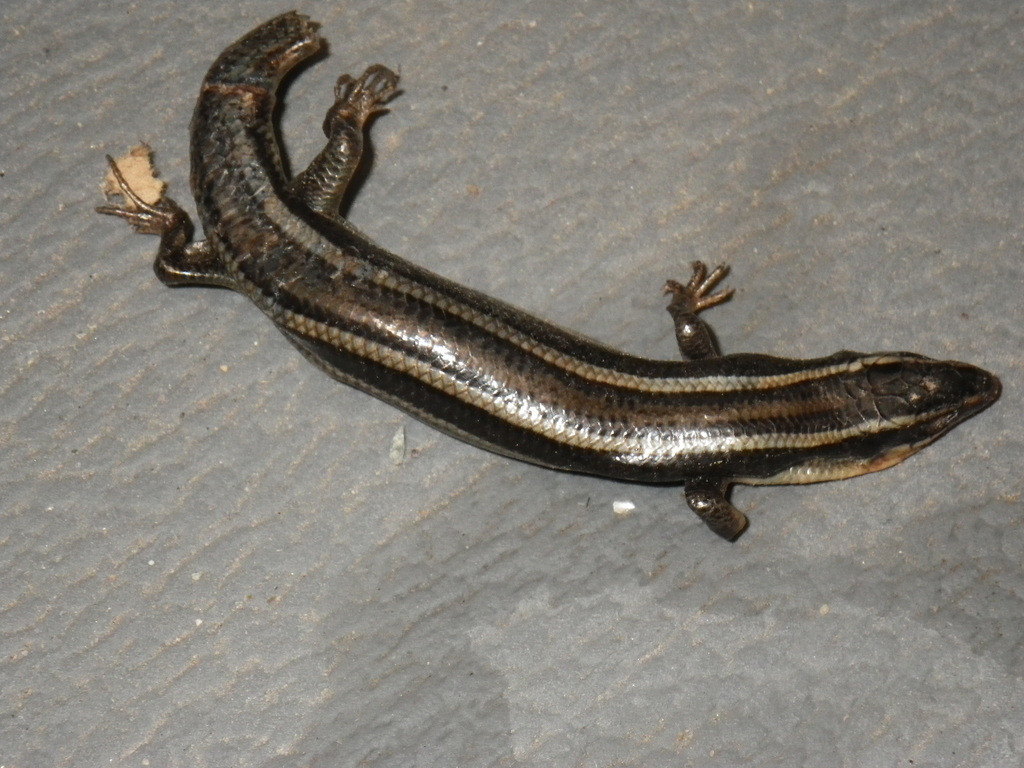
(c) Dominic, some rights reserved (CC BY) · licence
Family: Scincidae · Class: Reptilia · Order: Squamata
Plestiodon gilberti (Gilbert's Skink) is a California animal in the Scincidae family.
Gilbert's Skink is a medium-sized lizard species native to western North America, including California. Adults typically measure 16 to 21 centimeters (6.3 to 8.3 inches) in total length, with the tail comprising approximately 60% of the body length. The species exhibits sexual dimorphism and ontogenetic color changes. Juveniles display distinctive bright blue tails with dark longitudinal stripes running along the body and a bronze or golden head coloration. Adult females retain some striping but develop more subdued coloration, while breeding males lose most striping and develop enlarged heads with reddish-orange coloration on the throat and jaw region during the breeding season. Gilbert's Skink occurs throughout much of California, with populations documented in the Coast Ranges, Sierra Nevada foothills, Transverse Ranges, and Peninsular Ranges. The species extends from sea level to elevations of approximately 1,220 meters (4,000 feet). In California, populations are found from the Oregon border south through the Central Valley margins and coastal regions to Baja California. The species also occurs in Nevada, Arizona, and northwestern Mexico. This skink inhabits a variety of habitats including oak woodlands, chaparral, grasslands, and riparian areas. The species shows a preference for areas with abundant ground cover such as fallen logs, rock piles, leaf litter, and dense vegetation. Gilbert's Skink is commonly found under bark, in rotting logs, beneath rocks, and within brush piles. The species adapts well to disturbed habitats and can occur in suburban areas with suitable microhabitats. Gilbert's Skink is primarily insectivorous, feeding on a variety of arthropods including beetles, spiders, crickets, termites, and fly larvae. The species is diurnal and heliothermic, actively foraging during daylight hours and basking to regulate body temperature. Activity patterns vary seasonally, with peak activity occurring during spring and fall months. During winter, individuals enter brumation in underground retreats or beneath deep cover. Mating occurs in spring, typically from April through June. Females lay clutches of 2 to 6 eggs in underground nests or beneath cover objects, with incubation lasting approximately 50 to 60 days. Hatchlings emerge in late summer or early fall. Gilbert's Skink is not federally listed and appears to maintain stable populations throughout most of its California range. The species demonstrates adaptability to habitat modification and can persist in fragmented landscapes. However, localized populations may face pressure from habitat loss due to urban development, particularly in coastal and foothill regions. Fire management practices that remove ground cover and downed woody debris can temporarily reduce suitable microhabitats. The species benefits from maintaining diverse vegetation structure and preserving natural debris accumulations in managed landscapes.
Classification
Class: Reptilia · Order: Squamata · Family: Scincidae
Frequently asked questions
How is Plestiodon gilberti classified?
Plestiodon gilberti belongs to class Reptilia, order Squamata, family Scincidae.
What family does Plestiodon gilberti belong to?
Plestiodon gilberti is in the Scincidae family.
What is Plestiodon gilberti?
Gilbert's Skink is a medium-sized lizard species native to western North America, including California.
Is Plestiodon gilberti found in California?
Yes. Plestiodon gilberti is recorded in California in The California Species Project's catalogue.
Related species
Other California species in the same genus, family, or bioregion.
Data from The California Species Project — 14,000+ California species with verified data from CNPS, CDFW, USFWS, and more.