Plestiodon skiltonianus
Western Skink
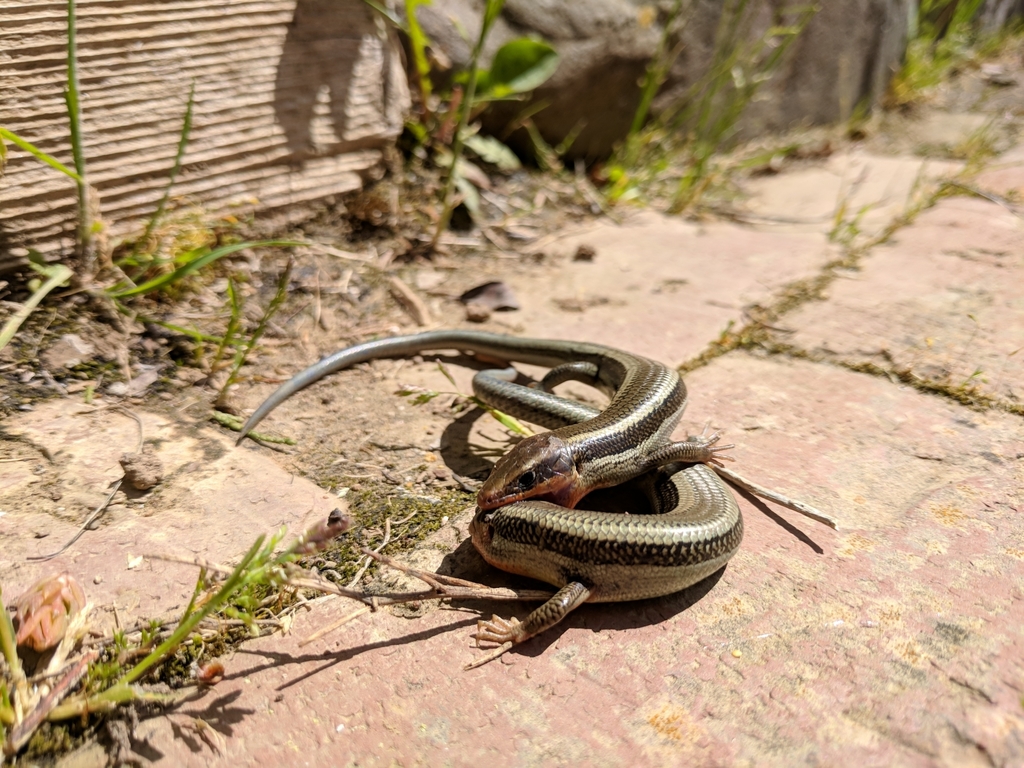
no rights reserved · CC0
Family: Scincidae · Class: Reptilia · Order: Squamata
Plestiodon skiltonianus (Western Skink) is a California animal in the Scincidae family.
The Western Skink is a medium-sized lizard measuring 16 to 21 cm (6.3 to 8.3 inches) in total length, with the tail comprising approximately 60% of the body length. Adults display distinctive longitudinal stripes running from head to tail: two light stripes bordered by darker bands along the dorsal surface, with the central stripe often appearing golden or yellowish. The sides are typically brown to gray, and the underside is cream to pale yellow. Juveniles exhibit bright blue tails that fade to gray or brown with age. Males develop orange or reddish coloration on the head and neck during breeding season. The body is covered in smooth, overlapping scales that give the skink a glossy appearance. The Western Skink ranges along the Pacific Coast from southern British Columbia to Baja California, extending inland to the eastern slopes of the Cascade Range and Sierra Nevada. In California, populations occur from sea level to elevations of 2,100 meters (6,890 feet), inhabiting coastal areas, foothills, and montane regions throughout much of the state except the Central Valley and southeastern deserts. The species is found in numerous counties including Alameda, Contra Costa, Marin, Napa, San Francisco, San Mateo, Santa Clara, Santa Cruz, Sonoma, and extending north through Mendocino, Humboldt, and Del Norte counties. This species inhabits diverse environments including grasslands, oak woodlands, chaparral, mixed conifer forests, and riparian areas. Western Skinks prefer areas with abundant ground cover such as fallen logs, rock piles, leaf litter, and dense vegetation. They are commonly found under rocks, logs, and debris, as well as in woodpiles and around human structures. The species shows a preference for areas with both sunny basking sites and nearby shelter for thermoregulation. Western Skinks are primarily insectivorous, feeding on beetles, caterpillars, crickets, spiders, and other small arthropods. They are active hunters that forage by day, using their keen eyesight to locate prey. The species exhibits typical skink defensive behavior, including tail autotomy when threatened—the detached tail continues to move, potentially distracting predators while the lizard escapes. Breeding occurs in spring, with females laying clutches of 2 to 6 eggs in moist soil or decaying vegetation. Eggs incubate for approximately 55 to 65 days, and females may remain with their eggs during incubation. Juveniles reach sexual maturity at 2 to 3 years of age. The Western Skink currently has no federal or state conservation listing and appears to maintain stable populations throughout most of its range in California. However, local populations may face pressure from habitat loss due to urban development, particularly in coastal and foothill regions. Fire suppression practices that eliminate natural burn cycles may reduce suitable habitat by allowing vegetation to become too dense. Climate change could affect the species through altered precipitation patterns and increased temperatures at higher elevations.
Classification
Class: Reptilia · Order: Squamata · Family: Scincidae
Frequently asked questions
How is Plestiodon skiltonianus classified?
Plestiodon skiltonianus belongs to class Reptilia, order Squamata, family Scincidae.
What family does Plestiodon skiltonianus belong to?
Plestiodon skiltonianus is in the Scincidae family.
What is Plestiodon skiltonianus?
The Western Skink is a medium-sized lizard measuring 16 to 21 cm (6.3 to 8.3 inches) in total length, with the tail comprising approximately 60% of the body length.
Is Plestiodon skiltonianus found in California?
Yes. Plestiodon skiltonianus is recorded in California in The California Species Project's catalogue.
Related species
Other California species in the same genus, family, or bioregion.
Data from The California Species Project — 14,000+ California species with verified data from CNPS, CDFW, USFWS, and more.