Plestiodon skiltonianus interparietalis
Coronado Skink
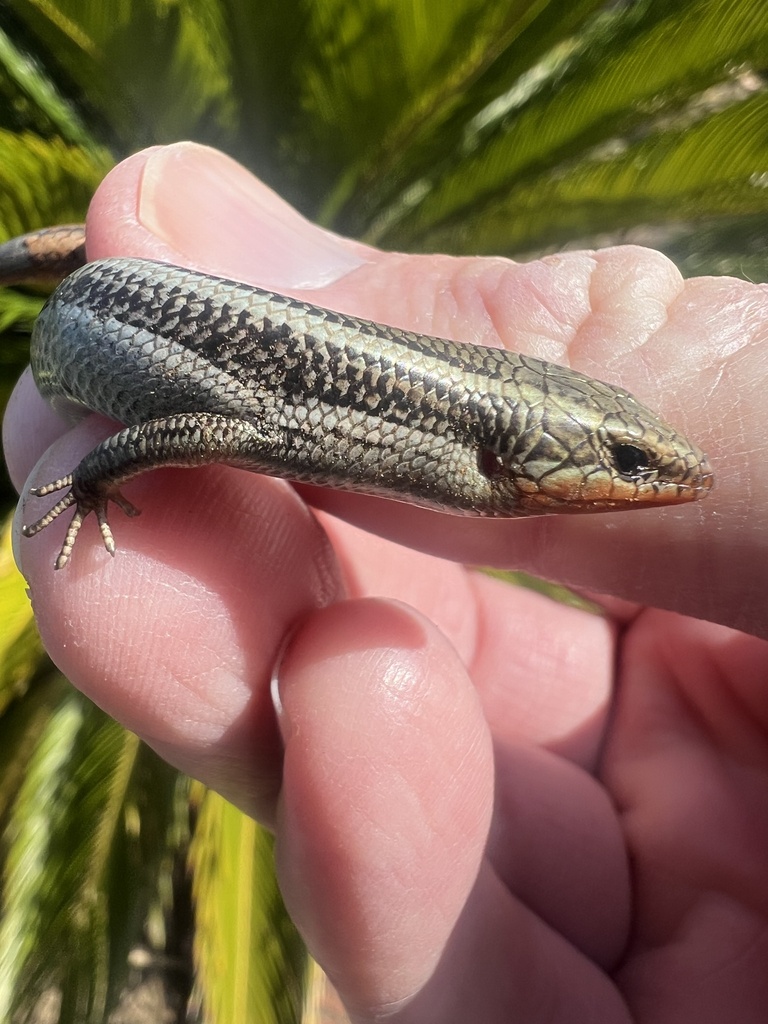
(c) kclarksdnhmorg, some rights reserved (CC BY) · licence
Family: Scincidae · Class: Reptilia · Order: Squamata
Conservation status: G5T5 S2S3
Plestiodon skiltonianus interparietalis (Coronado Skink) is a California animal in the Scincidae family.
The Coronado skink is a small subspecies of the western skink, measuring approximately 2 to 3 inches in body length, reaching up to 7.5 inches including the tail. This slender lizard exhibits a small head with a thick neck, small legs, and smooth, shiny scales characteristic of the skink family. Adults display olive to brown coloration with dark markings on the back that begin as distinct dark stripes in juveniles and fade with age. Young skinks are distinguished by prominent light and dark longitudinal stripes and a bright reddish or pink tail. During breeding season, males develop red coloration on the throat. The Coronado skink occurs in southwestern California, primarily in San Diego County and extending into Baja California, Mexico. This subspecies has a relatively restricted range compared to other western skink populations, with documented occurrences including the Coronado Islands. The species' distribution appears to be centered in the coastal and near-coastal regions of extreme southwestern California. This subspecies inhabits chaparral, cismontane woodland, and pinyon-juniper woodland communities. According to habitat assessments, Coronado skinks prefer early successional stages or open areas within these vegetation types. They are typically found in rocky areas close to streams and on dry hillsides, often seeking shelter underneath rocks, logs, and other surface debris. The species shows a preference for areas with adequate moisture nearby, distinguishing its habitat requirements from more xeric-adapted relatives. Coronado skinks are diurnal but secretive, making them uncommonly observed despite their presence in suitable habitat. They feed on a variety of small arthropods including ants and other insects, as well as slugs, snails, and worms. Females lay eggs from May through July, with eggs hatching in late summer and early fall. The species exhibits typical skink behavior of rapid movement when disturbed and extensive use of cover objects for thermoregulation and predator avoidance. Currently, the Coronado skink holds a NatureServe global ranking of G5T5, indicating it is secure as a subspecies, though specific population data are limited. The subspecies is not listed under federal or California endangered species acts as of December 2025. However, habitat assessments in some areas indicate only marginal suitable habitat remains, suggesting potential localized conservation concerns. Primary threats likely include habitat fragmentation and loss due to urbanization in coastal southern California, though comprehensive threat assessments have not been documented. The restricted range of this subspecies makes it potentially vulnerable to localized impacts, despite its current stable conservation status. Continued monitoring of populations and habitat quality would benefit long-term conservation planning for this geographically limited taxon.
Classification
Class: Reptilia · Order: Squamata · Family: Scincidae
Conservation status
G5T5 S2S3
Frequently asked questions
How is Plestiodon skiltonianus interparietalis classified?
Plestiodon skiltonianus interparietalis belongs to class Reptilia, order Squamata, family Scincidae.
What family does Plestiodon skiltonianus interparietalis belong to?
Plestiodon skiltonianus interparietalis is in the Scincidae family.
Is Plestiodon skiltonianus interparietalis protected or of conservation concern?
Plestiodon skiltonianus interparietalis carries the following status: G5T5 S2S3.
What is Plestiodon skiltonianus interparietalis?
The Coronado skink is a small subspecies of the western skink, measuring approximately 2 to 3 inches in body length, reaching up to 7.5 inches including the tail.
Is Plestiodon skiltonianus interparietalis found in California?
Yes. Plestiodon skiltonianus interparietalis is recorded in California in The California Species Project's catalogue.
Related species
Other California species in the same genus, family, or bioregion.
Data from The California Species Project — 14,000+ California species with verified data from CNPS, CDFW, USFWS, and more.