Plethodon asupak
Scott Bar salamander
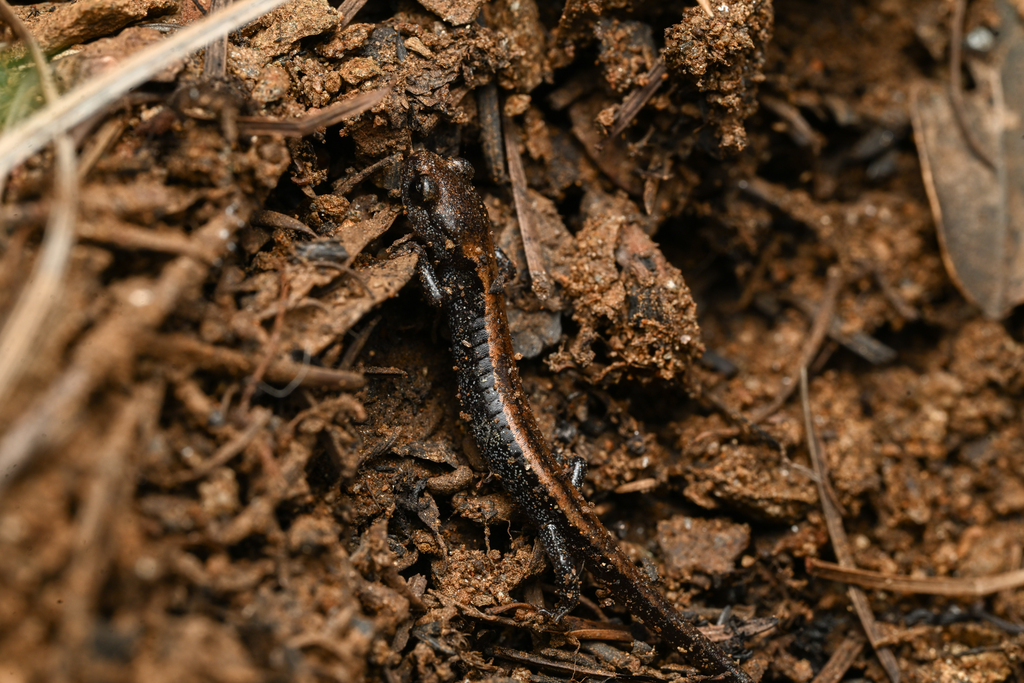
(c) Trevor Van Loon, some rights reserved (CC BY) · licence
Family: Plethodontidae · Class: Amphibia · Order: Caudata
Conservation status: ST · G2G3 S3
Plethodon asupak (Scott Bar salamander) is a California animal in the Plethodontidae family.
The Scott Bar salamander (Plethodon asupak) is a small terrestrial salamander endemic to the Klamath Mountains of northern California. Adults typically measure 90 to 120 mm (3.5 to 4.7 inches) in total length, with approximately half of this length consisting of the tail. The species exhibits a slender build characteristic of the genus Plethodon, with a slightly flattened head and prominent costal grooves along the sides of the body. Dorsal coloration ranges from dark brown to nearly black, often with lighter brown or reddish-brown mottling. The ventral surface is typically lighter, ranging from gray to pale brown with darker flecking. Historically, the Scott Bar salamander was considered a subspecies of the Siskiyou Mountains salamander (Plethodon stormi) but recent genetic and morphological analyses support its recognition as a distinct species. The species occurs in a highly restricted range within the Scott Bar area of Siskiyou County, California, along the Scott River drainage. This range encompasses elevations from approximately 610 to 1,520 meters (2,000 to 5,000 feet) in the Klamath Mountains physiographic province. Scott Bar salamanders inhabit mixed coniferous forests dominated by Douglas fir, sugar pine, and incense cedar, with an understory of madrone, canyon live oak, and various shrub species. The species requires areas with abundant coarse woody debris, rock outcrops, and talus slopes that provide shelter and maintain adequate moisture levels. They are typically found under logs, rocks, and bark, particularly in areas with north-facing slopes that retain moisture during dry periods. The species shows a strong association with areas containing fractured bedrock and permanent seepage zones. As lungless salamanders, Scott Bar salamanders respire entirely through their skin and must maintain constant moisture to prevent desiccation. They are primarily nocturnal and surface during periods of high humidity, particularly after rainfall. The species feeds on small invertebrates including springtails, mites, small beetles, and other arthropods found in the forest floor litter. Reproduction occurs through internal fertilization, with females depositing clusters of 8 to 15 eggs in moist underground chambers during late spring or early summer. Development is entirely terrestrial, with young emerging as miniature adults after approximately 3 to 4 months. The Scott Bar salamander was listed as threatened under the California Endangered Species Act as a sub-population of the Siskiyou Mountains salamander. According to CDFW, this protection was established due to the species' extremely limited range and vulnerability to habitat disturbance. Primary threats include timber harvest practices that remove canopy cover and coarse woody debris, road construction and maintenance activities, and climate change effects including increased temperature and altered precipitation patterns. The species' dependence on specific microhabitat conditions and limited dispersal ability make it particularly vulnerable to habitat fragmentation and degradation.
Classification
Class: Amphibia · Order: Caudata · Family: Plethodontidae
Conservation status
ST · G2G3 S3
Frequently asked questions
How is Plethodon asupak classified?
Plethodon asupak belongs to class Amphibia, order Caudata, family Plethodontidae.
What family does Plethodon asupak belong to?
Plethodon asupak is in the Plethodontidae family.
Is Plethodon asupak protected or of conservation concern?
Plethodon asupak carries the following status: ST · G2G3 S3.
What is Plethodon asupak?
The Scott Bar salamander (Plethodon asupak) is a small terrestrial salamander endemic to the Klamath Mountains of northern California.
Is Plethodon asupak found in California?
Yes. Plethodon asupak is recorded in California in The California Species Project's catalogue.
Related species
Other California species in the same genus, family, or bioregion.
Data from The California Species Project — 14,000+ California species with verified data from CNPS, CDFW, USFWS, and more.