Plethodon elongatus
Del Norte Salamander
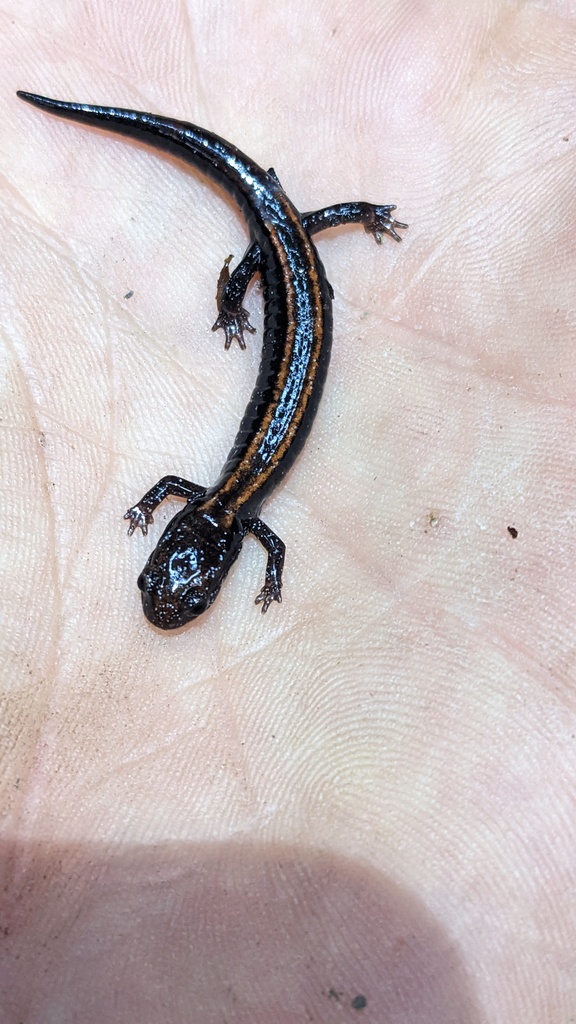
(c) Trevor Van Loon, some rights reserved (CC BY) · licence
Family: Plethodontidae · Class: Amphibia · Order: Caudata
Conservation status: WL · G4 S3
Plethodon elongatus (Del Norte Salamander) is a California animal in the Plethodontidae family.
The Del Norte salamander (Plethodon elongatus) is a lungless salamander endemic to the Pacific Northwest coastal regions of California and Oregon. Adults measure 90 to 140 mm (3.5 to 5.5 inches) in total length, with a slender, elongated body and relatively long tail comprising approximately 55% of the total length. The dorsal coloration ranges from dark brown to black, often with reddish-brown or tan undertones. A distinctive lighter-colored stripe may extend along the back, though this feature varies among individuals. The ventral surface is typically dark with small white or yellowish flecks. Males can be distinguished from females by their mental gland and enlarged premaxillary teeth during breeding season. The Del Norte salamander occurs along the Pacific coast from Del Norte and Humboldt counties in northwestern California north through southwestern Oregon to approximately Coos County. The species' range extends inland up to 40 kilometers (25 miles) from the coast, typically at elevations below 760 meters (2,500 feet). In California, populations are documented in coastal redwood forests and mixed coniferous forests within the fog belt influence zone. This species inhabits old-growth and mature second-growth coniferous forests, particularly those dominated by coast redwood (Sequoia sempervirens) and Douglas fir (Pseudotsuga menziesii). Del Norte salamanders require cool, moist microhabitats with abundant woody debris, including fallen logs, bark crevices, and rock talus. They are frequently found beneath the bark of dead or dying trees, in rotting logs, and among root systems. The species shows strong associations with areas having continuous canopy cover that maintains stable temperature and humidity conditions. Del Norte salamanders are nocturnal and largely arboreal, spending much of their time in the forest canopy. They are active on the surface during periods of high humidity, typically emerging on foggy or rainy nights to forage. The species feeds on small invertebrates including springtails, beetles, spiders, and mites. Reproduction is entirely terrestrial, with females depositing 6 to 12 unpigmented eggs in moist cavities within logs or beneath bark during late spring or early summer. Eggs develop directly without an aquatic larval stage, hatching after approximately 3 to 4 months. Juveniles resemble adults but are smaller and may have more prominent dorsal striping. The Del Norte salamander is currently designated as a Watch List species (WL) by California and receives a state ranking of S3 (vulnerable), indicating moderate risk of extirpation. The global ranking of G4 suggests the species is apparently secure rangewide, though California populations face greater threats. Primary conservation concerns include habitat loss from timber harvesting, particularly clear-cutting practices that eliminate the cool, moist microhabitats essential for survival. Climate change poses additional threats through altered precipitation patterns and increased temperatures that may reduce coastal fog frequency. Fire suppression practices that alter forest structure and the introduction of invasive species also present ongoing challenges to population stability.
Classification
Class: Amphibia · Order: Caudata · Family: Plethodontidae
Conservation status
WL · G4 S3
Frequently asked questions
How is Plethodon elongatus classified?
Plethodon elongatus belongs to class Amphibia, order Caudata, family Plethodontidae.
What family does Plethodon elongatus belong to?
Plethodon elongatus is in the Plethodontidae family.
Is Plethodon elongatus protected or of conservation concern?
Plethodon elongatus carries the following status: WL · G4 S3.
What is Plethodon elongatus?
The Del Norte salamander (Plethodon elongatus) is a lungless salamander endemic to the Pacific Northwest coastal regions of California and Oregon.
Is Plethodon elongatus found in California?
Yes. Plethodon elongatus is recorded in California in The California Species Project's catalogue.
Related species
Other California species in the same genus, family, or bioregion.
Data from The California Species Project — 14,000+ California species with verified data from CNPS, CDFW, USFWS, and more.