Plodia interpunctella
Indian-Meal Moth
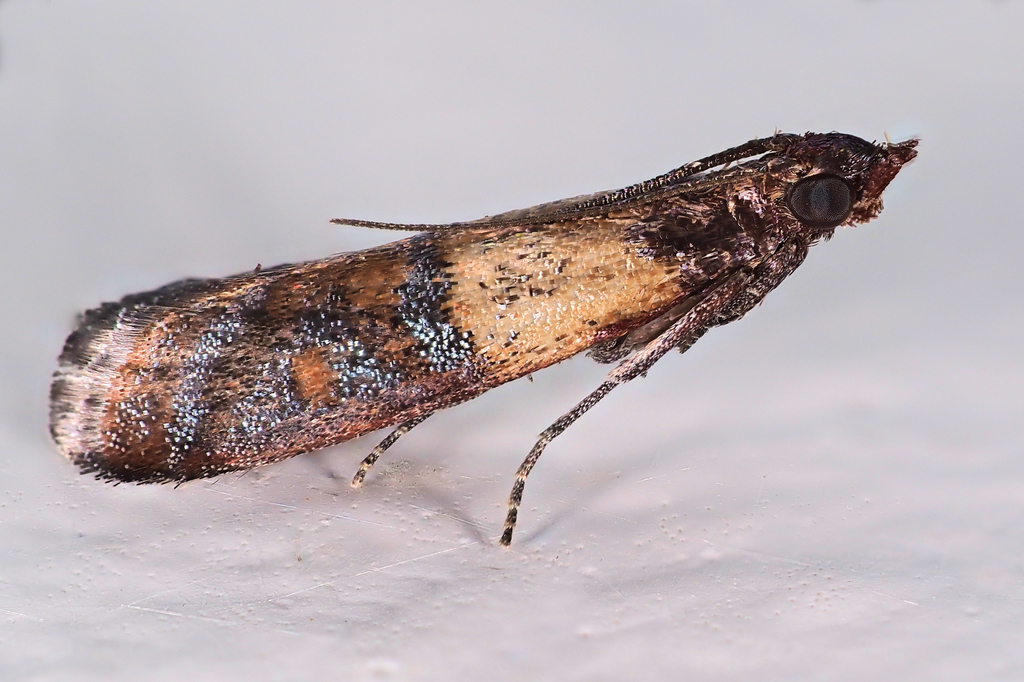
(c) Gilles San Martin, some rights reserved (CC BY-SA) · licence
Family: Pyralidae · Class: Insecta · Order: Lepidoptera
Plodia interpunctella (Indian-Meal Moth) is a California animal in the Pyralidae family.
The Indian meal moth is a small pyralid moth with distinctive wing coloration that makes it readily identifiable. Adults measure 16-20 mm in wingspan, with forewings displaying a characteristic two-toned pattern: the basal two-thirds are pale yellow to tan, while the outer third is reddish-brown to copper-colored with a metallic sheen. The hindwings are uniformly pale gray to whitish. Larvae are cream-colored to pinkish caterpillars reaching 12-17 mm in length, with brown head capsules and small dark spots along their bodies. Originally native to South America, the Indian meal moth now occurs worldwide due to human transport of corn meal and other grain products. The species has become cosmopolitan through global trade, establishing populations on all continents except Antarctica. In California, the moth is found throughout the state wherever suitable food sources exist, from coastal regions to inland valleys, typically in association with stored grain facilities, food processing plants, and residential pantries. The Indian meal moth inhabits environments containing stored grain products, dried fruits, nuts, seeds, and processed foods. The species thrives in warehouses, mills, grocery stores, and homes where cereals, flour, pet food, birdseed, and similar materials are stored. Larvae develop within food packages and can penetrate surprisingly small openings in packaging materials. The moth tolerates a wide range of temperatures but develops most rapidly at 25-30°C (77-86°F) with relative humidity between 60-90%. Adults are primarily nocturnal and attracted to lights. Females lay 100-400 eggs directly on or near food sources, with eggs hatching in 2-14 days depending on temperature. Larvae feed within food materials for 2-41 weeks, creating silk webbing that binds food particles together into characteristic clumps. The species completes 4-6 generations annually in heated buildings, with development time varying from 25 days to several months based on temperature and food quality. Pupation occurs in cocoons spun in crevices or on food surfaces. Adults live 10-14 days, during which time mating and egg-laying occur. As a cosmopolitan stored product pest, the Indian meal moth requires no conservation measures and is not listed under any protective status. The species causes significant economic damage to stored food products globally, with infestations resulting in contamination through larval feeding, silk webbing, and frass production. Control measures include sanitation, temperature management, pheromone traps, and targeted pesticide applications in commercial facilities (BugGuide 2025). The moth's ability to develop resistance to fumigants and its capacity to exploit diverse food sources ensure its continued success as a pantry pest species.
Classification
Class: Insecta · Order: Lepidoptera · Family: Pyralidae
Frequently asked questions
How is Plodia interpunctella classified?
Plodia interpunctella belongs to class Insecta, order Lepidoptera, family Pyralidae.
What family does Plodia interpunctella belong to?
Plodia interpunctella is in the Pyralidae family.
What is Plodia interpunctella?
The Indian meal moth is a small pyralid moth with distinctive wing coloration that makes it readily identifiable.
Is Plodia interpunctella found in California?
Yes. Plodia interpunctella is recorded in California in The California Species Project's catalogue.
Related species
Other California species in the same genus, family, or bioregion.
Data from The California Species Project — 14,000+ California species with verified data from CNPS, CDFW, USFWS, and more.