Pluvialis dominica
American Golden-Plover
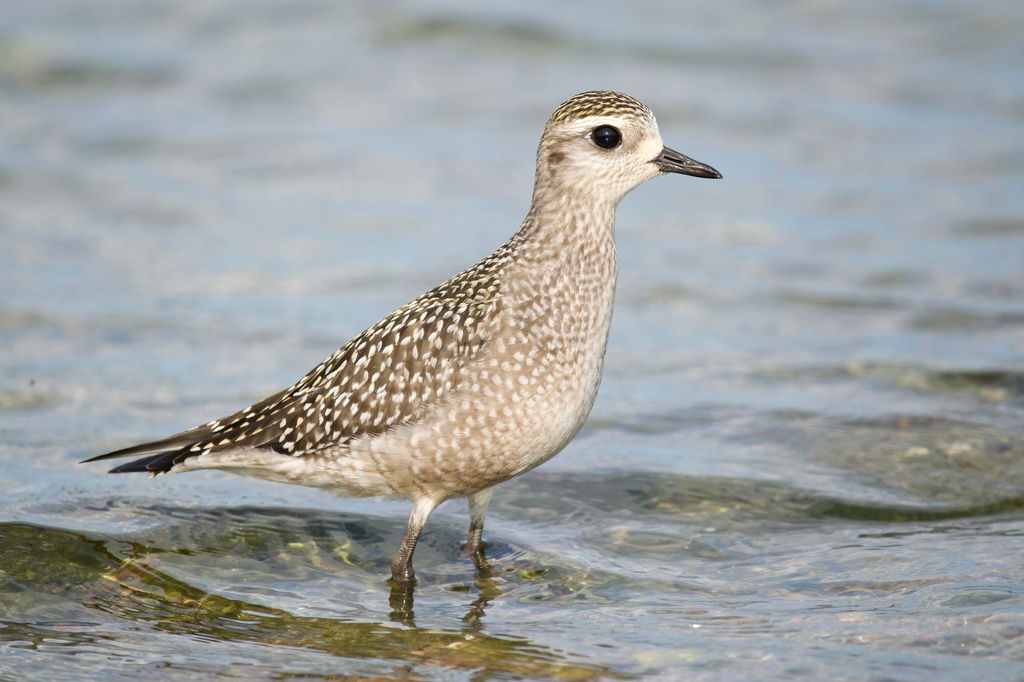
(c) Owen Strickland, some rights reserved (CC BY) · licence
Family: Charadriidae · Class: Aves · Order: Charadriiformes
Pluvialis dominica (American Golden-Plover) is a California animal in the Charadriidae family.
The American Golden-Plover is a medium-sized shorebird measuring 24 to 28 centimeters (9.4 to 11.0 inches) in length with a wingspan of 65 to 67 centimeters (25.6 to 26.4 inches). Adults weigh between 118 and 194 grams (4.2 to 6.8 ounces). During breeding season, the species displays distinctive plumage with golden-brown upperparts heavily spangled with black and white spots, creating a mottled appearance. The face, throat, and underparts are solid black, bordered by a prominent white stripe that extends from the forehead over the eye and down the sides of the neck and breast. Non-breeding adults show more subdued coloration with grayish-brown upperparts and whitish underparts with darker streaking. The bill is relatively short and straight, measuring 20 to 24 millimeters, and the legs are dark gray to black. The American Golden-Plover breeds across the Arctic tundra from Alaska to Baffin Island and migrates through the Great Plains to wintering grounds in South America. In California, the species occurs as an uncommon to rare migrant, primarily during fall migration from August through November, with peak numbers in September and October. Spring migration through California is less frequent, typically occurring from March through May. The species has been recorded throughout the state but is most regular in suitable habitat along the coast and in the Central Valley. During migration, American Golden-Plovers utilize short-grass habitats including agricultural fields, pastures, golf courses, airports, and mudflats. The species shows particular preference for recently harvested agricultural areas, burned grasslands, and other open areas with sparse, short vegetation. In coastal areas, they may use sandy beaches, mudflats, and salt pond margins. The species typically forages in areas where vegetation height is less than 10 centimeters. American Golden-Plovers are primarily insectivorous, feeding on beetles, fly larvae, caterpillars, and other invertebrates during the breeding season. During migration and winter, their diet expands to include berries, seeds, and small crustaceans. The species employs a run-stop-peck foraging strategy, making short runs followed by sudden stops to capture prey. They are often observed in loose flocks during migration, sometimes mixing with other shorebird species such as Black-bellied Plovers and various sandpipers. The American Golden-Plover is not federally listed and is considered a species of low conservation concern. According to the North American Bird Conservation Initiative, the species has a continental population estimated at 200,000 to 290,000 individuals as of 2019. However, like many Arctic-breeding shorebirds, the species faces potential threats from climate change affecting tundra breeding habitat, agricultural intensification along migration routes, and habitat loss in wintering areas. The species' extensive migration route, covering up to 40,000 kilometers annually, makes it vulnerable to cumulative impacts across multiple countries and continents.
Classification
Class: Aves · Order: Charadriiformes · Family: Charadriidae
Frequently asked questions
How is Pluvialis dominica classified?
Pluvialis dominica belongs to class Aves, order Charadriiformes, family Charadriidae.
What family does Pluvialis dominica belong to?
Pluvialis dominica is in the Charadriidae family.
What is Pluvialis dominica?
The American Golden-Plover is a medium-sized shorebird measuring 24 to 28 centimeters (9.4 to 11.0 inches) in length with a wingspan of 65 to 67 centimeters (25.6 to 26.4 inches).
Is Pluvialis dominica found in California?
Yes. Pluvialis dominica is recorded in California in The California Species Project's catalogue.
Related species
Other California species in the same genus, family, or bioregion.
Data from The California Species Project — 14,000+ California species with verified data from CNPS, CDFW, USFWS, and more.