Pluvialis fulva
Pacific Golden-Plover
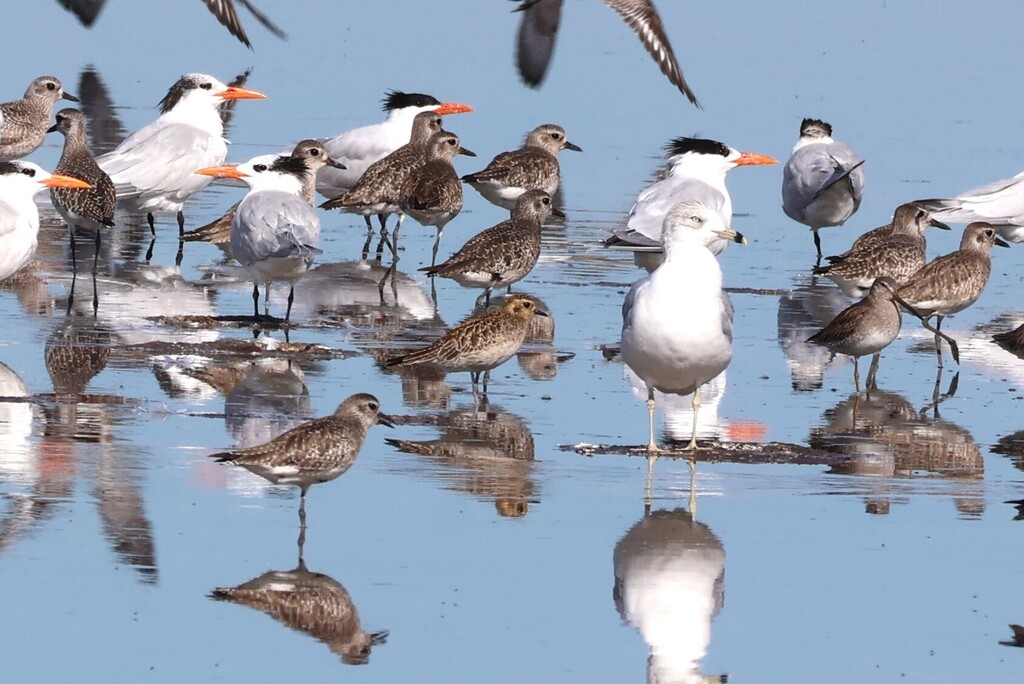
(c) Millie Basden, some rights reserved (CC BY) · licence
Family: Charadriidae · Class: Aves · Order: Charadriiformes
Pluvialis fulva (Pacific Golden-Plover) is a California animal in the Charadriidae family.
The Pacific Golden-Plover is a medium-sized shorebird measuring 23 to 26 centimeters (9 to 10 inches) in length with a wingspan of 60 to 67 centimeters (24 to 26 inches). Adults weigh between 118 to 213 grams (4.2 to 7.5 ounces). During breeding season, adults display distinctive golden-spangled upperparts with black underparts separated by a bold white stripe extending from the forehead, over the eye, and down the neck to the flanks. The face, throat, and breast are black, contrasting sharply with the white stripe. In non-breeding plumage, the species appears more subdued with grayish-brown upperparts retaining golden speckles and pale underparts with darker streaking on the breast. The bill is black and relatively short, measuring 22 to 25 millimeters, while the legs are dark gray to black. The Pacific Golden-Plover breeds across the tundra of Alaska and eastern Siberia, with the majority of the North American population nesting on the western and northern coastal plains of Alaska. During migration and winter, the species occurs throughout the Pacific Basin, including Hawaii, where it is a common winter resident, and along the Pacific coast from British Columbia to California. In California, Pacific Golden-Plovers are regular but uncommon migrants and winter visitors, primarily occurring along the coast from September through April. They are most frequently observed in the San Francisco Bay Area, Central Valley, and Southern California coastal regions. Pacific Golden-Plovers inhabit a variety of open habitats during different seasons. On breeding grounds, they prefer arctic and subarctic tundra with low vegetation, often near water. During migration and winter, they utilize mudflats, beaches, short grasslands, agricultural fields, golf courses, and airports. In California, they are commonly found on mudflats around San Francisco Bay, coastal beaches, flooded agricultural fields in the Central Valley, and maintained grass areas near airports. The species feeds primarily on invertebrates including marine worms, crustaceans, mollusks, and insects, supplemented by berries during the breeding season. Pacific Golden-Plovers employ a characteristic stop-and-go foraging technique, running rapidly then stopping abruptly to capture prey. Breeding occurs from May through July, with females typically laying four eggs in a simple ground scrape lined with vegetation. Both parents incubate eggs for 26 to 27 days and care for the precocial young. The Pacific Golden-Plover is not federally or state listed and maintains stable populations across most of its range. According to Partners in Flight, the global breeding population is estimated at 200,000 individuals. The species demonstrates extensive long-distance migration capabilities, with some individuals traveling over 4,000 kilometers non-stop between Alaska and Hawaii. While not currently threatened, the species faces potential challenges from habitat loss on wintering grounds, climate change effects on arctic breeding areas, and disturbance at roost sites. Coastal development and agricultural intensification in wintering areas represent ongoing concerns for population maintenance.
Classification
Class: Aves · Order: Charadriiformes · Family: Charadriidae
Frequently asked questions
How is Pluvialis fulva classified?
Pluvialis fulva belongs to class Aves, order Charadriiformes, family Charadriidae.
What family does Pluvialis fulva belong to?
Pluvialis fulva is in the Charadriidae family.
What is Pluvialis fulva?
The Pacific Golden-Plover is a medium-sized shorebird measuring 23 to 26 centimeters (9 to 10 inches) in length with a wingspan of 60 to 67 centimeters (24 to 26 inches).
Is Pluvialis fulva found in California?
Yes. Pluvialis fulva is recorded in California in The California Species Project's catalogue.
Related species
Other California species in the same genus, family, or bioregion.
Data from The California Species Project — 14,000+ California species with verified data from CNPS, CDFW, USFWS, and more.