Pluvialis squatarola
Black-bellied Plover
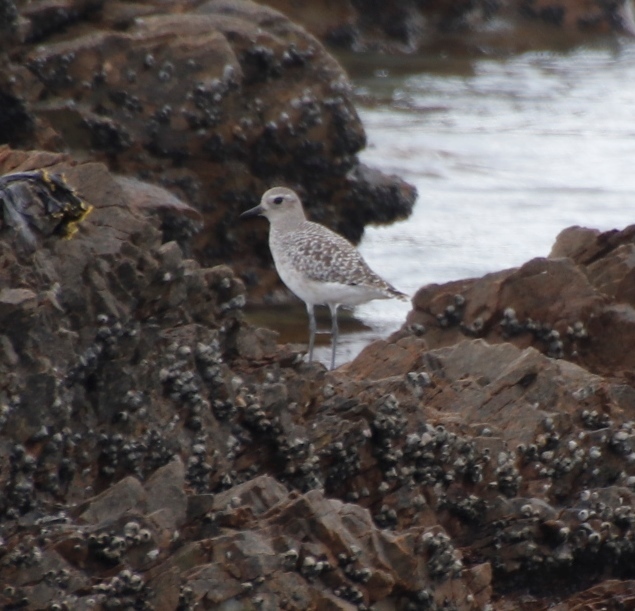
(c) Tony Rebelo, some rights reserved (CC BY-SA) · licence
Family: Charadriidae · Class: Aves · Order: Charadriiformes
Pluvialis squatarola (Black-bellied Plover) is a California animal in the Charadriidae family.
The Black-bellied Plover is a large, stocky shorebird and the largest member of the plover family in North America. Adults measure 27 to 30 cm (10.6 to 11.8 inches) in length with a wingspan of 71 to 83 cm (28 to 33 inches), weighing 190 to 280 grams. During breeding season, males display distinctive black underparts from throat to belly, contrasting sharply with white undertail coverts. The back and wings show a mottled pattern of black, white, and gray. A white stripe extends from the forehead over the crown to the nape. In non-breeding plumage, birds appear predominantly gray-brown above with whitish underparts and subtle streaking on the breast and neck. The bill is short, straight, and black, while the legs are black to dark gray. In flight, the species shows distinctive black axillary feathers (wingpits) and a white rump patch. Black-bellied Plovers breed in Arctic tundra across northern Alaska, northern Canada, and northern Siberia. The species winters along both Atlantic and Pacific coasts of North America, from southern Alaska to Central America on the Pacific side, and from Maritime Canada to northern South America on the Atlantic coast. In California, Black-bellied Plovers are common winter residents and migrants along the entire coastline, occurring regularly in San Francisco Bay, Monterey Bay, Humboldt Bay, and other estuarine systems. They are present from August through May, with peak numbers during fall and spring migration. This species inhabits coastal mudflats, sandy beaches, salt marshes, and shallow lagoons during winter and migration. They prefer areas with extensive intertidal zones that provide rich feeding opportunities. During breeding season, they occupy dry, elevated tundra with sparse vegetation, often selecting sites near water bodies. The species typically forages in areas where the receding tide exposes invertebrate prey. Black-bellied Plovers are visual hunters, using a characteristic run-stop-probe foraging technique. They feed primarily on marine worms, mollusks, crustaceans, and other invertebrates found in intertidal sediments. The species is known for its wariness and serves as a sentinel for mixed shorebird flocks, often being the first to detect and alert others to approaching threats. Breeding occurs from June to August in Arctic regions, with females laying 3 to 4 olive-buff eggs with dark markings in a simple scrape lined with vegetation. Incubation lasts 26 to 27 days, with both parents sharing duties. The Black-bellied Plover is not federally or state listed and maintains stable global populations. According to the North American Bird Conservation Initiative, the species shows stable population trends across its range as of 2022. However, like many shorebirds, it faces threats from coastal development, sea level rise, and disturbance at critical stopover and wintering sites. Climate change poses additional challenges by altering Arctic breeding habitats and shifting prey availability in coastal areas. The species benefits from protected coastal areas and wetland conservation efforts throughout its range.
Classification
Class: Aves · Order: Charadriiformes · Family: Charadriidae
Frequently asked questions
How is Pluvialis squatarola classified?
Pluvialis squatarola belongs to class Aves, order Charadriiformes, family Charadriidae.
What family does Pluvialis squatarola belong to?
Pluvialis squatarola is in the Charadriidae family.
What is Pluvialis squatarola?
The Black-bellied Plover is a large, stocky shorebird and the largest member of the plover family in North America.
Is Pluvialis squatarola found in California?
Yes. Pluvialis squatarola is recorded in California in The California Species Project's catalogue.
Related species
Other California species in the same genus, family, or bioregion.
Data from The California Species Project — 14,000+ California species with verified data from CNPS, CDFW, USFWS, and more.