Podiceps auritus
Horned Grebe
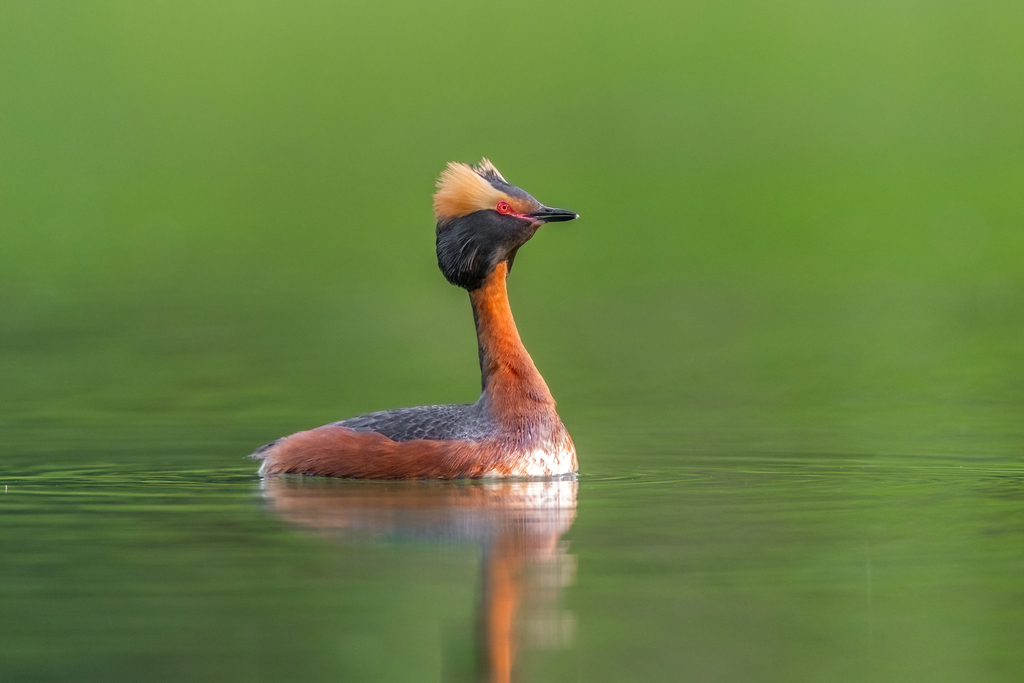
(c) egorbirder, some rights reserved (CC BY) · licence
Family: Podicipedidae · Class: Aves · Order: Podicipediformes
Podiceps auritus (Horned Grebe) is a California animal in the Podicipedidae family.
The Horned Grebe is a small, compact waterbird measuring 31 to 38 centimeters (12 to 15 inches) in length with a wingspan of 46 to 55 centimeters (18 to 22 inches). During breeding season, adults display distinctive golden-yellow ear tufts or "horns" extending from behind the eyes, along with a black head and neck, chestnut flanks, and a dark back. The bill is straight and pointed, dark with a pale tip. In winter plumage, the species becomes more subdued with a black cap extending to eye level, white cheeks and throat, and grayish upperparts. Both sexes appear similar, though males average slightly larger. The feet are positioned far back on the body with lobed toes adapted for swimming and diving. The Horned Grebe breeds across northern North America from Alaska through central Canada and marginally into the northern United States. In California, the species occurs primarily as a winter resident and migrant along the coast and in interior valleys. Winter populations concentrate in San Francisco Bay, Monterey Bay, and coastal lagoons from Humboldt County south to San Diego County. Smaller numbers winter on inland lakes and reservoirs throughout the Central Valley and southern California. The species is uncommon to fairly common from October through April, with peak abundance typically occurring from December through February. During winter in California, Horned Grebes inhabit saltwater bays, estuaries, coastal lagoons, and protected nearshore marine waters. They also utilize freshwater lakes, reservoirs, and large ponds, particularly those with abundant fish populations. The species shows preference for waters 1 to 20 meters deep with good visibility for hunting. Breeding habitat consists of shallow freshwater marshes, prairie potholes, and lake margins with emergent vegetation, though this habitat type is not present in California. Horned Grebes are excellent divers, pursuing prey underwater using their feet for propulsion while wings remain folded. Their diet consists primarily of small fish, aquatic insects, crustaceans, and occasionally amphibians and mollusks. In marine environments, they consume small schooling fish such as anchovies and sardines. Breeding occurs from May through August on northern breeding grounds, with pairs constructing floating nests anchored to emergent vegetation. Females typically lay 3 to 8 bluish-white eggs, with both parents sharing incubation duties for 22 to 25 days. Young are capable of swimming immediately after hatching but remain dependent on parents for several weeks. The Horned Grebe is not federally or state listed in California and maintains stable populations across most of its range. However, the species faces localized threats including habitat loss from development around coastal bays and inland water bodies, disturbance from recreational activities, and potential impacts from climate change affecting prey availability. Oil spills pose periodic risks to wintering populations in marine environments. According to Christmas Bird Count data, California winter populations have remained relatively stable over recent decades, though some coastal sites show declining trends. The species benefits from protection of wetland habitats and marine sanctuaries throughout its California range.
Classification
Class: Aves · Order: Podicipediformes · Family: Podicipedidae
Frequently asked questions
How is Podiceps auritus classified?
Podiceps auritus belongs to class Aves, order Podicipediformes, family Podicipedidae.
What family does Podiceps auritus belong to?
Podiceps auritus is in the Podicipedidae family.
What is Podiceps auritus?
The Horned Grebe is a small, compact waterbird measuring 31 to 38 centimeters (12 to 15 inches) in length with a wingspan of 46 to 55 centimeters (18 to 22 inches).
Is Podiceps auritus found in California?
Yes. Podiceps auritus is recorded in California in The California Species Project's catalogue.
Related species
Other California species in the same genus, family, or bioregion.
Data from The California Species Project — 14,000+ California species with verified data from CNPS, CDFW, USFWS, and more.