Podiceps grisegena
Red-necked Grebe
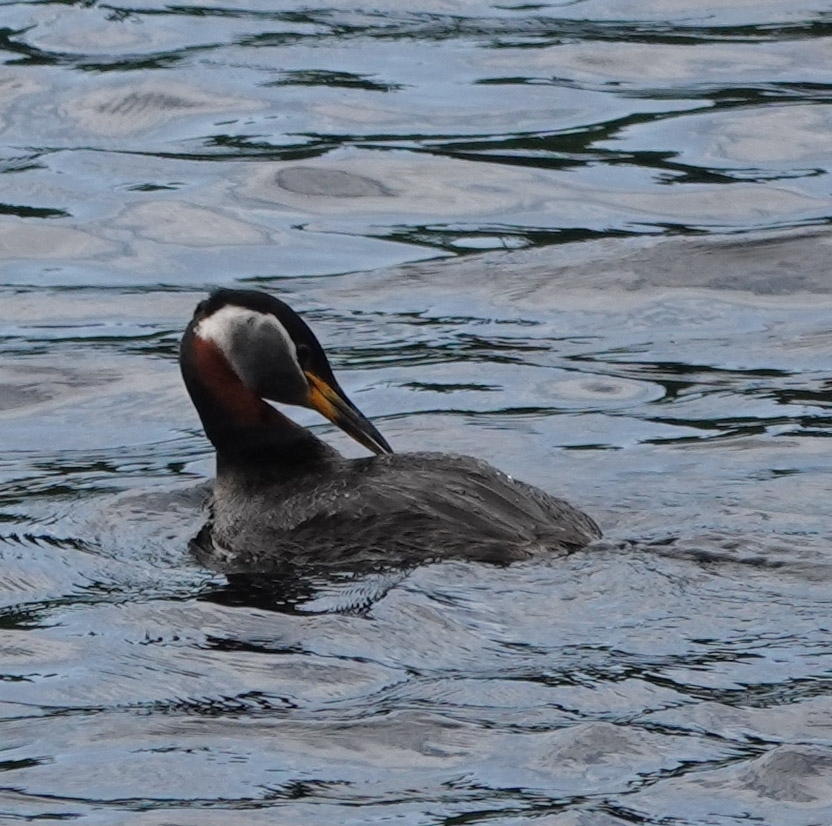
(c) Roman Titov, some rights reserved (CC BY) · licence
Family: Podicipedidae · Class: Aves · Order: Podicipediformes
Podiceps grisegena (Red-necked Grebe) is a California animal in the Podicipedidae family.
The Red-necked Grebe is a medium-sized waterbird measuring 40 to 56 cm (16 to 22 inches) in length with a wingspan of 77 to 85 cm (30 to 33 inches). Adults weigh between 692 to 1,650 grams (1.5 to 3.6 pounds). During breeding season, adults display distinctive rufous-red neck and throat plumage contrasting with dark gray-black upperparts and silvery-white underparts. The bill is straight, pointed, and dark with a yellow base. Non-breeding adults lose the red neck coloration, becoming gray-brown above with white underparts. A distinctive white cheek patch bordered by dark stripes extends from the eye to the nape. The Red-necked Grebe breeds across northern North America from Alaska through central Canada. In California, the species occurs primarily as a winter visitor and migrant along coastal waters from October through April. Small numbers are observed in the Central Valley and along inland water bodies during migration. The species is most commonly found in San Francisco Bay, Monterey Bay, and coastal waters from Humboldt County south to San Diego County. Historical breeding records exist for northeastern California, though current breeding status in the state remains uncertain. During winter in California, Red-necked Grebes inhabit marine environments including protected bays, estuaries, and nearshore coastal waters. They prefer areas with depths of 1 to 30 meters where diving for prey is feasible. The species also utilizes large inland lakes and reservoirs during migration. Breeding habitat consists of freshwater marshes, prairie potholes, and lake margins with emergent vegetation for nest construction. Red-necked Grebes are primarily piscivorous, diving underwater to capture small fish measuring 5 to 15 cm in length. Their diet includes herring, anchovies, sardines, and smelt in marine environments, while freshwater populations consume perch, minnows, and sticklebacks. Foraging dives typically last 20 to 30 seconds and reach depths of 1.5 to 6 meters. During breeding season, pairs engage in elaborate courtship displays including synchronized swimming, head shaking, and weed presentations. Nests are floating platforms constructed from aquatic vegetation anchored to emergent plants. Females lay 3 to 5 eggs which are incubated for 20 to 23 days by both parents. The Red-necked Grebe is not federally listed and lacks special conservation status in California. According to the North American Breeding Bird Survey, populations have remained relatively stable across the species' range over the past 50 years. However, local populations face threats from habitat loss due to wetland drainage, water level fluctuations, and human disturbance at breeding sites. Oil spills and plastic pollution pose risks to wintering populations in marine environments. Climate change may affect the timing of migration and availability of suitable breeding habitat in northern regions.
Classification
Class: Aves · Order: Podicipediformes · Family: Podicipedidae
Frequently asked questions
How is Podiceps grisegena classified?
Podiceps grisegena belongs to class Aves, order Podicipediformes, family Podicipedidae.
What family does Podiceps grisegena belong to?
Podiceps grisegena is in the Podicipedidae family.
What is Podiceps grisegena?
The Red-necked Grebe is a medium-sized waterbird measuring 40 to 56 cm (16 to 22 inches) in length with a wingspan of 77 to 85 cm (30 to 33 inches).
Is Podiceps grisegena found in California?
Yes. Podiceps grisegena is recorded in California in The California Species Project's catalogue.
Related species
Other California species in the same genus, family, or bioregion.
Data from The California Species Project — 14,000+ California species with verified data from CNPS, CDFW, USFWS, and more.