Podiceps nigricollis
Eared Grebe
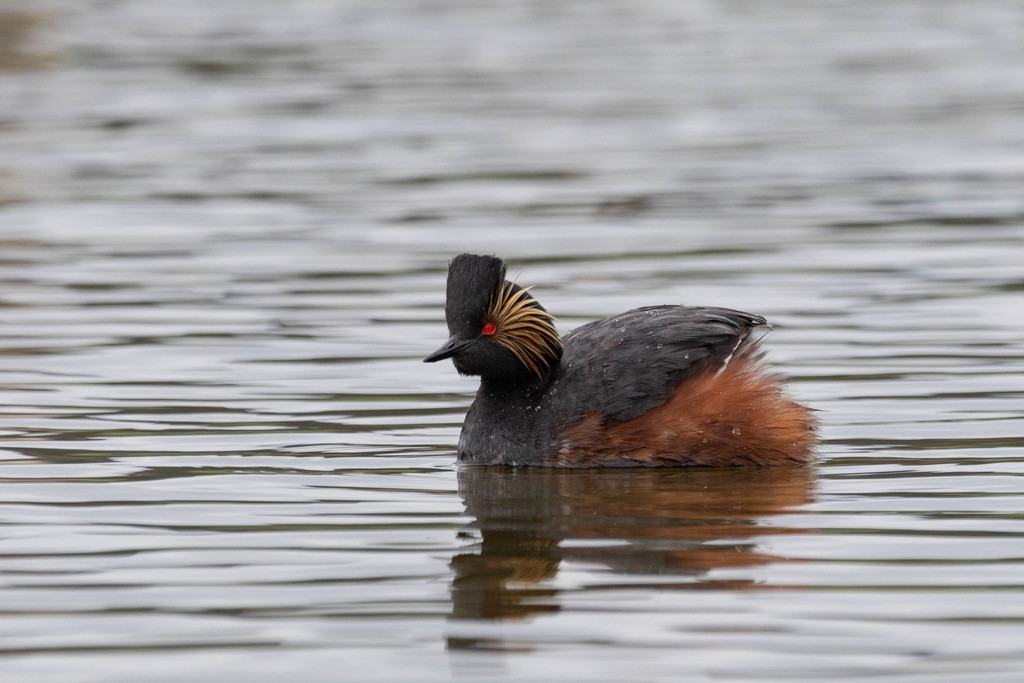
(c) Kalvin Chan, some rights reserved (CC BY) · licence
Family: Podicipedidae · Class: Aves · Order: Podicipediformes
Podiceps nigricollis (Eared Grebe) is a California animal in the Podicipedidae family.
The Eared Grebe is a small diving waterbird measuring 31 to 38 cm (12 to 15 inches) in length with a wingspan of 59 to 62 cm (23 to 24 inches). Adults weigh between 250 to 435 grams (0.55 to 0.96 pounds). During breeding season, adults display distinctive black head and neck plumage with prominent golden-yellow ear tufts extending behind the eyes. The bill is thin, straight, and black, while the eyes are bright red. The back and wings are dark brown to black, with chestnut-colored flanks. Non-breeding adults show grayish upperparts and white underparts, with the ear tufts absent and a duller bill coloration. Juveniles resemble non-breeding adults but with more brownish tones and striped head patterns. The Eared Grebe breeds throughout much of western North America, including suitable wetland habitats across California. Breeding populations occur in the Central Valley, northeastern California, and scattered locations in the Great Basin region. During winter, the species undergoes one of the most extensive concentrations of any North American waterbird, with hundreds of thousands gathering at hypersaline lakes, particularly Mono Lake and the Salton Sea in California. These staging areas support up to 95% of the North American population during post-breeding molt migration. Breeding habitat consists of shallow freshwater wetlands, ponds, and marshy areas with emergent vegetation such as cattails, bulrushes, and sedges. Water depths typically range from 0.3 to 3 meters (1 to 10 feet). During winter and migration, Eared Grebes utilize both freshwater and saline lakes, with a strong preference for hypersaline environments where invertebrate prey concentrations are highest. The species shows specialized physiological adaptations to high-salinity conditions, tolerating salt concentrations up to 150 parts per thousand. Eared Grebes are highly social outside the breeding season, forming massive flocks during migration and winter. The species is primarily piscivorous during breeding, consuming small fish, aquatic insects, and crustaceans. Diet shifts dramatically during winter staging periods, focusing almost exclusively on brine shrimp and alkali flies in saline lakes. Breeding occurs from April through August, with pairs constructing floating nests anchored to emergent vegetation. Females typically lay 3 to 4 eggs, with both parents sharing incubation duties for 20 to 22 days. Chicks are semi-precocial and often ride on parents' backs during their first weeks of life. The Eared Grebe is not federally listed and maintains stable continental populations. However, the species faces localized threats from habitat loss, water diversions affecting breeding wetlands, and potential climate impacts on critical staging lakes. Mono Lake and the Salton Sea, which support massive post-breeding concentrations, face ongoing challenges from water management and increasing salinity levels. Long-term monitoring indicates population fluctuations linked to drought cycles and wetland availability across the western breeding range.
Classification
Class: Aves · Order: Podicipediformes · Family: Podicipedidae
Frequently asked questions
How is Podiceps nigricollis classified?
Podiceps nigricollis belongs to class Aves, order Podicipediformes, family Podicipedidae.
What family does Podiceps nigricollis belong to?
Podiceps nigricollis is in the Podicipedidae family.
What is Podiceps nigricollis?
The Eared Grebe is a small diving waterbird measuring 31 to 38 cm (12 to 15 inches) in length with a wingspan of 59 to 62 cm (23 to 24 inches).
Is Podiceps nigricollis found in California?
Yes. Podiceps nigricollis is recorded in California in The California Species Project's catalogue.
Related species
Other California species in the same genus, family, or bioregion.
Data from The California Species Project — 14,000+ California species with verified data from CNPS, CDFW, USFWS, and more.