Pododesmus macrochisma
Green Falsejingle
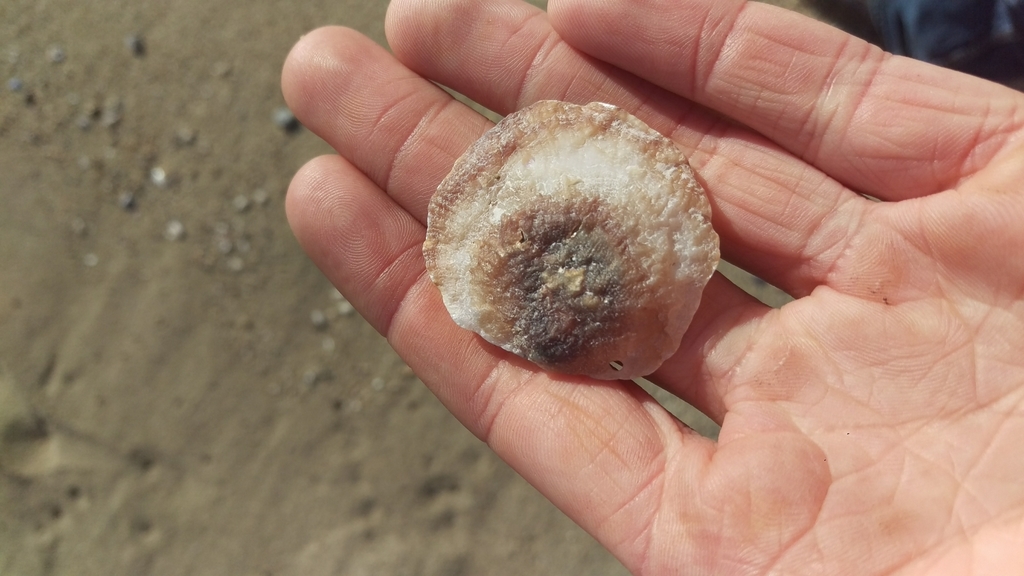
(c) Isaac Krone, some rights reserved (CC BY) · licence
Family: Anomiidae · Class: Bivalvia · Order: Pectinida
Pododesmus macrochisma (Green Falsejingle) is a California animal in the Anomiidae family.
The Green Falsejingle (Pododesmus macrochisma) is a marine bivalve mollusk in the family Anomiidae, commonly known as the jingle shell oyster. This species exhibits the characteristic asymmetrical shell morphology typical of anomiids, with a flat or slightly convex lower valve that attaches permanently to hard substrates and a more convex upper valve. The shell typically measures 25 to 100 millimeters (1 to 4 inches) in diameter and displays a greenish coloration that gives the species its common name. The lower valve features a distinctive large byssal notch through which strong byssal threads pass to secure the organism to rocks, shells, or other hard surfaces. Pododesmus macrochisma occurs along the Pacific coast of North America, ranging from Alaska south to Baja California, Mexico. The species is commonly found in California's coastal waters, inhabiting both intertidal and subtidal zones. Distribution extends from the low intertidal zone to depths of approximately 37 meters (120 feet), with populations documented in protected bays, estuaries, and open coastal areas. This species inhabits rocky intertidal and subtidal environments, typically attaching to hard substrates including rocks, shells of other mollusks, pilings, and artificial structures. Green Falsejingles prefer areas with moderate to strong water movement that facilitates filter feeding. They are commonly found in association with mussel beds, oyster reefs, and other complex hard-bottom communities. The species tolerates a range of salinity conditions, occurring in both fully marine environments and areas with reduced salinity near freshwater inputs. As a suspension feeder, Pododesmus macrochisma filters plankton, detritus, and organic particles from the water column using specialized gill structures. The species is dioecious, with separate male and female individuals. Spawning typically occurs during warmer months, with larvae undergoing a planktonic development phase before settling and metamorphosing into juvenile bivalves. Once settled, individuals remain permanently attached to their chosen substrate throughout their adult life. The species can live for several years and may reach sexual maturity within one to two years. Currently, Pododesmus macrochisma has no federal or state conservation listing status in California. The species appears to maintain stable populations throughout much of its range, benefiting from its wide distribution and adaptability to various coastal habitats. However, like many marine invertebrates, populations may face localized impacts from coastal development, water quality degradation, and ocean acidification. The species' ability to colonize artificial structures such as docks and breakwaters may provide some resilience to habitat modification. Climate change effects on ocean chemistry and temperature could potentially affect larval development and adult survival, though specific impacts on this species have not been well documented.
Classification
Class: Bivalvia · Order: Pectinida · Family: Anomiidae
Frequently asked questions
How is Pododesmus macrochisma classified?
Pododesmus macrochisma belongs to class Bivalvia, order Pectinida, family Anomiidae.
What family does Pododesmus macrochisma belong to?
Pododesmus macrochisma is in the Anomiidae family.
What is Pododesmus macrochisma?
The Green Falsejingle (Pododesmus macrochisma) is a marine bivalve mollusk in the family Anomiidae, commonly known as the jingle shell oyster.
Is Pododesmus macrochisma found in California?
Yes. Pododesmus macrochisma is recorded in California in The California Species Project's catalogue.
More California species
This species has no close relatives in our California data — here are other species to explore.
Data from The California Species Project — 14,000+ California species with verified data from CNPS, CDFW, USFWS, and more.