Poecile atricapillus
Black-capped Chickadee
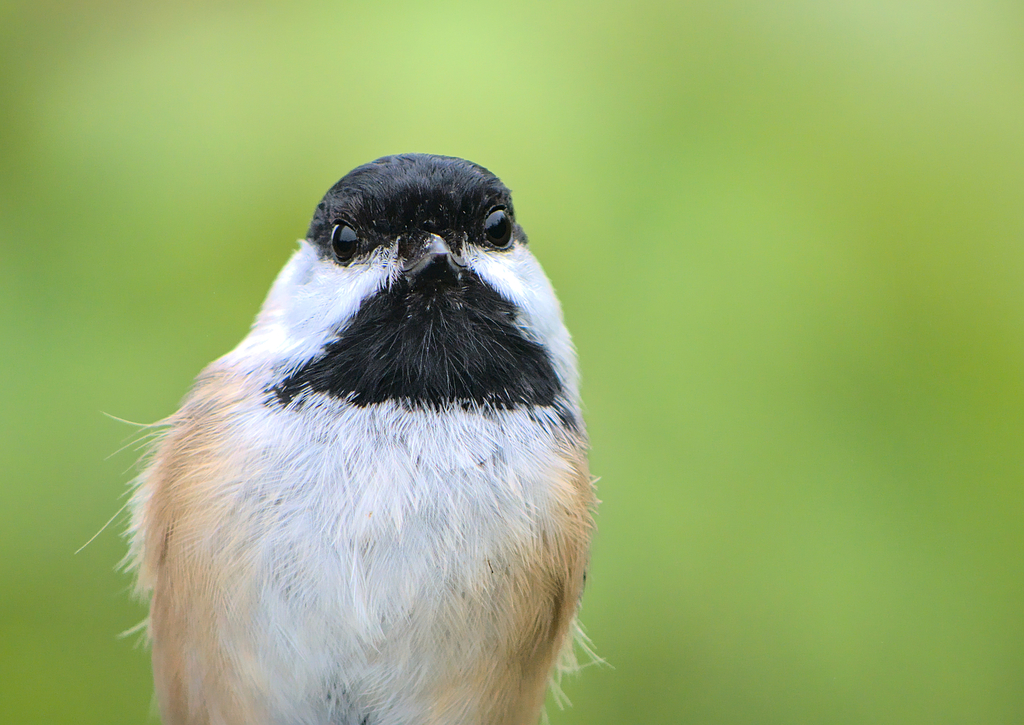
(c) Blake Ross, some rights reserved (CC BY) · licence
Family: Paridae · Class: Aves · Order: Passeriformes
Conservation status: WL · G5 S3
Poecile atricapillus (Black-capped Chickadee) is a California animal in the Paridae family.
The Black-capped Chickadee is a small, compact songbird measuring 11.5 to 15 cm (4.5 to 5.9 inches) in length with a wingspan of 15 to 20 cm (5.9 to 7.9 inches). Adults weigh 9 to 14 grams. The species displays distinctive black and white head markings, with a solid black cap extending from the forehead to the nape and a black bib covering the chin and upper throat. White cheek patches contrast sharply with the black areas. The back and wings are gray, while the underparts are white with buff-colored flanks. Males and females appear identical, though males average slightly larger. In California, Black-capped Chickadees occur primarily in the northeastern counties, including Modoc, Lassen, and portions of Siskiyou County. The species reaches the southern limit of its range in the Warner Mountains and Cascade Range. Across North America, the range extends from Alaska and Canada south through the northern United States, with isolated populations in the Appalachian Mountains. California populations represent the southwestern edge of the species' continental distribution. Black-capped Chickadees inhabit mixed and deciduous forests, particularly those dominated by aspen, birch, willow, and cottonwood. In California, they occur in riparian woodlands, aspen groves, and mixed coniferous forests at elevations ranging from 1,200 to 2,100 meters (3,900 to 6,900 feet). The species requires areas with suitable nesting cavities and prefers habitats with dense understory vegetation that provides foraging opportunities and cover. These birds are non-migratory residents that remain in their territories year-round. Black-capped Chickadees are cavity nesters, excavating nest holes in soft, decaying wood or utilizing existing cavities. Breeding occurs from April through July, with females laying 6 to 8 white eggs spotted with reddish-brown. Incubation lasts 12 to 13 days, and nestlings fledge after 14 to 18 days. The species typically produces one brood per year. Their diet consists primarily of insects during breeding season, including caterpillars, aphids, and beetle larvae. In winter, they supplement with seeds from conifers and deciduous trees, often caching food items for later retrieval. Black-capped Chickadees are highly social outside the breeding season, forming mixed-species foraging flocks with nuthatches, woodpeckers, and other small forest birds. They communicate through a complex vocal repertoire, including their distinctive 'chick-a-dee-dee-dee' call and clear whistled 'fee-bee' song. In California, the Black-capped Chickadee is designated as a Watch List species with a state rank of S3, indicating the species is vulnerable to extirpation. The global population is considered secure (G5), but California populations face habitat pressures from forest management practices, wildfire, and climate change. Riparian habitat degradation and loss of mature deciduous forests pose particular threats to the species' limited California range. Conservation efforts focus on maintaining diverse forest age classes and protecting riparian corridors in the species' northeastern California strongholds.
Classification
Class: Aves · Order: Passeriformes · Family: Paridae
Conservation status
WL · G5 S3
Frequently asked questions
How is Poecile atricapillus classified?
Poecile atricapillus belongs to class Aves, order Passeriformes, family Paridae.
What family does Poecile atricapillus belong to?
Poecile atricapillus is in the Paridae family.
Is Poecile atricapillus protected or of conservation concern?
Poecile atricapillus carries the following status: WL · G5 S3.
What is Poecile atricapillus?
The Black-capped Chickadee is a small, compact songbird measuring 11.5 to 15 cm (4.5 to 5.9 inches) in length with a wingspan of 15 to 20 cm (5.9 to 7.9 inches).
Is Poecile atricapillus found in California?
Yes. Poecile atricapillus is recorded in California in The California Species Project's catalogue.
Related species
Other California species in the same genus, family, or bioregion.
Data from The California Species Project — 14,000+ California species with verified data from CNPS, CDFW, USFWS, and more.