Poecile gambeli
Mountain Chickadee
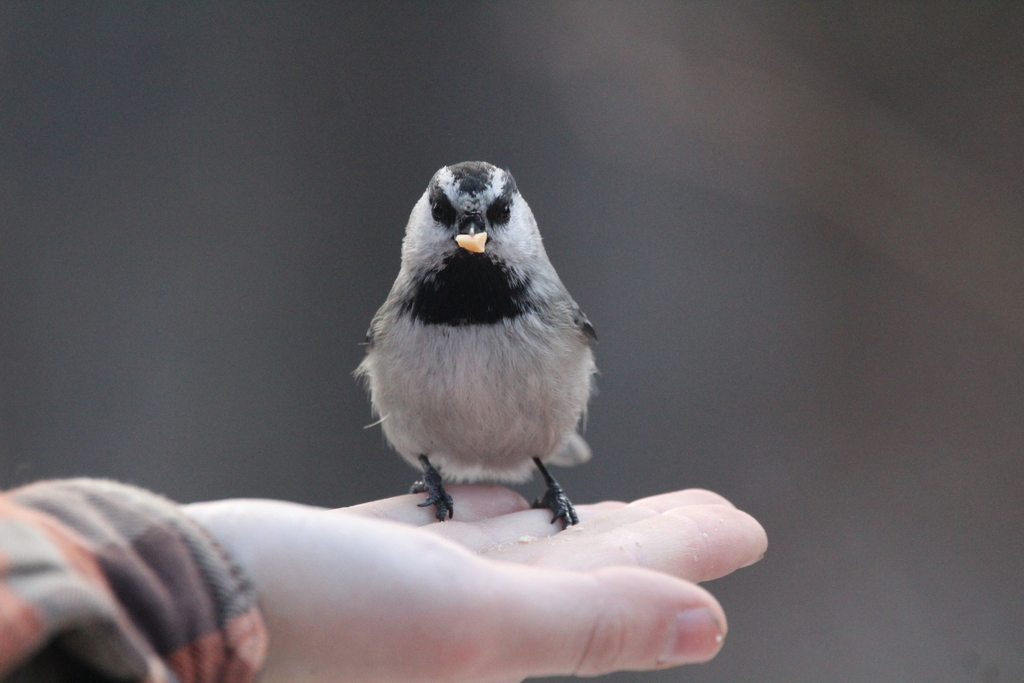
(c) Quinn, some rights reserved (CC BY-SA) · licence
Family: Paridae · Class: Aves · Order: Passeriformes
Poecile gambeli (Mountain Chickadee) is a California animal in the Paridae family.
The Mountain Chickadee is a small, active songbird measuring 13 to 15 cm (5.1 to 5.9 inches) in length with a wingspan of 19 to 21 cm (7.5 to 8.3 inches). Adults weigh between 9 and 14 grams. The species is distinguished by its black cap and bib, white cheeks, and distinctive white eyebrow stripe that separates it from other chickadee species. The back and wings are gray, while the underparts are white with buff-colored flanks. Males and females appear similar, though males may have slightly more pronounced markings during breeding season. Mountain Chickadees range across western North America, from British Columbia south to Baja California and from the Pacific Coast east to the Rocky Mountains. In California, the species is resident in mountainous regions throughout the state, including the Sierra Nevada, Cascade Range, Coast Ranges, Transverse Ranges, and Peninsular Ranges. The species occurs from Siskiyou County in the north to San Diego County in the south, with populations also present in the mountains of the Mojave Desert. The species inhabits coniferous and mixed coniferous-deciduous forests, primarily between elevations of 1,200 to 3,400 meters (3,900 to 11,200 feet). Mountain Chickadees show preference for mature forests with diverse canopy structure, including ponderosa pine, Douglas fir, white fir, red fir, lodgepole pine, and mixed conifer stands. During winter, some populations move to lower elevations, utilizing oak woodlands and riparian areas. The species requires cavities for nesting, using both natural holes and old woodpecker excavations in dead or decaying trees. Mountain Chickadees are non-migratory but exhibit altitudinal movements, with some individuals descending to lower elevations during winter months. The species is highly social outside the breeding season, forming mixed-species flocks with nuthatches, woodpeckers, and other small passerines. Diet consists primarily of insects and spiders during breeding season, including caterpillars, aphids, beetle larvae, and spiders gleaned from bark and foliage. Seeds become increasingly important during fall and winter, particularly conifer seeds which the species caches for later retrieval. Breeding occurs from April through July, with females laying 5 to 9 white eggs spotted with reddish-brown. The female incubates eggs for 14 to 16 days, and young fledge approximately 21 days after hatching. Mountain Chickadees are not federally or state listed and are considered stable across most of their range. The species is classified as Least Concern by the International Union for Conservation of Nature. However, some populations may face localized threats from habitat modification due to logging practices, fire suppression leading to altered forest structure, and climate change impacts on montane ecosystems. The North American Bird Conservation Initiative identifies the species as having moderate conservation concern in some regions due to potential vulnerability to climate-driven habitat shifts at higher elevations.
Classification
Class: Aves · Order: Passeriformes · Family: Paridae
Frequently asked questions
How is Poecile gambeli classified?
Poecile gambeli belongs to class Aves, order Passeriformes, family Paridae.
What family does Poecile gambeli belong to?
Poecile gambeli is in the Paridae family.
What is Poecile gambeli?
The Mountain Chickadee is a small, active songbird measuring 13 to 15 cm (5.1 to 5.9 inches) in length with a wingspan of 19 to 21 cm (7.5 to 8.3 inches).
Is Poecile gambeli found in California?
Yes. Poecile gambeli is recorded in California in The California Species Project's catalogue.
Related species
Other California species in the same genus, family, or bioregion.
Data from The California Species Project — 14,000+ California species with verified data from CNPS, CDFW, USFWS, and more.