Poecile rufescens
Chestnut-backed Chickadee
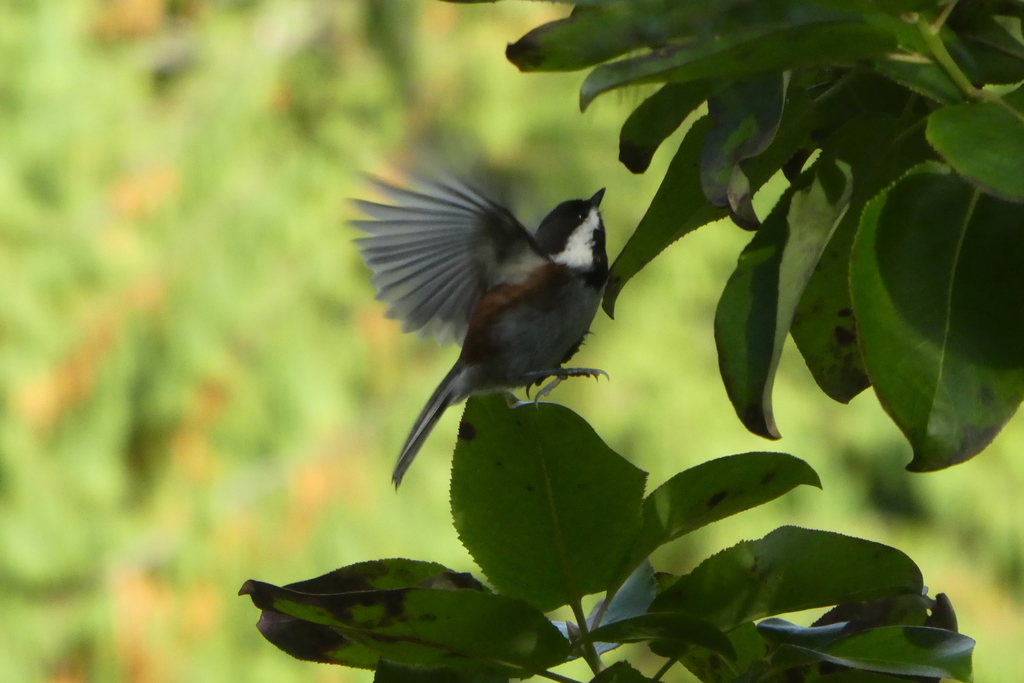
(c) Mara Christensen, some rights reserved (CC BY) · licence
Family: Paridae · Class: Aves · Order: Passeriformes
Poecile rufescens (Chestnut-backed Chickadee) is a California animal in the Paridae family.
The Chestnut-backed Chickadee is a small songbird measuring 11.5 to 12.5 cm (4.5 to 4.9 inches) in length with a wingspan of 19 to 20 cm (7.5 to 7.9 inches). Adults weigh 8.5 to 12.5 grams. The species displays distinctive plumage with a black cap and bib contrasting sharply with white cheeks. The back and sides are rich chestnut-brown, while the wings show darker brown with white wing bars. The underparts are white with chestnut flanks. Juveniles appear similar to adults but with slightly duller coloration and less distinct markings. The Chestnut-backed Chickadee occurs along the Pacific Coast from southeastern Alaska to central California. In California, the species is found primarily in the coastal ranges from Del Norte and Humboldt counties south to San Luis Obispo County, with isolated populations in the Sierra Nevada. The range extends inland approximately 160 kilometers (100 miles) from the coast in northern California but becomes increasingly restricted to coastal areas in the southern portion of the range. This species inhabits coniferous and mixed coniferous-deciduous forests, showing strong preference for mature stands with dense canopy cover. Primary habitat includes coast redwood forests, Douglas-fir forests, and mixed evergreen forests containing tan oak and madrone. The species occurs from sea level to approximately 1,980 meters (6,500 feet) elevation in the Sierra Nevada, though most populations are found below 1,220 meters (4,000 feet). Dense understory vegetation and abundant snags for nesting cavities are important habitat components. Chestnut-backed Chickadees are non-migratory residents that form mixed-species foraging flocks during winter months. The species exhibits typical chickadee foraging behavior, moving acrobatically through tree canopies while gleaning insects and arthropods from bark crevices and foliage. Diet consists primarily of insects during breeding season, including caterpillars, beetles, aphids, and scale insects. Seeds and berries supplement the diet year-round. Breeding occurs from April through July, with pairs excavating nest cavities in soft wood of dead or dying trees. Females lay 5 to 9 white eggs with fine reddish-brown spots. Incubation lasts 11 to 12 days, with nestlings fledging after 18 to 21 days. The Chestnut-backed Chickadee is not federally or state listed and maintains stable populations throughout most of its range. The species is classified as Least Concern by the International Union for Conservation of Nature. North American Breeding Bird Survey data indicate stable to slightly increasing population trends from 1966 to 2019. Primary threats include habitat loss from timber harvesting and urban development, particularly in coastal areas experiencing human population growth. Climate change may affect the species through altered precipitation patterns and increased wildfire frequency in Pacific Coast forests. The species' dependence on mature forest stands makes it vulnerable to intensive forest management practices that reduce old-growth characteristics.
Classification
Class: Aves · Order: Passeriformes · Family: Paridae
Frequently asked questions
How is Poecile rufescens classified?
Poecile rufescens belongs to class Aves, order Passeriformes, family Paridae.
What family does Poecile rufescens belong to?
Poecile rufescens is in the Paridae family.
What is Poecile rufescens?
The Chestnut-backed Chickadee is a small songbird measuring 11.5 to 12.5 cm (4.5 to 4.9 inches) in length with a wingspan of 19 to 20 cm (7.5 to 7.9 inches).
Is Poecile rufescens found in California?
Yes. Poecile rufescens is recorded in California in The California Species Project's catalogue.
Related species
Other California species in the same genus, family, or bioregion.
Data from The California Species Project — 14,000+ California species with verified data from CNPS, CDFW, USFWS, and more.