Poecile sclateri
Mexican Chickadee
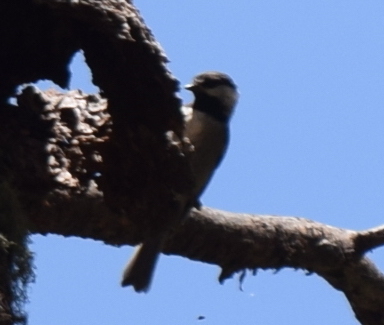
(c) William Harmon, some rights reserved (CC BY) · licence
Family: Paridae · Class: Aves · Order: Passeriformes
Poecile sclateri (Mexican Chickadee) is a California animal in the Paridae family.
The Mexican Chickadee is a small passerine bird measuring approximately 12.7 to 14 cm (5.0 to 5.5 inches) in length. This species displays typical chickadee characteristics with a distinctive black cap and bib contrasting sharply with white cheeks. The upperparts are gray-brown, while the underparts are pale gray to whitish. The wings show faint wingbars, and the relatively short tail appears dark gray. Males and females exhibit similar plumage patterns, making field identification between sexes difficult. In the United States, the Mexican Chickadee has an extremely restricted distribution, occurring only in high-elevation areas of two mountain ranges: the Chiricahua Mountains of southeastern Arizona and the Animas Mountains of southwestern New Mexico (USFWS). The species ranges more broadly throughout the mountains of Mexico, extending south through the Sierra Madre Occidental and other montane regions to central Mexico. This disjunct U.S. population represents the northernmost extent of the species' range. Mexican Chickadees inhabit montane coniferous forests, typically at elevations above 1,800 meters (5,900 feet). In Arizona and New Mexico, they are closely associated with mature pine-fir forests, particularly those dominated by Douglas fir, white fir, and ponderosa pine. In the southern portions of their Mexican range, the species also utilizes oak-pine forests. These birds show a strong preference for areas with dense canopy cover and an abundance of dead and dying trees that provide foraging opportunities and nesting sites. As insectivores, Mexican Chickadees employ typical parid foraging behaviors, gleaning insects, larvae, and spiders from bark crevices and foliage surfaces. They often hang upside down while foraging on branch tips and outer twigs. During the non-breeding season, these chickadees frequently join mixed-species flocks with other bark and foliage gleaners including titmice, nuthatches, kinglets, warblers, and vireos (Birds of the World). Like other members of the Paridae family, they excavate nest cavities in dead or decaying wood, though they will also utilize nest boxes when available. The breeding biology of this species remains poorly studied, with much research needed on reproductive timing, clutch size, and nesting success rates. The Mexican Chickadee is included on the U.S. Fish and Wildlife Service's Birds of Conservation Concern 2021 list, indicating potential conservation concerns (USFWS 2021). While not federally listed under the Endangered Species Act, the species' extremely limited U.S. range makes local populations vulnerable to habitat loss, climate change, and forest management practices. The small, isolated nature of U.S. populations poses additional risks related to genetic bottlenecks and reduced demographic resilience. Climate change may be particularly concerning as warming temperatures could force suitable habitat to higher elevations, potentially reducing available habitat in the sky island mountain ranges where this species occurs. Conservation efforts focus on maintaining mature coniferous forest habitat and monitoring population trends in the species' restricted U.S. range.
Classification
Class: Aves · Order: Passeriformes · Family: Paridae
Frequently asked questions
How is Poecile sclateri classified?
Poecile sclateri belongs to class Aves, order Passeriformes, family Paridae.
What family does Poecile sclateri belong to?
Poecile sclateri is in the Paridae family.
What is Poecile sclateri?
The Mexican Chickadee is a small passerine bird measuring approximately 12.7 to 14 cm (5.0 to 5.5 inches) in length.
Is Poecile sclateri found in California?
Yes. Poecile sclateri is recorded in California in The California Species Project's catalogue.
Related species
Other California species in the same genus, family, or bioregion.
Data from The California Species Project — 14,000+ California species with verified data from CNPS, CDFW, USFWS, and more.