Pogonomyrmex californicus
California Harvester Ant
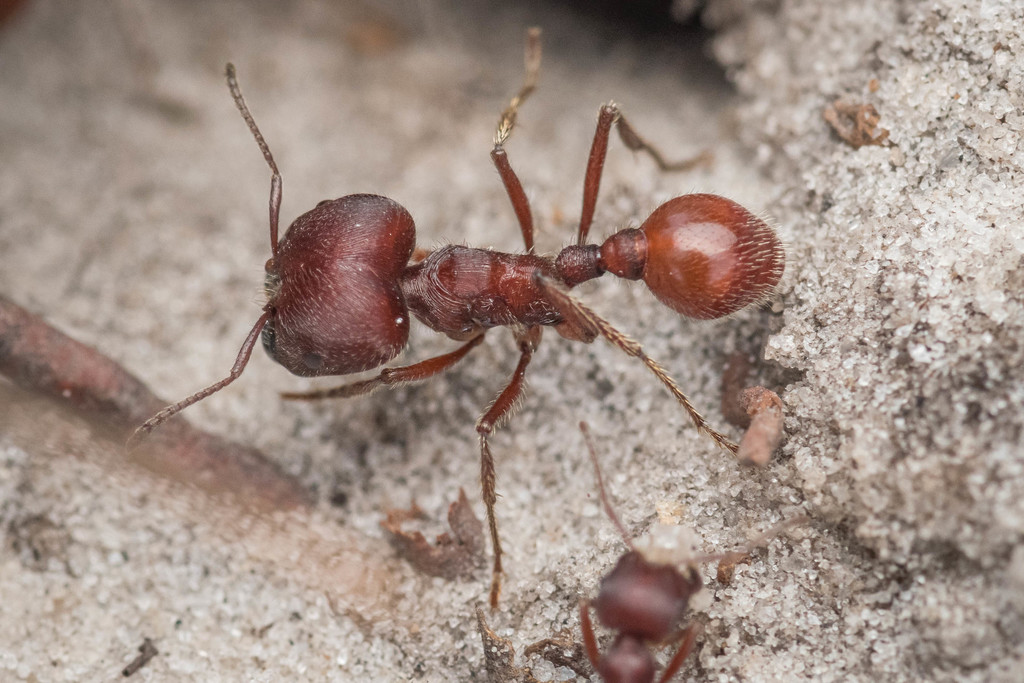
(c) Nash Turley, some rights reserved (CC BY) · licence
Family: Formicidae · Class: Insecta · Order: Hymenoptera
Pogonomyrmex californicus (California Harvester Ant) is a California animal in the Formicidae family.
The California harvester ant is a medium-sized ant species with workers measuring approximately 6 mm in length. The species exhibits considerable morphological variation across its range, with coloration ranging from reddish-brown to black. Workers possess the characteristic features of harvester ants, including a distinctive beard of long hairs (psammophore) beneath the head used for carrying sand and seeds, and robust mandibles adapted for seed processing. Pogonomyrmex californicus occurs throughout much of California, extending into Nevada, Arizona, and Baja California. In California, the species is widely distributed across southern regions, with documented populations from Riverside County's Coachella Valley to coastal areas. The species has been recorded at elevations from near sea level to approximately 1,160 feet, as documented in creosote-stabilized sand dune habitat near Banning and Palm Springs (BugGuide 2011). This harvester ant inhabits diverse arid and semi-arid environments, including desert scrubland, chaparral, grasslands, and coastal sage scrub. The species shows particular affinity for sandy soils and areas with sparse to moderate vegetation cover. Colonies are typically established in open, sunny locations with well-drained soils that facilitate nest excavation and seed caching. The species has been observed in creosote bush communities and other desert plant associations characteristic of southern California. California harvester ants are granivorous, with colonies primarily collecting and storing seeds from various plant species. Workers forage individually along distinct trails radiating from the nest entrance, which is typically marked by a cleared area or disk. Colony founding occurs through nuptial flights, with reproductive individuals dispersing to establish new colonies. The species exhibits typical harvester ant social structure, with colonies containing a single queen, workers of varying sizes, and seasonal production of reproductive castes. Foraging activity varies seasonally and is influenced by temperature and moisture conditions. Pogonomyrmex californicus is not federally or state listed and appears to maintain stable populations across much of its range. The species demonstrates adaptability to various habitat types within its arid land distribution. However, like many native California insects, local populations may face pressures from habitat conversion, urbanization, and altered fire regimes in some areas. The species' wide distribution and habitat flexibility suggest it is not currently of conservation concern, though continued monitoring of populations in rapidly developing regions of southern California would be beneficial. Climate change impacts on arid land ecosystems may affect future distribution patterns, particularly at elevational and latitudinal range margins.
Classification
Class: Insecta · Order: Hymenoptera · Family: Formicidae
Frequently asked questions
How is Pogonomyrmex californicus classified?
Pogonomyrmex californicus belongs to class Insecta, order Hymenoptera, family Formicidae.
What family does Pogonomyrmex californicus belong to?
Pogonomyrmex californicus is in the Formicidae family.
What is Pogonomyrmex californicus?
The California harvester ant is a medium-sized ant species with workers measuring approximately 6 mm in length.
Is Pogonomyrmex californicus found in California?
Yes. Pogonomyrmex californicus is recorded in California in The California Species Project's catalogue.
Related species
Other California species in the same genus, family, or bioregion.
Data from The California Species Project — 14,000+ California species with verified data from CNPS, CDFW, USFWS, and more.