Pogonortalis doclea
Boatman Fly
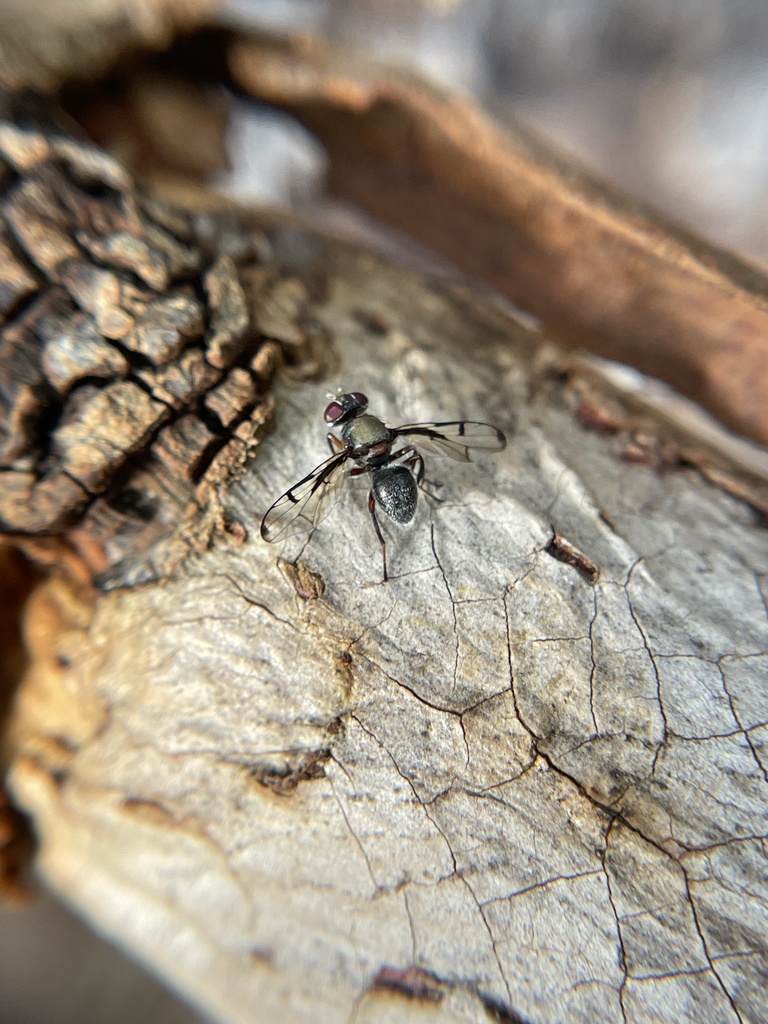
no rights reserved · CC0
Family: Platystomatidae · Class: Insecta · Order: Diptera
Pogonortalis doclea (Boatman Fly) is a California animal in the Platystomatidae family.
The Boatman Fly (Pogonortalis doclea) is a distinctive member of the signal fly family Platystomatidae found in California. This species belongs to the order Diptera, characterized by having only two functional wings, with the hind wings modified into small club-shaped structures called halteres. Adult Boatman Flies are notable for their characteristic wing movements, exhibiting a distinct rowing motion when walking that gives the species its common name (BugGuide.net). Pogonortalis doclea occurs in southern California, with documented observations primarily from the Los Angeles Basin region. The species has been recorded in coastal and inland areas of Southern California, though specific distributional boundaries have not been comprehensively mapped. According to Hogue's field guide to insects of the Los Angeles Basin, this species is present in urban and suburban environments throughout the region (Hogue 1992). The Boatman Fly inhabits diverse terrestrial environments typical of Southern California, including urban gardens, parks, and natural areas with mixed vegetation. Unlike aquatic water boatmen insects that share a similar common name, Pogonortalis doclea is entirely terrestrial. The species appears to be adapted to Mediterranean climate conditions characteristic of coastal Southern California, though specific microhabitat preferences and elevation ranges have not been documented in available literature. Detailed behavioral and ecological information for Pogonortalis doclea remains limited in published literature. As a member of the Platystomatidae, the species likely feeds on decaying organic matter, though specific dietary preferences have not been documented. The characteristic rowing wing motion observed in walking individuals may serve as a form of visual communication or territorial display, as wing-waving behaviors are common among signal flies. Reproductive biology, including mating behaviors, larval development sites, and seasonal activity patterns, requires further scientific study. The conservation status of Pogonortalis doclea has not been formally assessed by state or federal agencies. The species is not listed under the Endangered Species Act or California's endangered species regulations. Current population trends and potential threats are unknown due to limited ecological research. As an apparently urban-adapted species in the heavily developed Los Angeles Basin, the Boatman Fly may face habitat pressures from continued urbanization and landscape modification, though its ability to persist in developed environments suggests some degree of ecological flexibility. The species would benefit from systematic surveys to better understand its distribution, population status, and ecological requirements. Scientific documentation for this species remains limited despite its presence in one of North America's most studied urban entomological environments. The information presented here synthesizes available observations from taxonomic databases and regional field guides. More comprehensive ecological studies are needed to understand the full biology and conservation needs of this California endemic signal fly.
Classification
Class: Insecta · Order: Diptera · Family: Platystomatidae
Frequently asked questions
How is Pogonortalis doclea classified?
Pogonortalis doclea belongs to class Insecta, order Diptera, family Platystomatidae.
What family does Pogonortalis doclea belong to?
Pogonortalis doclea is in the Platystomatidae family.
What is Pogonortalis doclea?
The Boatman Fly (Pogonortalis doclea) is a distinctive member of the signal fly family Platystomatidae found in California.
Is Pogonortalis doclea found in California?
Yes. Pogonortalis doclea is recorded in California in The California Species Project's catalogue.
Related species
Other California species in the same genus, family, or bioregion.
Data from The California Species Project — 14,000+ California species with verified data from CNPS, CDFW, USFWS, and more.