Poladryas arachne
Arachne Checkerspot
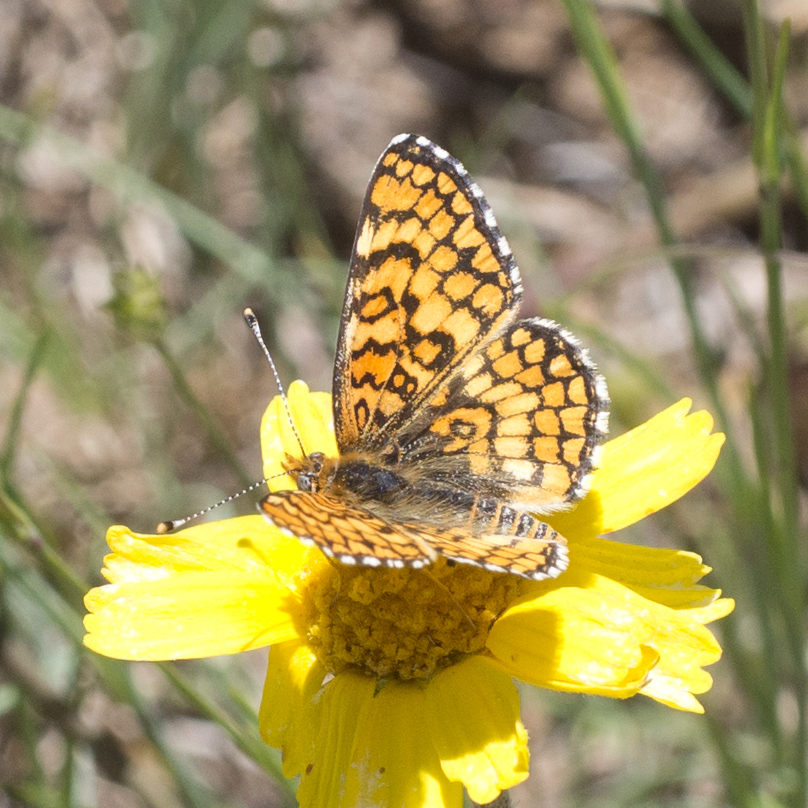
no rights reserved · CC0
Family: Nymphalidae · Class: Insecta · Order: Lepidoptera
Poladryas arachne (Arachne Checkerspot) is a California animal in the Nymphalidae family.
The Arachne checkerspot is a medium-sized butterfly with a wingspan of 38 to 50 mm (1.5 to 2.0 inches). The dorsal wing surfaces display a distinctive checkerboard pattern of orange and black markings with white spots, characteristic of checkerspot butterflies. Males typically exhibit more vibrant coloration than females. The ventral wing surfaces are lighter with cream-colored patches and reduced black markings. The species can be distinguished from similar checkerspots by its specific wing pattern and association with Penstemon host plants. Poladryas arachne has a disjunct distribution across western North America. The primary range extends from western Nebraska and southeast Wyoming through eastern Nevada, continuing south through the Rocky Mountains to Arizona, New Mexico, and west Texas, with populations reaching into southern Mexico. Of particular significance is an isolated population in the southern Sierra Nevada of California, representing the species' only known occurrence in the state. This Sierra Nevada population is geographically separated from the main Rocky Mountain populations by several hundred kilometers. The species inhabits montane environments, typically occurring in open meadows, hillsides, and canyon areas within coniferous forest zones. In California, the isolated population is found in the southern Sierra Nevada at elevations ranging from 1,500 to 2,500 meters (4,900 to 8,200 feet). Habitat requirements center on the presence of Penstemon host plants, which grow in well-drained soils with adequate sunlight exposure. Adults are often observed nectaring on various wildflowers in proximity to breeding areas. Larvae are specialist feeders, exclusively utilizing various species of beardtongue (Penstemon) in the figwort family (Scrophulariaceae). Females deposit eggs in clusters on or near Penstemon leaves, and caterpillars feed on the foliage throughout their development. The species exhibits a single generation per year, with adults typically emerging in late spring to early summer. Adults engage in mate-seeking behavior around host plant patches, and males establish territories through patrolling flight patterns. Overwintering occurs in the larval stage, with caterpillars entering diapause during colder months. The Arachne checkerspot does not currently hold federal or state listing status in California. However, the isolated nature of the Sierra Nevada population raises conservation concerns regarding genetic connectivity and long-term viability. The geographic separation from main populations makes this California population particularly vulnerable to local extinctions from habitat disturbance, climate change, or stochastic events. Threats to montane butterfly populations generally include habitat fragmentation from development, altered fire regimes, invasive plant species that compete with native Penstemon, and climate-induced shifts in suitable habitat zones. The species' dependence on specific Penstemon host plants makes it susceptible to any factors that negatively impact these botanical resources. Conservation efforts would benefit from monitoring of the isolated Sierra Nevada population and protection of known Penstemon-rich habitats within the species' California range.
Classification
Class: Insecta · Order: Lepidoptera · Family: Nymphalidae
Frequently asked questions
How is Poladryas arachne classified?
Poladryas arachne belongs to class Insecta, order Lepidoptera, family Nymphalidae.
What family does Poladryas arachne belong to?
Poladryas arachne is in the Nymphalidae family.
What is Poladryas arachne?
The Arachne checkerspot is a medium-sized butterfly with a wingspan of 38 to 50 mm (1.5 to 2.0 inches).
Is Poladryas arachne found in California?
Yes. Poladryas arachne is recorded in California in The California Species Project's catalogue.
Related species
Other California species in the same genus, family, or bioregion.
Data from The California Species Project — 14,000+ California species with verified data from CNPS, CDFW, USFWS, and more.