Poladryas minuta
Dotted Checkerspot
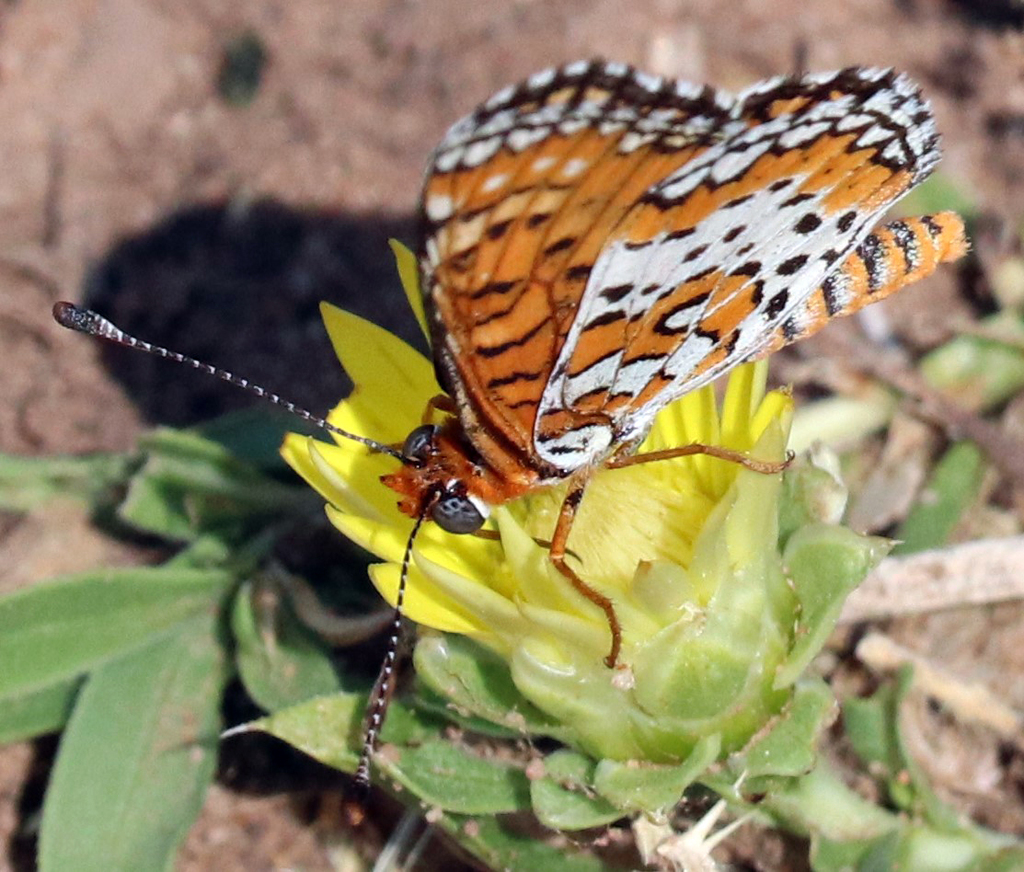
(c) Catherine C. Galley, some rights reserved (CC BY) · licence
Family: Nymphalidae · Class: Insecta · Order: Lepidoptera
Poladryas minuta (Dotted Checkerspot) is a California animal in the Nymphalidae family.
The dotted checkerspot is a medium-sized butterfly with a wingspan ranging from 32 to 44 mm (1.3 to 1.7 inches). The dorsal wing surfaces display an intricate pattern of orange, black, and white checkered markings that give the species its common name. The forewings feature prominent black spots arranged in regular rows across an orange-red background, while the hindwings show similar but smaller spotted patterns. The ventral surfaces are lighter, with cream-colored to pale orange ground color and reduced black markings. Males and females are similar in appearance, though females tend to be slightly larger with more subdued coloration. Poladryas minuta has a disjunct distribution across western North America, ranging from western Nebraska and southeast Wyoming through eastern Nevada, south through south-central Texas, New Mexico, and Arizona, extending into southern Mexico. An isolated population occurs in the southern Sierra Nevada of California, representing the westernmost extent of the species' range. This California population is geographically separated from the main distribution by several hundred kilometers, likely representing a relict population from a previously more continuous range. The species inhabits open, semi-arid environments including grasslands, desert scrub, pinyon-juniper woodlands, and mountain slopes at elevations ranging from 1,200 to 2,400 meters (4,000 to 8,000 feet). In California, the dotted checkerspot occurs in montane chaparral and mixed coniferous forest openings. The species requires areas with suitable host plants and nectar sources, typically in locations with moderate slopes and well-drained soils. Dotted checkerspots are obligate herbivores in their larval stage, feeding exclusively on various beardtongue species (Penstemon) in the figwort family (Scrophulariaceae). Females deposit eggs singly or in small clusters on host plant leaves, typically on the undersides near the base of the plant. Larvae develop through five instars, overwintering as partially grown caterpillars in the third or fourth instar. Adults emerge in late spring to early summer, with flight periods typically occurring from May through August, depending on elevation and local climate conditions. The species produces one generation per year in most locations. Adults feed on nectar from various wildflowers, including rabbitbrush, asters, and other composites. Mating occurs shortly after emergence, with males engaging in patrolling behavior to locate receptive females. The species exhibits strong site fidelity, with adults rarely dispersing far from their natal habitat patches. The dotted checkerspot is not currently listed under federal or state endangered species acts. However, the isolated California population faces potential threats from habitat modification, climate change, and the species' dependence on specific host plants. Long-term monitoring data for population trends are limited. The species' fragmented distribution pattern suggests vulnerability to local extinctions, particularly for disjunct populations like those in the Sierra Nevada. Conservation efforts focus on habitat protection and monitoring of known populations, especially in areas where development pressure or climate change may impact suitable habitat.
Classification
Class: Insecta · Order: Lepidoptera · Family: Nymphalidae
Frequently asked questions
How is Poladryas minuta classified?
Poladryas minuta belongs to class Insecta, order Lepidoptera, family Nymphalidae.
What family does Poladryas minuta belong to?
Poladryas minuta is in the Nymphalidae family.
What is Poladryas minuta?
The dotted checkerspot is a medium-sized butterfly with a wingspan ranging from 32 to 44 mm (1.3 to 1.7 inches).
Is Poladryas minuta found in California?
Yes. Poladryas minuta is recorded in California in The California Species Project's catalogue.
Related species
Other California species in the same genus, family, or bioregion.
Data from The California Species Project — 14,000+ California species with verified data from CNPS, CDFW, USFWS, and more.